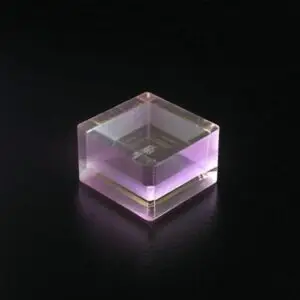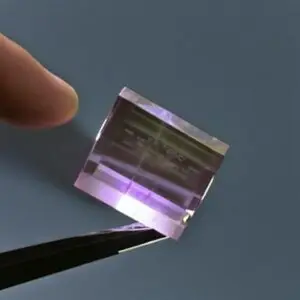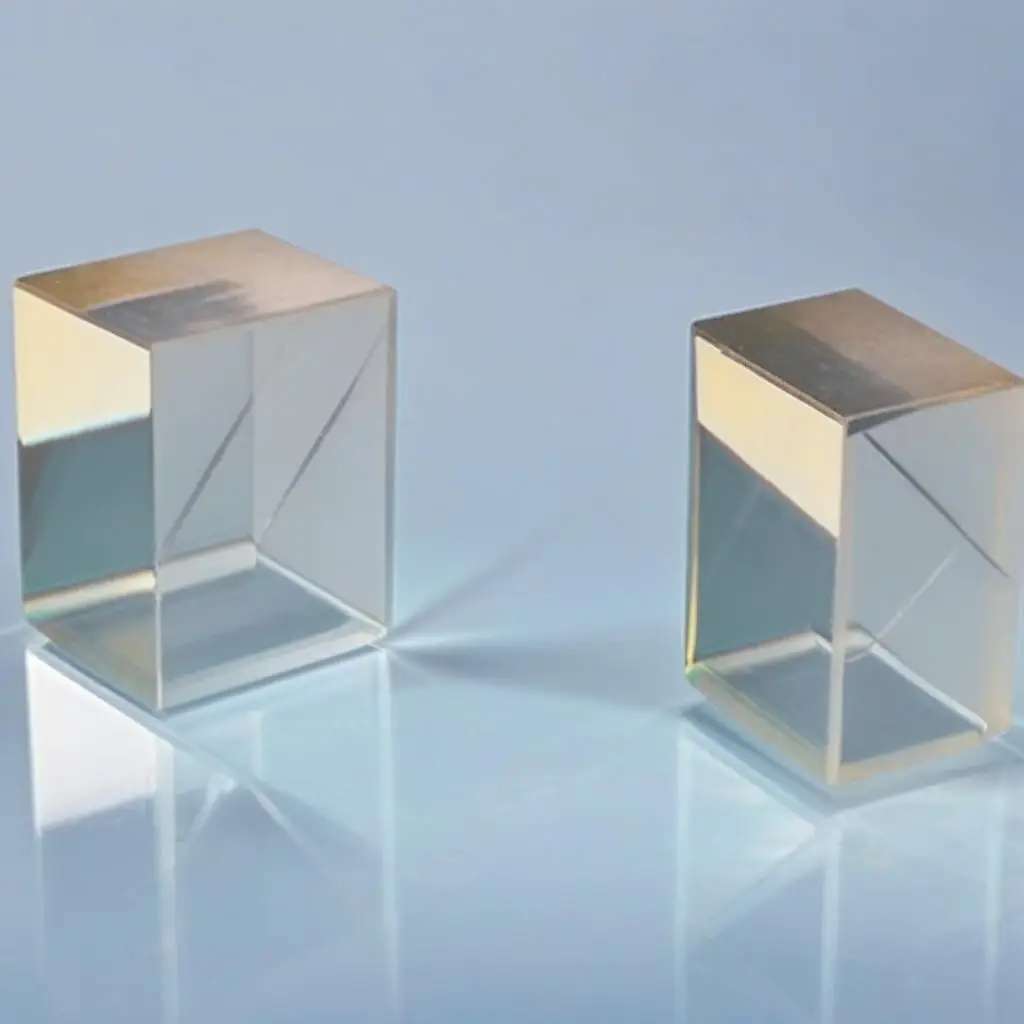
POC-OC-122451-Tm:Ho:KYW Crystal

  • Large and broad polarized absorption and emission bands for enhanced versatility.
  • High-efficiency energy transfer from Tm³⁺ to Ho³⁺ ions.
  • High dopant concentration tolerance with minimal concentration quenching.
  • Efficient laser operation at 2 µm wavelength region, ideal for low-threshold operations.
  • Custom crystals available upon request for unique applications.

Customizable Components Available for This Material to Meet Your Specific Needs!

General Description

Tm:Ho:KYW (Thulium, Holmium co-doped Potassium Yttrium Tungstate) crystals are highly efficient laser gain mediums operating in the mid-infrared range (~2 µm). These crystals are characterized by broad polarized absorption and emission bands, making them suitable for applications requiring precise wavelength tunability. The co-doping of Tm³⁺ and Ho³⁺ ions facilitates efficient energy transfer, enabling enhanced laser performance. The monoclinic crystal structure ensures high thermal stability, while the superior spectroscopic and mechanical properties make it a preferred choice for advanced laser systems.

Tm:Ho:KYW crystals have become critical for remote sensing, medical treatments, and industrial applications due to their robustness and consistent output at eye-safe wavelengths.

General Applications and Examples

  1. Remote Sensing and LIDAR: Tm:Ho:KYW Crystal  lasers are widely used in LIDAR systems for atmospheric monitoring, pollution detection, and geographical mapping.
  2. Medical Applications: The 2 µm emission wavelength is highly absorbed by water and tissue, making it ideal for surgical and therapeutic procedures.
  3. Mid-Infrared Optical Parametric Oscillators (OPOs): Used as a pump source for mid-IR lasers, enabling precise and tunable wavelength generation for scientific and industrial purposes.
  4. Industrial Processing: Tm:Ho:KYW Crystal Utilized for material processing, such as welding and cutting, due to its ability to concentrate high energy over small areas.
  5. Defense and Security: Eye-safe lasers in the 2 µm range are critical for secure communication and target designation systems.

Chemical and Structural Properties

ParameterValue
Chemical FormulaTm, Ho:KYW (K(Y,W)O₄)
Crystal StructureMonoclinic
Density3.95 g/cm³
Mohs Hardness6.5
Thermal Conductivity3.3 W/m·K
Thermal Expansion Coefficient10.5 × 10⁻⁶ /°C (a-axis)
Typical Doping Level5 at.% (Tm³⁺), 1 at.% (Ho³⁺)
Lattice Constantsa = 7.2 Å, b = 10.3 Å, c = 7.5 Å

Optical, Laser and Nonlinear Optical Properties

ParameterValue
Laser Wavelength2060 nm
Absorption Peak Wavelength802 nm
Absorption Cross Section7.6 × 10⁻²⁰ cm²
Emission Cross Section4.7 × 10⁻²⁰ cm²
Absorption Bandwidth at Peak~4 nm
Lifetime of T₁ Energy Level1.8 ms
Refractive Index (@1040 nm)nₑ = 2.05, nₒ = 1.97

Standard Fabrication Specifications

SpecificationValue
OrientationNₐ-cut
Clear Aperture>90%
Face Dimensions Tolerance±0.1 mm
Length Tolerance±0.1 mm
Parallelism Error<20 arcsec
Perpendicularity Error<10 arcmin
Surface Flatnessλ/10 @ 632.8 nm
Surface Quality20-10 S-D
Protective Chamfers<0.1 mm at 45°

Spectrum Transmission Curve

Refer to the transmission chart for absorption and emission properties across key wavelengths, highlighting peak values at 802 nm (absorption) and 2060 nm (emission). If additional data is required, please contact POC for technical reports.
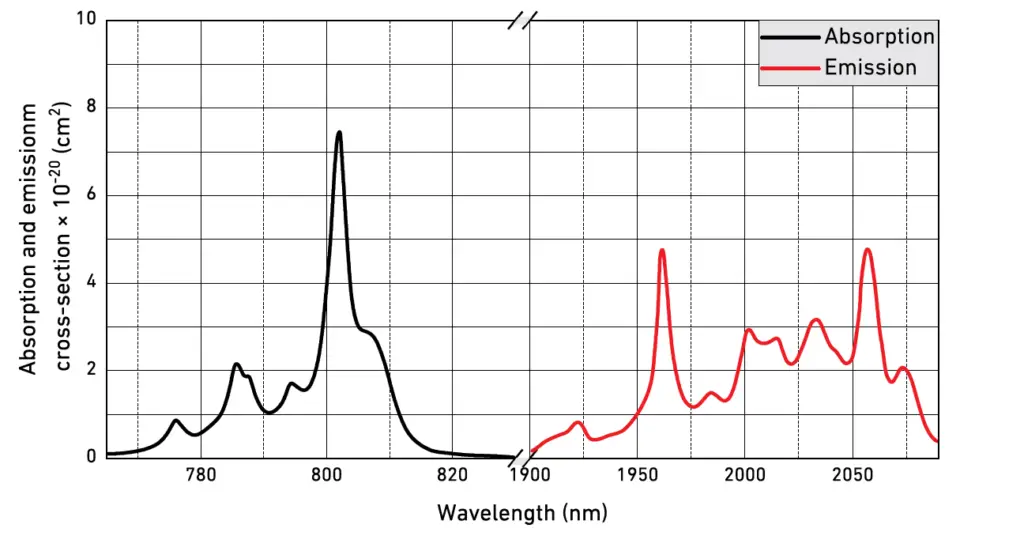
POC-Tm, Ho KYW Crystal Spectrum Transmission Curve

Coating Specification

  • AR Coatings: AR@802 nm ± 10 nm + AR@1900-2100 nm on both faces for minimal reflectivity and high transmission efficiency.
  • Custom coating options available upon request.
  • Adhesion Test: Compliant with MIL-C-675C military standards, an adhesion test involved applying a tape that meets LT-90 specifications onto the lens film layer. The tape was affixed fully and then removed vertically. This procedure was performed three times, resulting in no blistering or peeling.
  • Temperature Test: In line with MIL-C-675C specifications, test pieces were subjected to temperatures of -62±1℃ and 71±1℃. After maintaining them at room temperature (16℃~32℃) for two hours, the adhesion test was repeated, confirming no film detachment.
  • Abrasion Resistance Test: Conforming to MIL-C-675C and CCC-C-440 standards, the abrasion resistance test involved a gauze tester applying a minimum force of 1.0 lbs (0.45 kg) to the film. This was repeated 25 times with gauze widths of 1/4 inch (6.4mm) and 3/8 inch (9.5mm), ensuring no damage occurred to the film surface.
  • Humidity Test: Under MIL-C-675C criteria, the test piece was placed in a controlled temperature and humidity chamber set to 49 ±2℃ and 95%~100% humidity for 24 hours. The film remained intact, with no peeling, scratches, or other defects.
  • Solvent and Cleaning Testing: Following MIL-C-675C specifications, test pieces were exposed to room temperature conditions (16℃~32℃) and tested with acetone and alcohol for at least 10 minutes each. After air drying and subsequent cleaning with a cotton cloth soaked in alcohol, the film surface showed no signs of peeling or scratches.
  • Salt Spray Test: After 100 hours in a 35°C environment with a 5% saltwater concentration, the film showed no signs of damage.
Face DimensionsLengthEnd FacesDopingCoatingsPrice (USD)
5 x 5 mm2 mmBrewster-angle cut1%Uncoated620
5 x 5 mm2 mmRight-angle cut1%AR@802 nm + AR@2100 nm750
8 x 8 mm2 mmBrewster-angle cut1%Uncoated620
8 x 8 mm2 mmRight-angle cut1%AR@802 nm + AR@2100 nm750
CustomizationCustomCustom optionsCustomAvailable upon requestRequest Quote
//body code