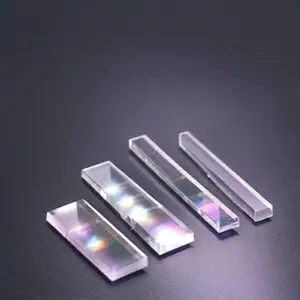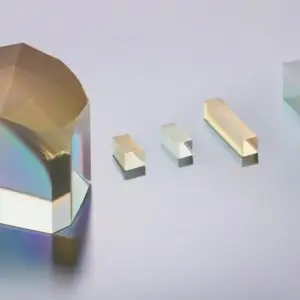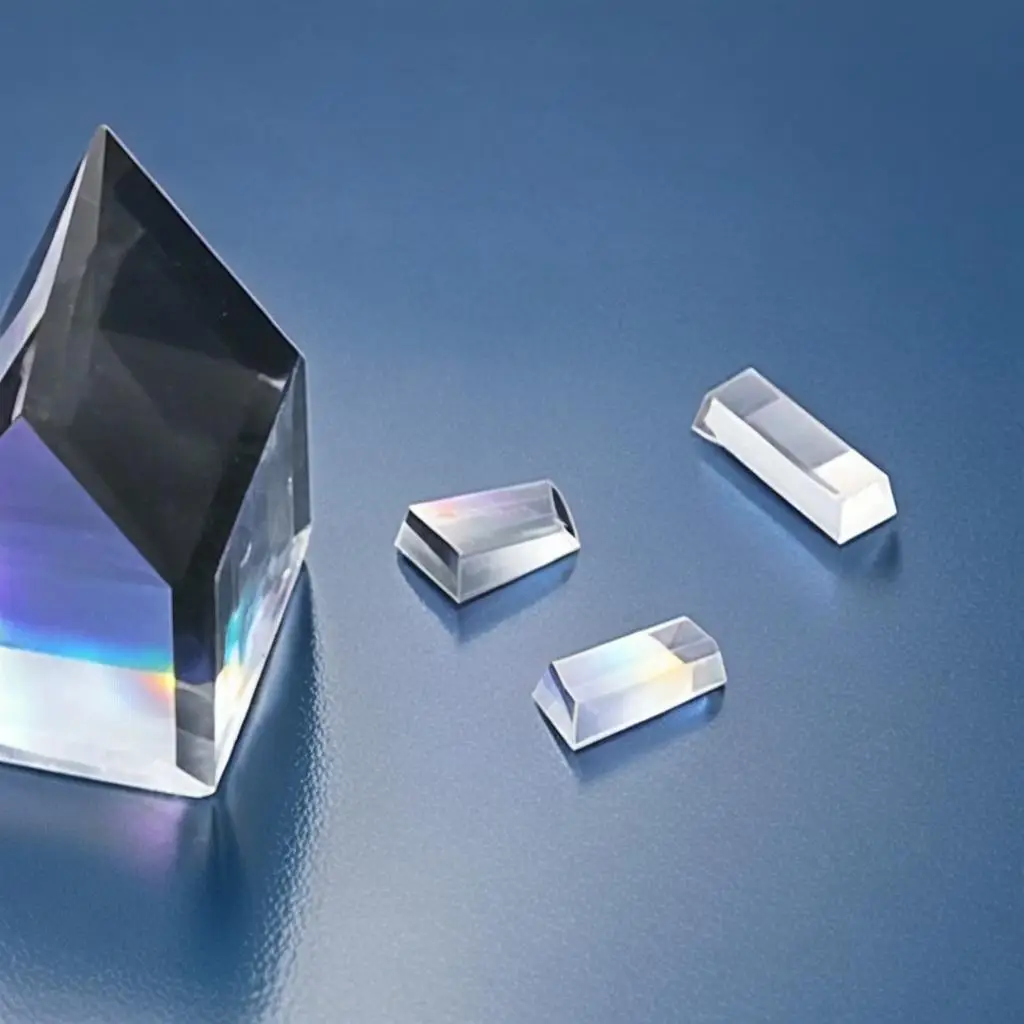
POC-OC-122463-Er:KYW Crystal

  • Strong absorption bandwidth near 1534 nm, ideal for InGaAsP/InP laser diode emission.
  • Wide emission bandwidth near 1600 nm for high versatility.
  • High energy conversion efficiency with low quantum defect (>80% slope efficiency).
  • Enables “eye-safe” laser operations in CW and Q-switched modes.
  • Custom crystal sizes and orientations available upon request.

Customizable Components Available for This Material to Meet Your Specific Needs!

General Description

Er:KYW (Erbium-doped Potassium Yttrium Tungstate) crystals are a promising active laser medium for “eye-safe” wavelength emissions, particularly in the 1570-1630 nm spectral range. These crystals are tailored for diode-pumped solid-state lasers, benefiting from their broad absorption and emission bands. Their high efficiency in energy transfer, coupled with excellent thermo-mechanical properties, makes them suitable for high-power and pulsed laser systems. Er:KYW crystals exhibit a low quantum defect, allowing superior slope efficiencies when pumped by InGaAs/InP diode lasers. The broad emission spectrum also supports the generation of mode-locked laser pulses.

General Applications and Examples

Er:KYW crystals find applications across a wide range of laser systems, including:

  1. In-Band Pumped “Eye-Safe” Lasers: With emissions in the 1530-1600 nm range, these lasers are ideal for applications where eye safety is a critical concern, such as:
    • Medical diagnostics and therapeutic procedures.
    • Environmental monitoring and industrial process control.
  2. Waveguide Lasers: Their wide absorption and emission capabilities allow efficient integration into waveguide lasers, providing compact and efficient designs.
  3. Diode-Pumped Solid-State Lasers: Er:KYW crystals can be resonantly pumped using fiber or diode lasers, achieving high slope efficiencies for CW and Q-switched operations.
  4. Mode-Locked Lasers: The broad and smooth emission spectra support the generation of ultra-short laser pulses for femtosecond applications.

Chemical and Structural Properties

PropertyValue
Chemical FormulaEr:KY(WO₄)₂
Absorption Peak Wavelength1534 nm
Emission Wavelength1609 nm
Absorption Bandwidth (at peak)3 nm
Emission Cross-Section0.4 × 10^-20 cm²
Lifetime of Er³⁺ Upper Laser Level3.1 ms
Refractive Indexn_p = 2.05, n_m = 2.01, n_g = 1.97
Crystal StructureMonoclinic
Density6.5 g/cm³
Mohs Hardness5
Thermal Conductivity3.5 W/m·K
Typical Doping Level<20 at.%

Optical, Laser and Nonlinear Optical Property

Optical PropertyValue
Absorption Coefficient at Peak2.4 × 10^-20 cm²
Absorption Wavelength Range1520-1540 nm
Emission Cross-Section0.4 × 10^-20 cm²
Emission Bandwidth3 nm
Laser Wavelength1570-1630 nm
Efficiency>80% (High slope efficiency)
Transparency Range400 nm to 5 μm

Standard Fabrication Specifications

SpecificationValue
OrientationN_p-cut (standard), other cuts available
Clear Aperture>90%
Face Dimensions Tolerance+0/-0.1 mm
Length Tolerance±0.1 mm
Parallelism Error<20 arcsec
Perpendicularity Error<10 arcmin
Surface Flatness<λ/10 @ 632.8 nm
Surface Quality20-10 S-D
Laser Damage Threshold>10 J/cm² @1530 nm, 10 ns
MountUnmounted

Spectrum Transmission Curve

The absorption and emission spectra indicate strong absorption at 1534 nm and significant emission near 1609 nm. This aligns well with the emission wavelengths of InGaAs/InP diode lasers, making Er:KYW ideal for these systems.
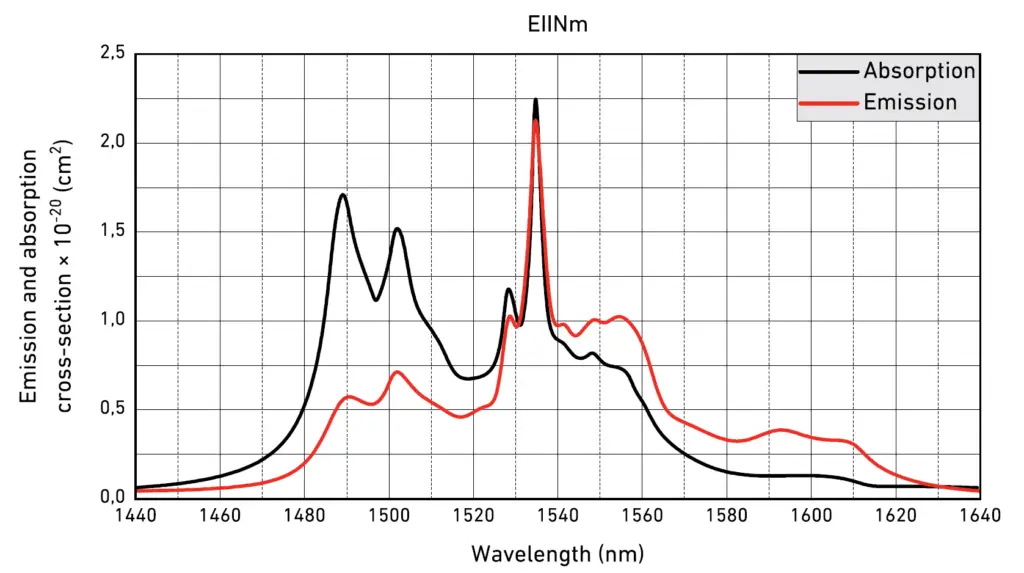
POC-Er KYW crystals Crystal Spectrum Absorption and emission Curve

Coating Specification

  • AR Coating: Custom coatings available for optimized transmission between 1520-1640 nm.
  • Standard Coatings:
    • AR/AR@1530-1600 nm for both crystal faces.
    • Reflectance <0.25% at specified wavelength ranges.
  • Adhesion Test: Compliant with MIL-C-675C military standards, an adhesion test involved applying a tape that meets LT-90 specifications onto the lens film layer. The tape was affixed fully and then removed vertically. This procedure was performed three times, resulting in no blistering or peeling.
  • Temperature Test: In line with MIL-C-675C specifications, test pieces were subjected to temperatures of -62±1℃ and 71±1℃. After maintaining them at room temperature (16℃~32℃) for two hours, the adhesion test was repeated, confirming no film detachment.
  • Abrasion Resistance Test: Conforming to MIL-C-675C and CCC-C-440 standards, the abrasion resistance test involved a gauze tester applying a minimum force of 1.0 lbs (0.45 kg) to the film. This was repeated 25 times with gauze widths of 1/4 inch (6.4mm) and 3/8 inch (9.5mm), ensuring no damage occurred to the film surface.
  • Humidity Test: Under MIL-C-675C criteria, the test piece was placed in a controlled temperature and humidity chamber set to 49 ±2℃ and 95%~100% humidity for 24 hours. The film remained intact, with no peeling, scratches, or other defects.
  • Solvent and Cleaning Testing: Following MIL-C-675C specifications, test pieces were exposed to room temperature conditions (16℃~32℃) and tested with acetone and alcohol for at least 10 minutes each. After air drying and subsequent cleaning with a cotton cloth soaked in alcohol, the film surface showed no signs of peeling or scratches.
  • Salt Spray Test: After 100 hours in a 35°C environment with a 5% saltwater concentration, the film showed no signs of damage.
Face Dimensions (mm)Length (mm)CoatingPrice (USD)
3 × 35AR/AR@1530-1600 nmRequest
3 × 310AR/AR@1530-1600 nmRequest
CustomizationAvailableUpon RequestRequest
//body code