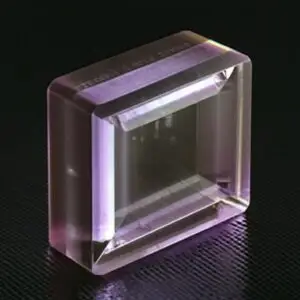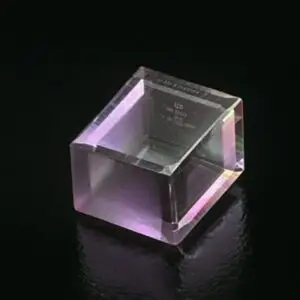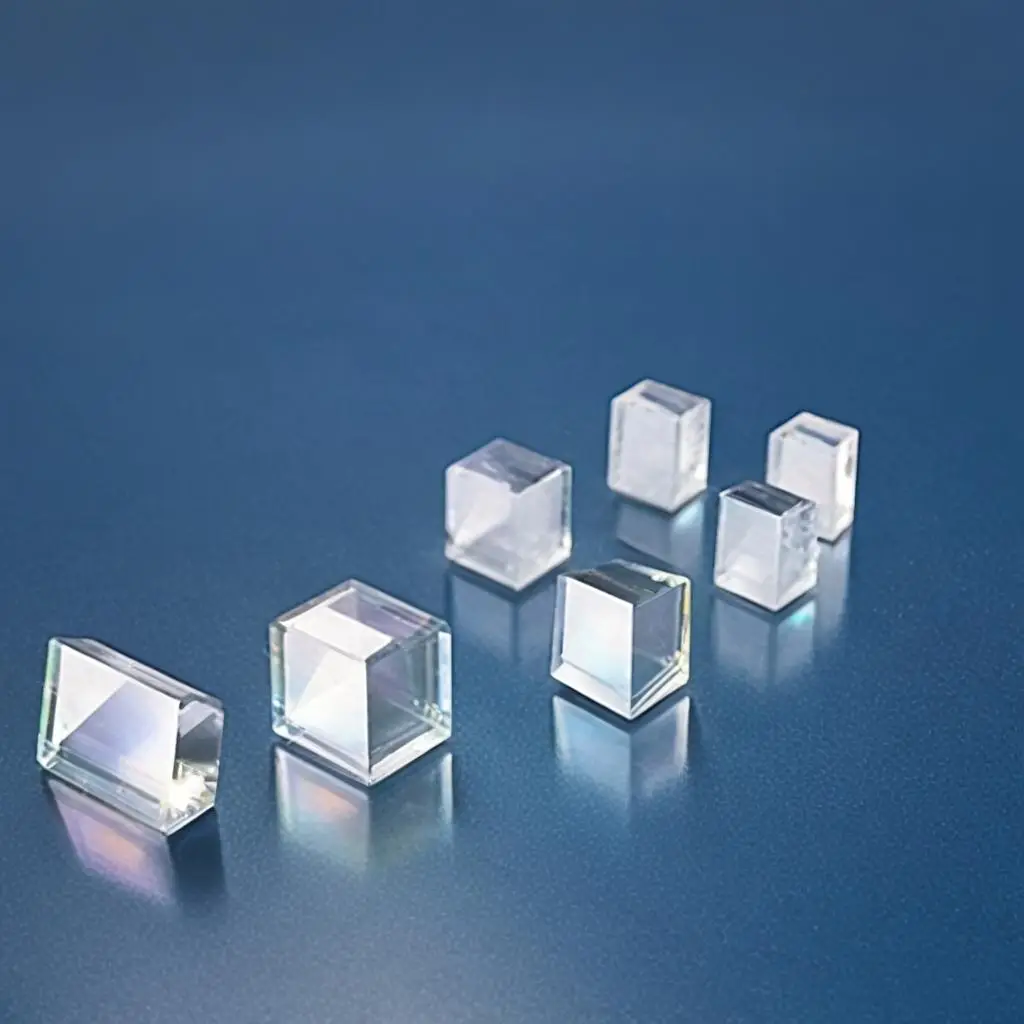
POC-OC-122501-BGO Crystal

  • High scintillation efficiency under γ-radiation.
  • High density and short radiation length.
  • Excellent optical, mechanical, and scintillation properties.
  • Suitable for high-energy physics and nuclear imaging applications.
  • Custom sizes and OEM services available upon request.

Customizable Components Available for This Material to Meet Your Specific Needs!

General Description

Bismuth Germanate (Bi₄Ge₃O₁₂), commonly known as BGO, is a high-performance scintillation crystal widely utilized in applications requiring high scintillation efficiency and excellent mechanical stability. Its high density (7.13 g/cm³) and short radiation length make it an ideal material for detecting γ-rays in nuclear medicine imaging, high-energy physics, geological exploration, and oil well logging. BGO exhibits superior transparency and scintillation performance, enabling precise radiation detection in complex environments. Customization in dimensions and coating specifications is available through POC’s advanced processing capabilities.

General Applications and Examples

Applications include:

  • High-Energy Physics: BGO crystals are integral components in detectors for particle accelerators, where they detect γ-rays with high precision and efficiency.
  • Nuclear Medicine Imaging: In PET and SPECT systems, BGO crystals convert γ-radiation into visible light, enabling accurate imaging for medical diagnostics.
  • Geological Prospecting: Utilized in γ-ray spectrometers for mineral exploration and resource analysis.
  • Oil Well Logging: Supports energy spectrum analysis for oil and gas exploration.
  • Industrial and Security Applications: Applied in radiation monitoring and safety inspection systems.

Case Study Example:
A PET imaging system employing BGO crystals achieved enhanced image resolution and higher γ-ray detection efficiency, outperforming traditional scintillators in clinical diagnostic settings.

Chemical and Structural Properties

Property Value
Chemical Formula Bi₄Ge₃O₁₂
Density 7.13 g/cm³
Melting Point 1050°C
Radiation Length 11 mm
Refractive Index 2.15
Emission Peak 480 nm
Decay Constant 300 ns
Light Output 11% ~ 14%
Energy Resolution (511 KeV) 20%
Crystal Structure Cubic System

Optical Properties

Parameter Specification
Transmission Range 0.45 – 7 μm
Refractive Index @ 0.63 μm 2.55
Electro-Optic Coefficient r₄₁ 3.5 pm/V
Dielectric Constant 40
Dark Resistance 10⁴ Ohm cm

Standard Fabrication Specifications

Parameter Specification
Clear Aperture ≥ 85%
Face Dimensions Tolerance ± 0.1 / ± 0.25 mm
Thickness Tolerance ± 0.2 mm
Parallelism Error ≤ 30 arcsec
Protective Chamfers ≤ 0.3 mm at 45°
Surface Quality 40-20 S-D
Wavefront Distortion ≤ λ/4 @ 632.8 nm
Coatings Uncoated or per request
Mount Unmounted

Spectrum Transmission Curve

The spectral response curve of BGO shows optimal transmission in the visible light range with an emission peak at 480 nm. Custom measurements can be provided upon request.

Coating Specification

Coatings are available on request for specific wavelength ranges, ensuring high optical efficiency and minimal reflection. Examples include anti-reflective (AR) coatings for 450-700 nm.

  • Adhesion Test: Compliant with MIL-C-675C military standards, an adhesion test involved applying a tape that meets LT-90 specifications onto the lens film layer. The tape was affixed fully and then removed vertically. This procedure was performed three times, resulting in no blistering or peeling.
  • Temperature Test: In line with MIL-C-675C specifications, test pieces were subjected to temperatures of -62±1℃ and 71±1℃. After maintaining them at room temperature (16℃~32℃) for two hours, the adhesion test was repeated, confirming no film detachment.
  • Abrasion Resistance Test: Conforming to MIL-C-675C and CCC-C-440 standards, the abrasion resistance test involved a gauze tester applying a minimum force of 1.0 lbs (0.45 kg) to the film. This was repeated 25 times with gauze widths of 1/4 inch (6.4mm) and 3/8 inch (9.5mm), ensuring no damage occurred to the film surface.
  • Humidity Test: Under MIL-C-675C criteria, the test piece was placed in a controlled temperature and humidity chamber set to 49 ±2℃ and 95%~100% humidity for 24 hours. The film remained intact, with no peeling, scratches, or other defects.
  • Solvent and Cleaning Testing: Following MIL-C-675C specifications, test pieces were exposed to room temperature conditions (16℃~32℃) and tested with acetone and alcohol for at least 10 minutes each. After air drying and subsequent cleaning with a cotton cloth soaked in alcohol, the film surface showed no signs of peeling or scratches.
  • Salt Spray Test: After 100 hours in a 35°C environment with a 5% saltwater concentration, the film showed no signs of damage.
Face Dimensions Length Orientation SKU Price (USD)
20 x 20 mm 1.1 mm [100] 6875 490
25 x 25 mm 1.1 mm [110] 6874 570
30 x 30 mm 1.4 mm [110] 6877 690
//body code