



Key Features
- Enables precise laser intensity modulation outside the cavity.
- Supports a wide frequency range of up to 300 MHz for versatile applications.
- Low rise/fall times, as fast as 6 ns, for high-speed modulation.
- Customizable designs to meet requirements for wavelength, power, and beam diameter.
- Constructed with high-quality materials (Crystalline Quartz or Tellurium Oxide) for durability and reliability.
General Description
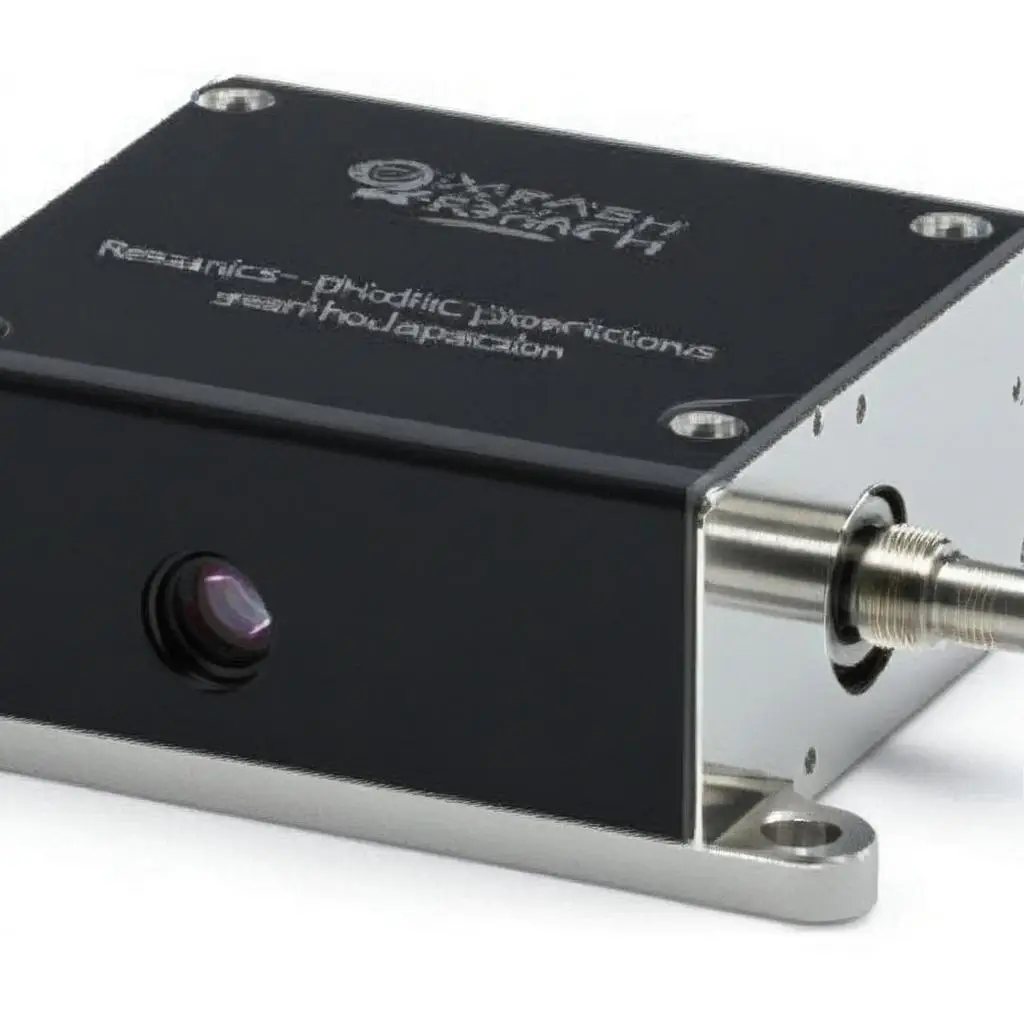
Acousto-Optic Modulators (AOM) are state-of-the-art devices engineered to modify the intensity of incident laser beams through amplitude modulation. Operating outside the laser cavity, these modulators utilize RF drivers to facilitate both digital (on/off) and analog modulation modes, such as sine, square wave, or linear modulation, to suit a variety of operational needs. The performance of an AOM is characterized by its rise/fall time, determining the achievable modulation speed and bandwidth. To ensure optimal speed, POC AOMs are designed to control the beam diameter precisely, minimizing the rise/fall time to as low as 6 ns. With a frequency range of up to 300 MHz, POC’s AOMs cater to applications requiring fast, reliable modulation. Using high-quality materials such as Crystalline Quartz (CQ) and Tellurium Oxide (TeO2), the devices ensure low insertion loss and high extinction ratios, making them ideal for a wide range of industries, from medical technology to material processing.General Applications and Examples
- Laser Marking AOMs provide precise modulation control for high-speed marking of materials. This ensures clean, accurate marks, making the technology suitable for industrial and consumer product marking.
- Photolithography In semiconductor manufacturing, POC AOMs enable fine control of laser intensity for lithographic patterning, contributing to the precision fabrication of micro-scale electronic components.
- Material Processing High-frequency modulation allows POC AOMs to perform advanced processes like laser cutting, welding, and micromachining with exceptional precision.
- Medical Applications AOMs are utilized in laser-based medical devices for procedures such as precise tissue ablation and therapeutic treatments requiring controlled laser intensity.
Our Standard Products and Model Numbers
| Model Number | Center Frequency (MHz) | Aperture (mm) | Material | Mode | Wavelength (nm) | RF Connector | Housing |
|---|---|---|---|---|---|---|---|
| CAOM-f-a-mt-w-c-h | 40.68 | 1 | CQ / TE | C (Compression) | 266 | SMA-F | B09 |
Typical Specifications
| Wavelength (nm) | Active Aperture (mm) | Operating Frequency (MHz) | Rise/Fall Time (ns/mm) | Material |
|---|---|---|---|---|
| 266, 355 | 3 | 110, 200 | 113 | CQ |
| 400–540 | 1–3 | 110 | 113 | CQ |
| 780–850 | 0.5 | 200 | 153 | TE |
| 1030–1064 | 1–5 | 68, 80 | 113 | CQ |
| 1064 | 0.5–1 | 100, 120 | 153 | TE |
| 9.4–10.6 μm | 3–11.6 | 40.68 | 120 | – |
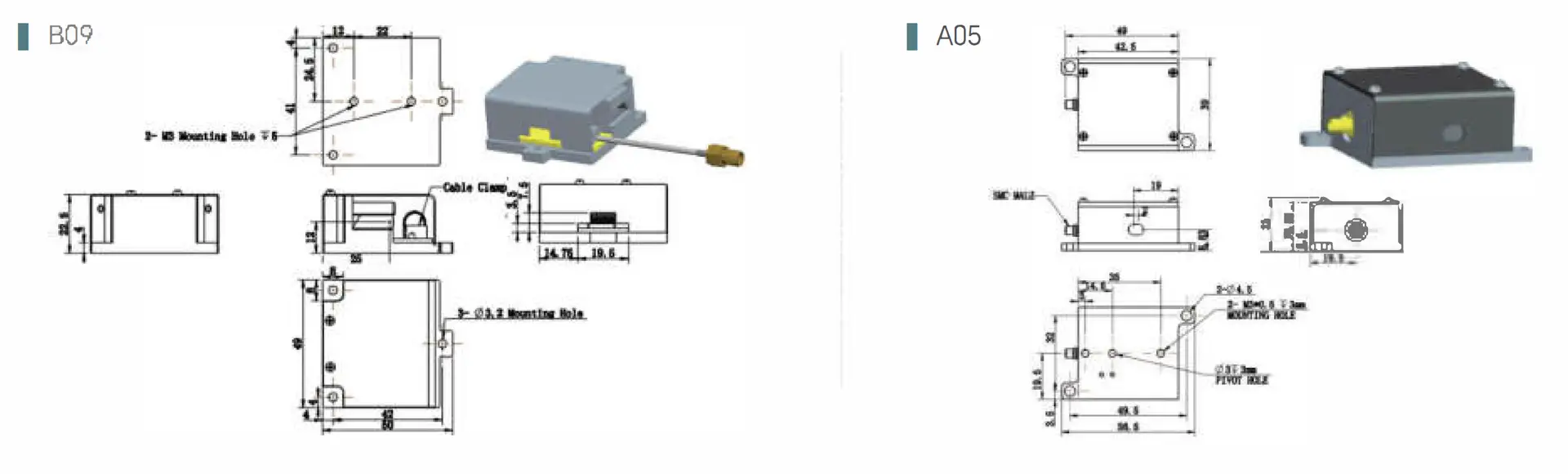
Housing Dimensions (mm)
- B09: 54.5 x 47.5 x 25 mm, compact and suitable for integration in confined spaces.
- A05: 64 x 40 x 25 mm, designed for robust industrial applications with larger housing requirements.