



Key Features
- High-performance modulators for dynamic phase retardation and polarization modulation.
- Wide operational frequency range, suitable for ultraviolet, visible, and infrared light.
- Supports both one-dimensional and two-dimensional vibration modes for enhanced functionality.
- Exceptional transmission rates of ≥98% and acceptance angles up to 20°.
- Robust construction with isotropic materials for high precision and reliability.
General Description
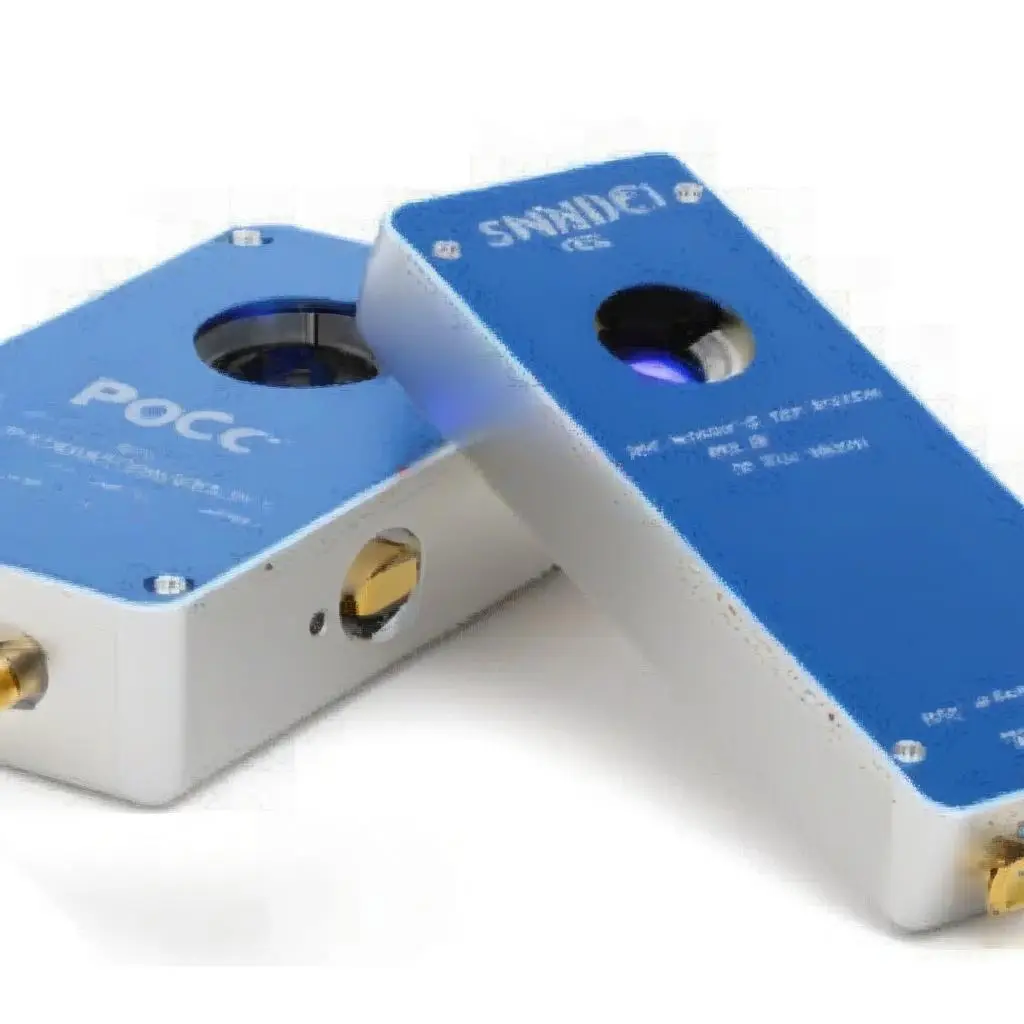
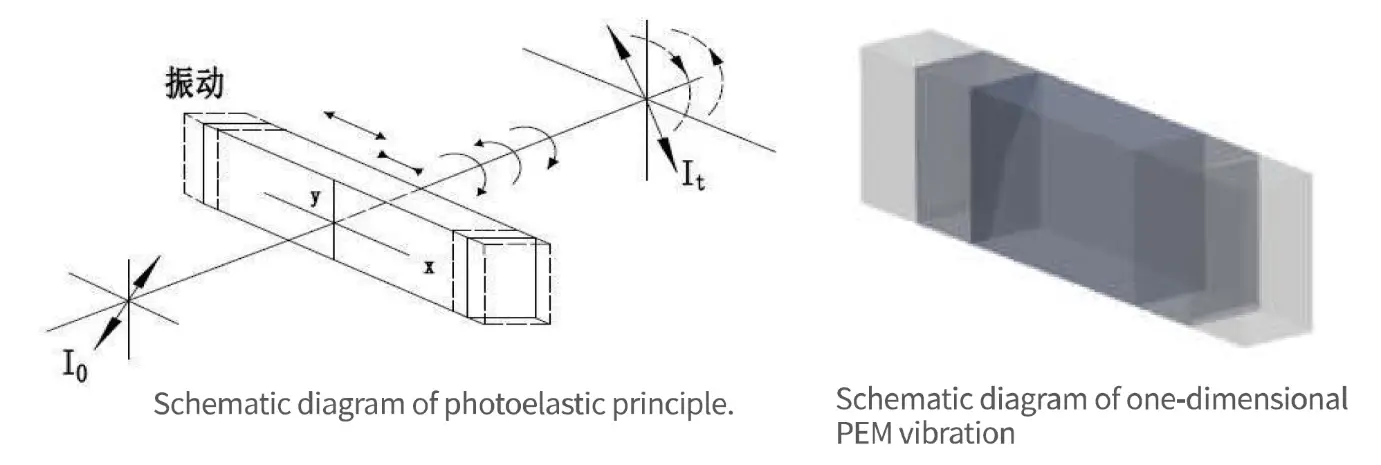
Photoelastic Modulators (PEM) are state-of-the-art modulation devices designed to alter the polarization state of light by introducing a dynamic phase retardation to transmitted light. Utilizing isotropic materials, PEMs operate at inherent resonant frequencies, leveraging the photoelastic effect to achieve periodic refractive index changes that influence the retardation of incident light.
POC’s PEMs stand out for their high modulation frequency, large acceptance angle, and superior precision, making them ideal for demanding optical applications. Available in one-dimensional and two-dimensional configurations, these modulators cater to diverse requirements: one-dimensional PEMs are optimal for UV, visible, and near-infrared applications, while two-dimensional PEMs enable broader phase modulation capabilities across visible and infrared bands.
The innovative design of POC’s PEMs ensures accurate phase control, reduced crosstalk, and high throughput, positioning them as a reliable choice for advanced optical systems. Their high-quality construction supports seamless integration into various setups, delivering consistent and precise modulation.
General Applications and Examples
- Polarization Measurement
PEMs are indispensable tools for analyzing the polarization state of light in spectroscopic and imaging systems, offering unparalleled precision in real-time applications. - Quantum Sensing
With their high modulation frequency and accuracy, PEMs support cutting-edge quantum sensing technologies, enabling advancements in fundamental physics and quantum communication. - Astronomical Observation
PEMs enhance telescopic systems by providing precise polarization modulation, crucial for detecting faint celestial objects and analyzing polarized light from distant stars. - Magnetometry
PEMs contribute to the accurate measurement of magnetic fields through their ability to modulate light with high sensitivity and resolution.
Our Standard Products and Model Numbers
|
Model Number |
Frequency (kHz) |
Aperture (mm) |
Material |
Type |
Housing |
Wavelength (nm) |
|---|---|---|---|---|---|---|
|
CPEM-f-a-m-t-h-w |
40 |
13 |
FS |
1 |
A01 |
633 |
Typical Specifications
|
Frequency |
Type |
Aperture (mm) |
Transmission (%) |
Acceptance Angle |
Retardation |
|---|---|---|---|---|---|
|
50 kHz |
1D |
16 |
≥98 |
20° |
λ/2 |
|
60 kHz |
1D |
13 |
≥98 |
20° |
λ/2 |
|
50 kHz |
2D |
22 |
≥98 |
20° |
λ/2 |
|
60 kHz |
2D |
13 |
≥98 |
20° |
λ/2 |
For more frequencies and wavelengths, please consult us.
Housing Dimensions (mm)
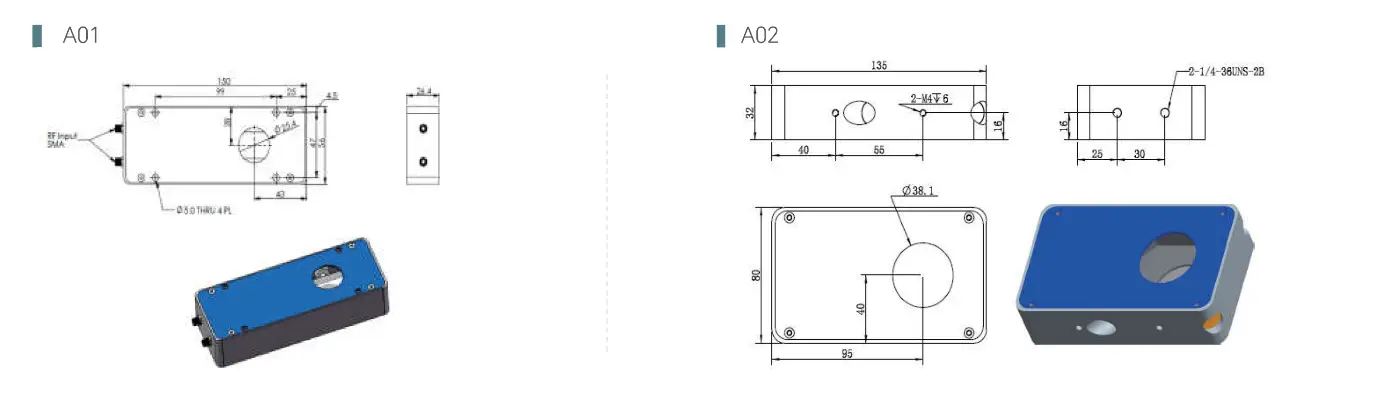
- A01: Compact design for standard setups, 130 x 24 x 99 mm.
- A02: Enhanced configuration for high-precision applications, 135 x 50 x 95 mm.