
Germanium is widely used in infrared optical systems such as thermal imaging cameras, infrared sensors, MWIR systems, LWIR systems, and custom IR optical assemblies.
However, Germanium optical components often require coating to improve transmission, reduce reflection, or protect the surface. Common coating options include AR coating, DLC coating, and BBAR coating.
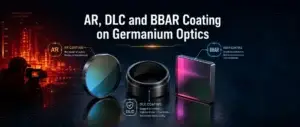
AR, DLC and BBAR Coating on Germanium Optics
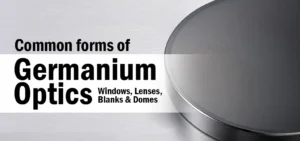
Germanium is a common infrared material used for windows, lenses, blanks, domes, and other custom optical components.
It is widely used in thermal imaging, infrared sensing, MWIR systems, LWIR systems, night vision systems, industrial inspection, and surveillance equipment.
However, Germanium has a high refractive index, which means its surface can reflect a significant amount of light if it is left uncoated. Because of this, coating is often applied to improve optical performance.
Common Germanium coating options include:
- AR coating
- DLC coating
- BBAR coating
Each coating has a different purpose.
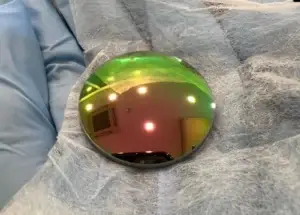
What Is AR Coating on Germanium?
AR coating stands for Anti-Reflection coating.
It is used to reduce surface reflection and improve infrared transmission through the Germanium component.
In simple words, AR coating helps more infrared energy pass through the Germanium window or lens.
AR coating is commonly used for:
- Germanium windows
- Germanium lenses
- Thermal imaging systems
- Infrared sensors
- MWIR and LWIR optical systems
- Custom IR optical components
AR coating can be designed for specific wavelength ranges, such as 3–5 µm MWIR, 8–12 µm LWIR, or other custom infrared bands.
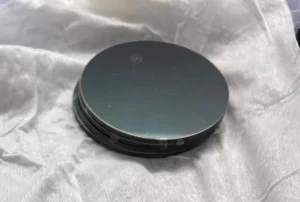
What Is DLC Coating on Germanium?
DLC stands for Diamond-Like Carbon.
DLC coating is mainly used to improve surface protection. It is often applied when the Germanium window needs to operate in outdoor or harsh environments.
In simple words, DLC coating helps make the surface more durable.
DLC coating is commonly used for:
- Outdoor thermal imaging systems
- Surveillance systems
- Defense optical systems
- Harsh environment IR windows
- Front protective Germanium windows
- Long-term outdoor optical equipment
DLC coating is often used on the external side of a Germanium window, where the surface may be exposed to dust, moisture, cleaning, or environmental contact.
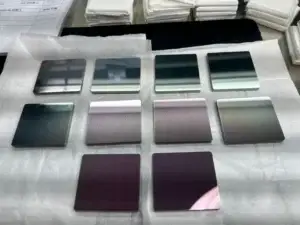
What Is BBAR Coating on Germanium?
BBAR stands for Broadband Anti-Reflection coating.
While normal AR coating is usually designed for a narrower wavelength range, BBAR coating is designed to reduce reflection across a wider infrared band.
In simple words, BBAR coating is useful when the optical system needs better transmission over a broader wavelength range.
BBAR coating may be used for:
- Broadband infrared systems
- Multi-wavelength IR systems
- Scientific instruments
- Infrared measurement systems
- Custom optical systems
- Applications where a wider IR band is required
BBAR coating is usually customized based on the required wavelength range, angle of incidence, and application.
Simple Comparison Table
| Coating Type | Full Name | Main Purpose | Common Use |
|---|---|---|---|
| AR Coating | Anti-Reflection Coating | Reduces reflection and improves transmission | MWIR or LWIR Germanium windows and lenses |
| DLC Coating | Diamond-Like Carbon Coating | Improves surface protection and durability | Outdoor, surveillance, defense, harsh environment windows |
| BBAR Coating | Broadband Anti-Reflection Coating | Reduces reflection over a wider wavelength range | Broadband IR systems and custom optical instruments |
AR Coating vs DLC Coating
AR coating and DLC coating are used for different reasons.
AR coating focuses mainly on optical transmission. It helps reduce reflection and allows more infrared energy to pass through.
DLC coating focuses mainly on surface protection. It is often selected when the Germanium window is used as the first surface in an outdoor or exposed system.
For some applications, a Germanium window may use DLC coating on one side and AR coating on the other side.
When Should You Choose AR, DLC or BBAR Coating?
You may choose AR coating if your system needs improved transmission at a specific infrared wavelength range.
You may choose DLC coating if the window needs better surface protection in outdoor or harsh environments.
You may choose BBAR coating if the system needs broadband infrared transmission across a wider wavelength range.
The final coating choice depends on the wavelength range, application, operating environment, angle of incidence, and required transmission performance.
What Information Should You Provide Before Requesting a Coated Germanium Component?
To request a coated Germanium window, lens, dome, or blank, it is helpful to provide:
- Component type: window, lens, blank, or dome
- Germanium material type, if required
- Diameter, size, or drawing
- Thickness or center thickness
- Required wavelength range
- Coating type: AR, DLC, BBAR, or custom coating
- Coating side: one side or both sides
- Angle of incidence, if applicable
- Surface quality requirement
- Clear aperture
- Quantity
- Application or system type
This information helps the supplier recommend a suitable coating design and manufacturing process.
Example Specification for Coated Germanium Window
| Item | Example Specification |
|---|---|
| Material | Germanium / Ge |
| Component Type | Infrared optical window |
| Diameter | 50.00 mm |
| Thickness | 5.00 mm |
| Wavelength Range | 8–12 µm LWIR |
| Coating Requirement | AR coating / DLC coating / BBAR coating |
| Coating Side | Single side / both sides / DLC on outer side + AR on inner side |
| Surface Quality | 60/40 scratch-dig |
| Surface Flatness | λ/2 @ 632.8 nm |
| Clear Aperture | ≥ 90% of diameter |
| Edge / Chamfer | Protective chamfer, 0.2 mm × 45° |
| Quantity | 10 pcs |
Conclusion
Coating is an important part of Germanium optical component design.
AR coating helps improve infrared transmission. DLC coating helps improve surface protection. BBAR coating supports broader infrared transmission requirements.
POC supplies Germanium optical components including Germanium windows, lenses, blanks, domes, AR-coated Germanium optics, DLC-coated Germanium windows, BBAR-coated Germanium components, and custom Germanium optics.
Contact us to discuss your coated Germanium optical component requirements.