
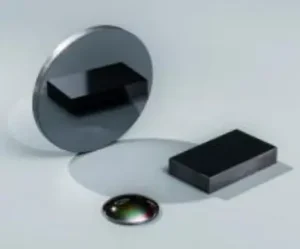
The Germanium optics fabrication process transforms raw Germanium material into finished infrared windows, lenses, blanks, domes, and custom optical components. The process generally includes raw material selection, inspection, cutting, grinding, polishing, coating, final inspection, cleaning, packing, and delivery.
Germanium optical components are commonly used in thermal imaging cameras, infrared sensors, MWIR systems, LWIR systems, night vision equipment, surveillance systems, industrial inspection equipment, and custom infrared optical assemblies.
However, the exact Germanium fabrication process may vary depending on the component type, dimensions, drawing tolerances, coating requirements, wavelength range, quantity, and final application.
Germanium Optics Fabrication Process: From Raw Material to Final Delivery
Germanium is a common infrared optical material used for windows, lenses, blanks, domes, and other custom optical components.
It is widely used in thermal imaging, infrared sensing, MWIR systems, LWIR systems, surveillance equipment, and industrial inspection applications.
To produce a finished Germanium optical component, the material needs to go through a controlled fabrication process. The exact process may vary depending on the product type, drawing, tolerance, coating requirement, and application.
Below is a simple overview of the typical Germanium optics fabrication process or learn more about the common forms of Germanium optics, including windows, lenses, blanks, and domes.
1. Germanium Raw Material Selection
The process starts with selecting the suitable Germanium raw material.
Depending on the application, customers may request different material types, such as monocrystalline Germanium or polycrystalline Germanium. Some projects may also specify N-type or P-type Germanium.
At this stage, the required size, thickness, material quality, and quantity are reviewed before production starts.
Common raw material considerations include:
- Germanium material type
- Diameter or block size
- Thickness allowance
- Optical quality requirement
- Application wavelength range
- Quantity and delivery schedule
2. Incoming Germanium Material Inspection
After receiving the raw material, the manufacturer performs an incoming inspection.
This inspection helps confirm that the material matches the purchase specification before production begins. The quality team may check:
- Diameter, length, or block dimensions
- Material thickness
- Surface condition
- Edge condition
- Visible defects
- Material identification
- Resistivity, when specified
- Crystal orientation, when specified
- Material certificate or supporting documents
As a result, the manufacturer can identify material issues before cutting or machining. This step reduces the risk of production delays and unnecessary material loss.
3. Cutting or Slicing the Germanium Material
Next, the manufacturer cuts or slices the Germanium ingot, rod, disc, or block into a suitable starting shape.
Depending on the final product, the cutting process may produce:
- Round Germanium blanks
- Square or rectangular blanks
- Lens blanks
- Dome blanks
- Custom-shaped components
The manufacturer normally leaves a processing allowance on the diameter, thickness, and surface. Therefore, the cut blank remains slightly larger than the finished dimensions.
Careful cutting also helps reduce edge damage, excessive chipping, and unnecessary material waste.
4. Grinding and Initial Shaping
After cutting, the component enters the grinding and shaping stage.
During this stage, the manufacturer brings the blank closer to the required dimensions and geometry. The required process depends on the component type.
For a flat Germanium window, the manufacturer may grind:
- Both optical surfaces
- Outer diameter
- Square or rectangular edges
- Overall thickness
- Mounting steps or shoulders
For a Germanium lens, the manufacturer may also generate:
- Convex surfaces
- Concave surfaces
- Meniscus geometry
- Aspheric geometry
- Custom curved surfaces
Meanwhile, a dome requires controlled grinding of its inner and outer curved surfaces.
The production team must leave enough material for fine grinding and polishing while maintaining the required geometry.
5. Lapping and Fine Grinding
The component then goes through lapping and fine grinding.
This stage improves the surface condition and brings the component closer to its final dimensional and optical tolerances.
The manufacturer may control:
- Overall thickness
- Center thickness
- Surface flatness
- Surface radius
- Wedge
- Parallelism
- Surface form
- Material removal consistency
Fine grinding also removes deeper marks left by the earlier grinding process. Consequently, it prepares the surface for efficient optical polishing.
6. Germanium Optical Polishing
Polishing is one of the key steps in optical manufacturing.
During polishing, the Germanium surface is refined to achieve the required optical quality.
For Germanium windows, the surface is usually polished flat.
For Germanium lenses, the curved optical surface is polished according to the required radius or design.
The polishing process helps improve surface quality, optical clarity, and performance.
7. Edge Processing and Chamfering
After polishing, the manufacturer processes the component edges.
Germanium is a relatively brittle optical material. Therefore, a protective chamfer helps reduce sharp edges and lowers the risk of chipping during handling, coating, assembly, and transportation.
Common edge requirements may include:
- Protective chamfer
- Bevel
- Edge break
- Ground edge
- Polished edge
- Blackened edge
- Mounting shoulder
- Custom mechanical feature
A typical chamfer may be 0.2 mm × 45°. However, the final size depends on the component dimensions, drawing, mounting method, and customer specification.
The manufacturer must also ensure that the chamfer does not enter the required clear aperture.
8. Germanium Optical Coating
After polishing and edge processing, the component may receive an infrared optical coating.
Uncoated Germanium surfaces reflect a significant amount of infrared energy because of the material’s high refractive index. Therefore, many infrared systems use a coating to improve transmission, protect the surface, or support a specific wavelength range.
Common coating options include:
- Anti-reflection coating
- Diamond-like carbon coating
- Broadband anti-reflection coating
- Custom infrared coating
- AR coating on both sides
- DLC coating on the outer surface and AR coating on the inner surface
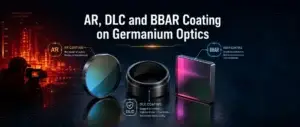
AR Coating
An AR coating reduces surface reflection and improves transmission within a specified wavelength range.
Common coating ranges may include:
- MWIR 3–5 µm
- LWIR 8–12 µm
- LWIR 8–14 µm
- CO₂ laser wavelength at 10.6 µm
- Custom wavelength bands
DLC Coating
A DLC coating provides additional protection for exposed optical surfaces.
Manufacturers often use DLC-coated Germanium windows in outdoor, industrial, surveillance, aerospace, and harsh-environment systems.
BBAR Coating
A BBAR coating supports broader infrared wavelength requirements. However, the coating designer must consider the substrate, operating band, angle of incidence, transmission requirement, and environmental conditions.
Learn more about AR, DLC, and BBAR coatings for Germanium optics.
9. Final Optical and Mechanical Inspection
After polishing or coating, the quality team performs a final inspection.
The inspection confirms that the finished Germanium component meets the agreed drawing and specification.
Depending on the product, the inspection may cover:
- Outer diameter
- Length and width
- Overall thickness
- Center thickness
- Radius
- Sag
- Surface quality
- Surface flatness
- Surface irregularity
- Parallelism
- Wedge
- Centration
- Clear aperture
- Chamfer dimensions
- Coating appearance
- Coating adhesion
- Spectral transmission
- Drawing requirements
For a Germanium window, the manufacturer may focus on flatness, parallelism, surface quality, dimensions, and coating performance.
For a Germanium lens, the manufacturer may also inspect radius, center thickness, centration, surface form, and optical performance.
Furthermore, the customer may request an inspection report, transmission curve, material certificate, coating report, or First Article Inspection documentation.
10. Cleaning the Germanium Optics
Next, the manufacturer cleans the finished optical components.
The cleaning process removes:
- Dust
- Loose particles
- Fingerprints
- Polishing residue
- Coating residue
- Handling contamination
The production team must use suitable cleaning materials and handling procedures because improper cleaning can scratch or damage an optical surface.
In addition, operators normally wear gloves or finger cots and avoid direct contact with the clear aperture.
11. Protective Packing
After cleaning, the manufacturer packs each component carefully.
Suitable optical packaging helps protect the Germanium component from:
- Surface scratches
- Dust and particles
- Moisture
- Fingerprints
- Edge chips
- Coating damage
- Movement during transportation
Depending on the size and quantity, the manufacturer may use:
- Individual lens tissue
- Optical component boxes
- Protective plastic containers
- Foam inserts
- Vacuum-sealed packaging
- Desiccant
- Custom wooden cases
For fragile, coated, or high-value Germanium optics, individual packaging usually provides better protection.
12. Warehouse, Documentation, and Delivery
Finally, the manufacturer transfers the packed components to the warehouse or shipping area.
Before dispatch, the logistics team checks the quantity, labels, customer information, packing method, and shipping documents.
The shipment may include:
- Packing list
- Commercial invoice
- Inspection report
- Material certificate
- Coating report
- Transmission curve
- Certificate of conformity
- First Article Inspection report
- Customer-specific documents
Once the team completes these checks, the finished Germanium optical components are ready for delivery.
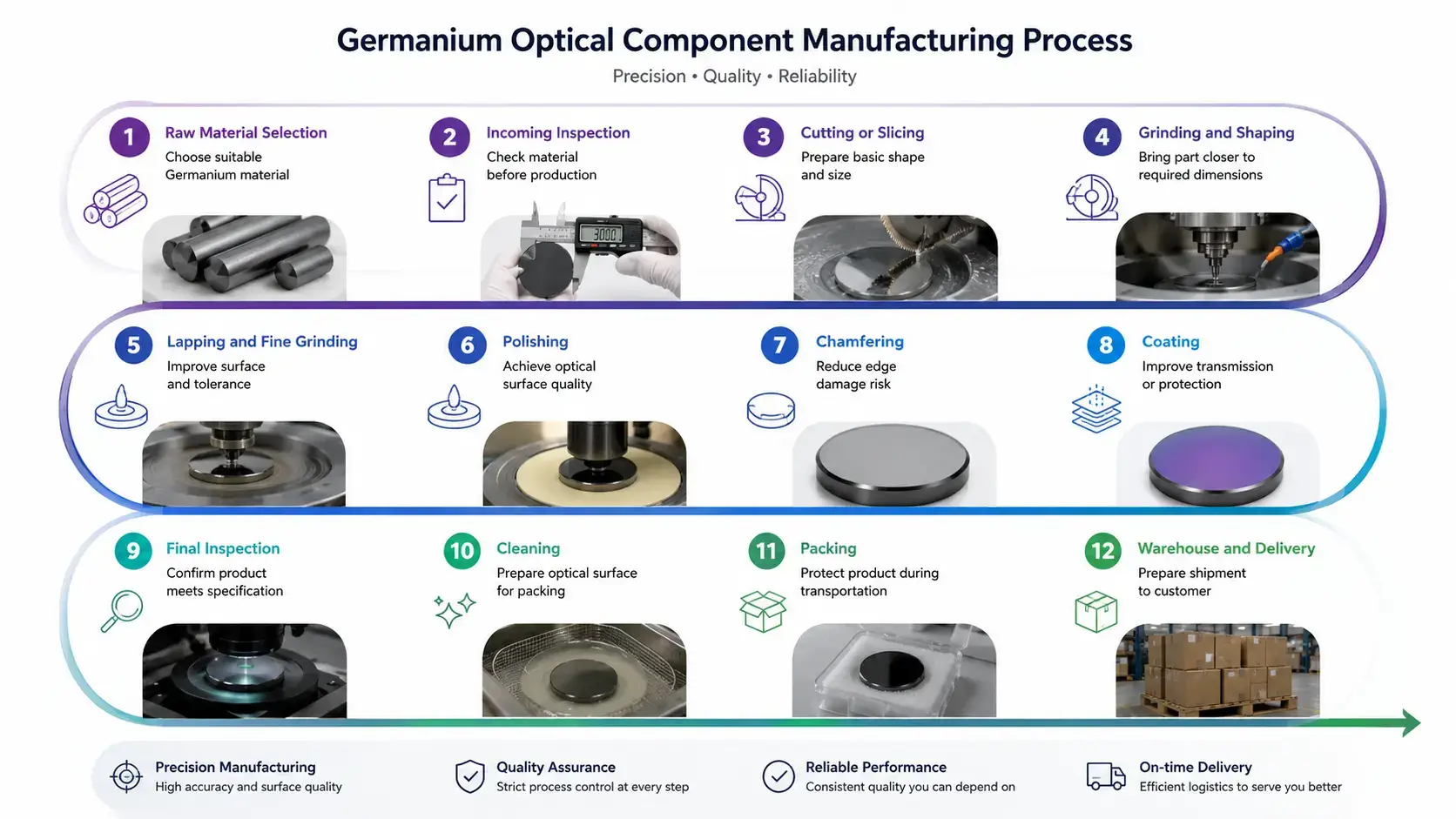
Simple Process Flow
What Information Should You Provide Before Production?
To support Germanium optical component production, it is helpful to provide:
- Component type: window, lens, blank, or dome
- Material type, if required
- Diameter, size, or drawing
- Thickness or center thickness
- Wavelength range
- Coating requirement
- Surface quality
- Surface flatness
- Parallelism or wedge requirement
- Clear aperture
- Quantity
- Delivery schedule
Clear specifications help reduce production risk and make the quotation and manufacturing process smoother.
Example Specification for Germanium Component
| Item | Example Specification |
|---|---|
| Lens Type | LWIR continuous zoom lens module |
| Wavelength Range | 8–12 µm |
| Detector Type | Uncooled LWIR detector |
| Detector Resolution | 640 × 512 |
| Pixel Size | 12 µm |
| Focal Length | 20–120 mm |
| F-number | F/1.1 |
| Focus Type | Motorized focus |
| Zoom Control | Motorized zoom |
| Coating Requirement | AR coating for 8–12 µm |
| Application | Thermal imaging, surveillance, long-range observation |
| Interface / Mount | Customizable based on camera system |
| Quantity | 1 set / prototype / batch production |
Conclusion
The fabrication of Germanium optical components involves several controlled steps, from raw material selection to cutting, grinding, polishing, coating, inspection, cleaning, packing, warehouse, and final delivery.
Each step is important to ensure the final component meets the required optical, mechanical, and coating specifications.
POC supplies Germanium optical components including Germanium windows, lenses, blanks, domes, coated Germanium optics, and custom Germanium parts based on customer drawings and application requirements.
Contact us to discuss your Germanium optical component requirements.