


Key Features
- Allows simultaneous modulation of up to 10 optical channels.
- Reduces crosstalk and enhances linear modulation performance.
- Utilizes high-quality materials such as fused quartz, crystalline quartz, and Tellurium Dioxide for durability and efficiency.
- Provides low insertion loss (<3 dB) and high diffraction efficiency (>70%).
- Supports operation frequencies up to 200 MHz, ensuring high-speed modulation.
General Description
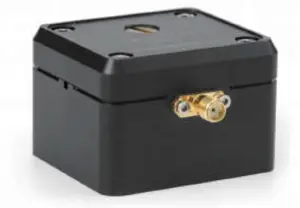
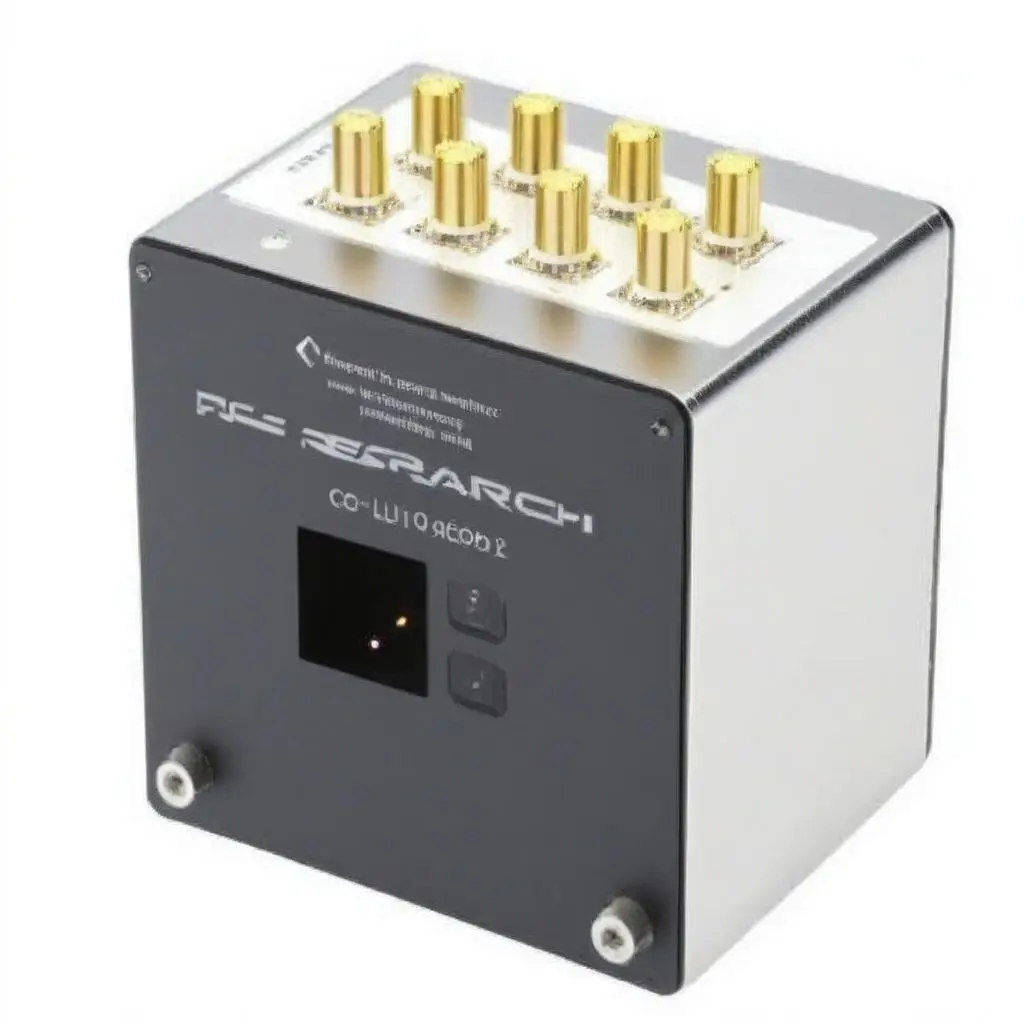
Acousto-Optic Multi-Channel Modulators (AOMM) are advanced devices designed to modulate or deflect multiple optical beams simultaneously. By integrating transducer arrays into a single acousto-optic crystal, AOMMs significantly increase the number of modulated beams, reduce scanning rates, and lower modulation bandwidth, improving overall linearity and efficiency.
Compared to single-channel AOMs, AOMMs provide independent control of multiple beams or collimated light lines, making them ideal for demanding applications such as laser color printers, multi-channel acousto-optic spectrometers, optical digital computers, and video infrared image processing systems.
POC’s AOMMs are constructed using low-scatter fused quartz, crystalline quartz, and Tellurium Dioxide to ensure low insertion loss, high diffraction efficiency, and robustness under high-power conditions. These modulators support up to 10 channels and operate at frequencies up to 200 MHz, minimizing acoustic and electrical crosstalk while delivering precise performance.
General Applications and Examples
- Laser Color Printing
AOMMs are integral to high-resolution laser color printers, providing simultaneous modulation of multiple beams to enable efficient and precise color printing processes. - Spectroscopy and Imaging
Multi-channel modulation enhances the performance of spectrometers and dynamic infrared imaging systems, enabling faster data acquisition and higher-quality image processing. - 2D Information Processing
AOMMs are used in optical computing systems to modulate multiple light beams for parallel data processing, improving computational speed and accuracy. - Material Processing
AOMMs enable simultaneous modulation of multiple laser beams for high-speed micromachining, marking, and welding applications, enhancing productivity and precision.
Our Standard Products and Model Numbers
|
Model Number |
Center Frequency (MHz) |
Aperture (mm) |
Number of Channels |
Material |
Mode |
Wavelength (nm) |
RF Connector |
Housing |
|---|---|---|---|---|---|---|---|---|
|
CAOMM-f-a-mt-w-cn-h |
40.68 |
1 |
5 |
CQ / TE |
C (Compression) |
266 |
SMA-F |
B23 |
Typical Specifications
|
Wavelength (nm) |
Aperture (mm) |
Operating Frequency (MHz) |
Number of Channels |
Channel Crosstalk (dB) |
Diffraction Efficiency (%) |
|---|---|---|---|---|---|
|
370 |
0.2–1 |
100 |
5 |
>20 |
≥70 |
|
355 |
0.2–1 |
200 |
10 |
>20 |
≥70 |
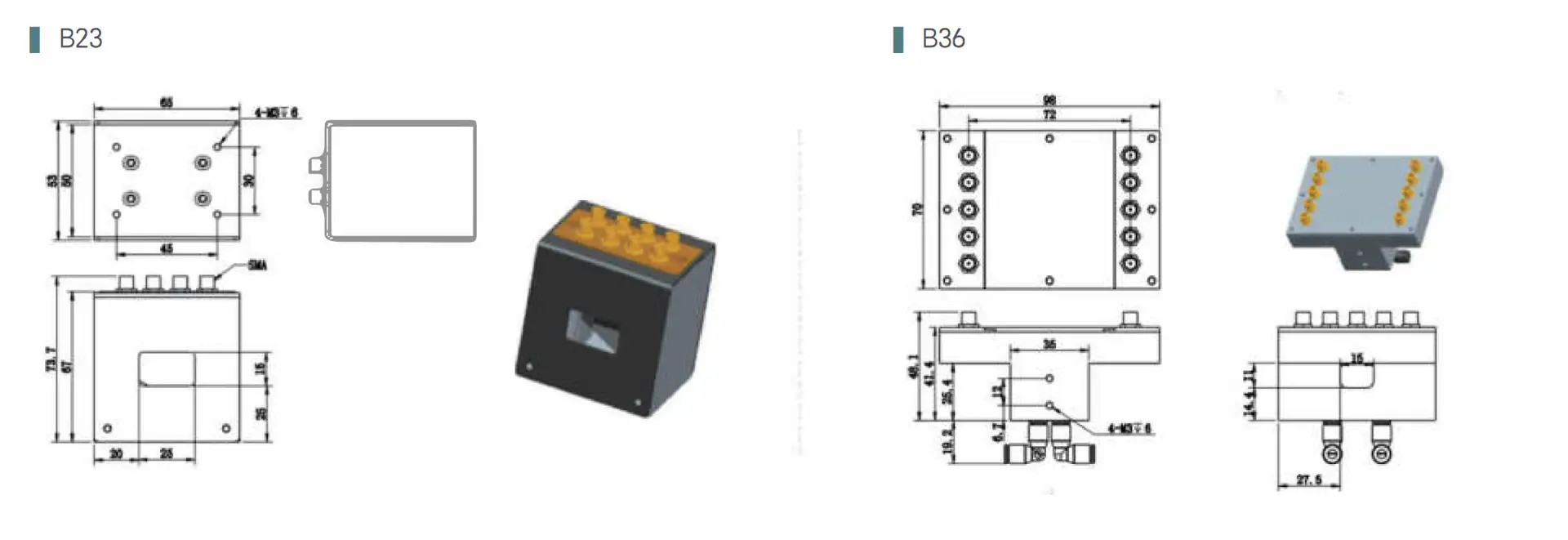
Housing Dimensions (mm)
- B23: 65 x 45 x 35 mm, optimized for compact multi-channel setups with reduced footprint.
- B36: 98 x 72 x 36 mm, ideal for systems requiring larger configurations and higher channel counts.