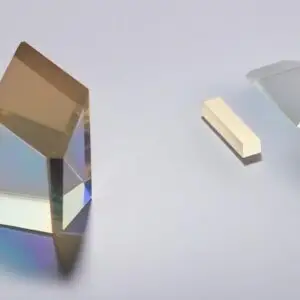
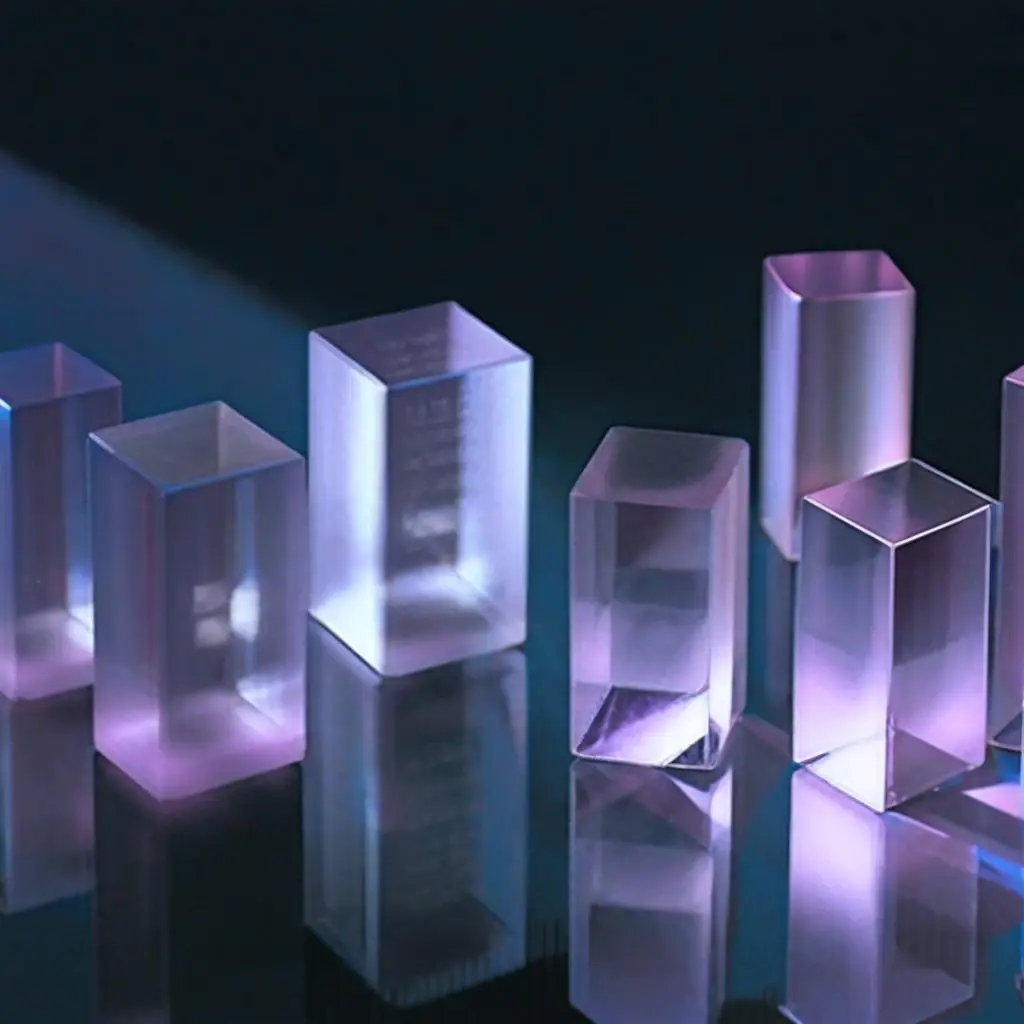
POC-OC-122467-a-BBO Crystal

  • Wide transparency range: 190 nm – 3500 nm.
  • High UV transmittance with low bulk absorption.
  • Large birefringence for optical applications.
  • High damage threshold: >1 GW/cm².
  • Stable physical and mechanical properties, ideal for high-power laser systems.

Customizable Components Available for This Material to Meet Your Specific Needs!

General Description

Alpha-Barium Borate (a-BBO, BaB2O4) is a negative uniaxial crystal with a broad transparency range extending from UV (190 nm) to IR (3500 nm). Its large birefringence and low absorption make it an excellent choice for UV and high-power laser applications. a-BBO is mechanically and thermally stable, offering advantages in environments requiring high durability. However, due to its central symmetry, a-BBO does not exhibit nonlinear optical properties and is not suitable for nonlinear laser operations.

a-BBO Crystal is widely used for optical elements like polarizers, wave plates, and other UV optical components, where birefringence and high transmission are essential.

General Applications and Examples

The a-BBO crystal serves critical roles in numerous high-precision and high-power optical applications, including:

  • Polarizers and Wave Plates: Ideal for use in UV polarizers and wave plates due to its wide transparency and birefringence.
  • Laser Systems: Functions effectively in high-power UV laser systems where high damage thresholds are critical.
  • Spectroscopic Instruments: a-BBO Crystal Suitable for UV and IR spectrometers, where high transmittance and low absorption are required.
  • Optical Communication Systems: Used in devices requiring stable birefringence for wavelength management and beam displacement.

Chemical and Structural Properties

PropertyValue
Crystal StructureTrigonal
Transparency Range190 nm – 3500 nm
Density3.85 g/cm³
Hygroscopic SusceptibilityLow
Mohs Hardness4.5
Thermal Expansion Coefficient-9.3 × 10^-6/°C (C-axis)
-9.5 × 10^-6/°C (A-axis)
Damage Threshold>1 GW/cm²
Refractive Indices (532 nm)nₑ = 1.6776, nₒ = 1.5534
Refractive Indices (1064 nm)nₑ = 1.6579, nₒ = 1.5379
Sellmeier Equation (A in μm)n² = 2.7471 + 0.01878/(λ² – 0.01822) – 0.01354λ²

Optical Properties

PropertyValue
BirefringenceHigh
UV Transmittance>90%
Refractive Index RangeVaries with wavelength
Damage Threshold>1 GW/cm² for high-power lasers
ApplicationsUV spectrometers, wave plates

Standard Fabrication Specifications

SpecificationValue
SizeAperture up to <50 mm and length up to 40 mm
Surface Quality10/5 to MIL-PRF-13830B
Flatness1/4 @ 633 nm
Optical Axis Orientation±6 arc min
Parallelism20 arc sec
Clear Aperture>90%

Spectrum Transmission Curve

The transparency curve highlights high UV transmittance across 190-3500 nm, with minimal absorption losses, making it suitable for UV and IR applications.
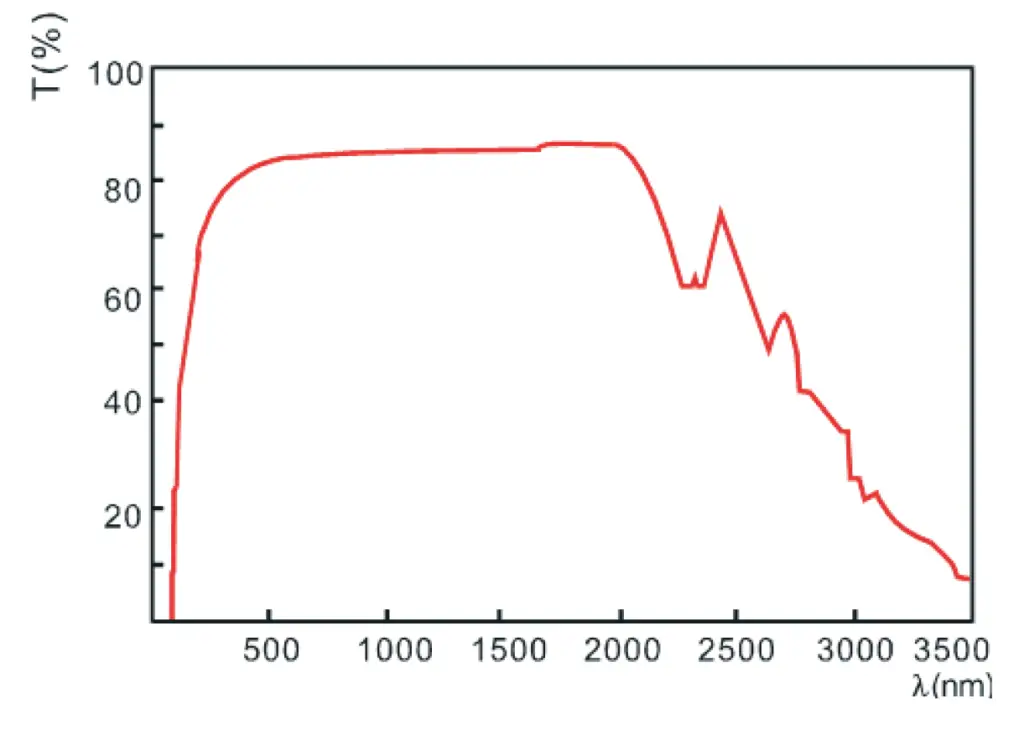
POC-BBO Crystal Spectrum Transmission Curve

Coating Specification

  • AR Coating: Available for UV and high-power laser applications.
  • Coating Quality: <0.2% reflection at specific wavelengths (e.g., 1064 nm, 532 nm).
  • Custom coating options available upon request.
  • Adhesion Test: Compliant with MIL-C-675C military standards, an adhesion test involved applying a tape that meets LT-90 specifications onto the lens film layer. The tape was affixed fully and then removed vertically. This procedure was performed three times, resulting in no blistering or peeling.
  • Temperature Test: In line with MIL-C-675C specifications, test pieces were subjected to temperatures of -62±1℃ and 71±1℃. After maintaining them at room temperature (16℃~32℃) for two hours, the adhesion test was repeated, confirming no film detachment.
  • Abrasion Resistance Test: Conforming to MIL-C-675C and CCC-C-440 standards, the abrasion resistance test involved a gauze tester applying a minimum force of 1.0 lbs (0.45 kg) to the film. This was repeated 25 times with gauze widths of 1/4 inch (6.4mm) and 3/8 inch (9.5mm), ensuring no damage occurred to the film surface.
  • Humidity Test: Under MIL-C-675C criteria, the test piece was placed in a controlled temperature and humidity chamber set to 49 ±2℃ and 95%~100% humidity for 24 hours. The film remained intact, with no peeling, scratches, or other defects.
  • Solvent and Cleaning Testing: Following MIL-C-675C specifications, test pieces were exposed to room temperature conditions (16℃~32℃) and tested with acetone and alcohol for at least 10 minutes each. After air drying and subsequent cleaning with a cotton cloth soaked in alcohol, the film surface showed no signs of peeling or scratches.
  • Salt Spray Test: After 100 hours in a 35°C environment with a 5% saltwater concentration, the film showed no signs of damage.
Face DimensionsLengthCoatingPrice (USD)
10 × 10 mm²20 mmAR-coated (UV)Request
20 × 20 mm²30 mmP-coated (532)Request
CustomCustomCustom CoatingsRequest
//body code