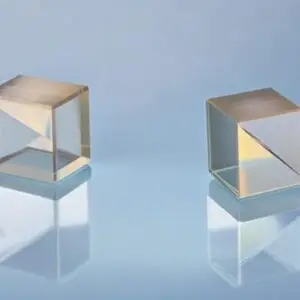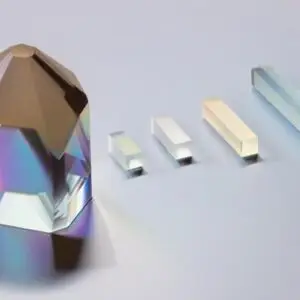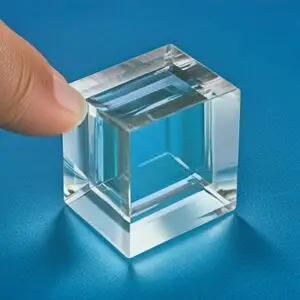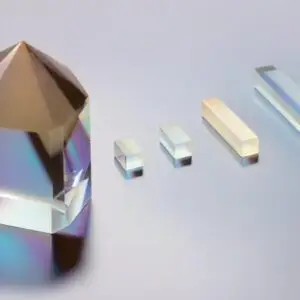
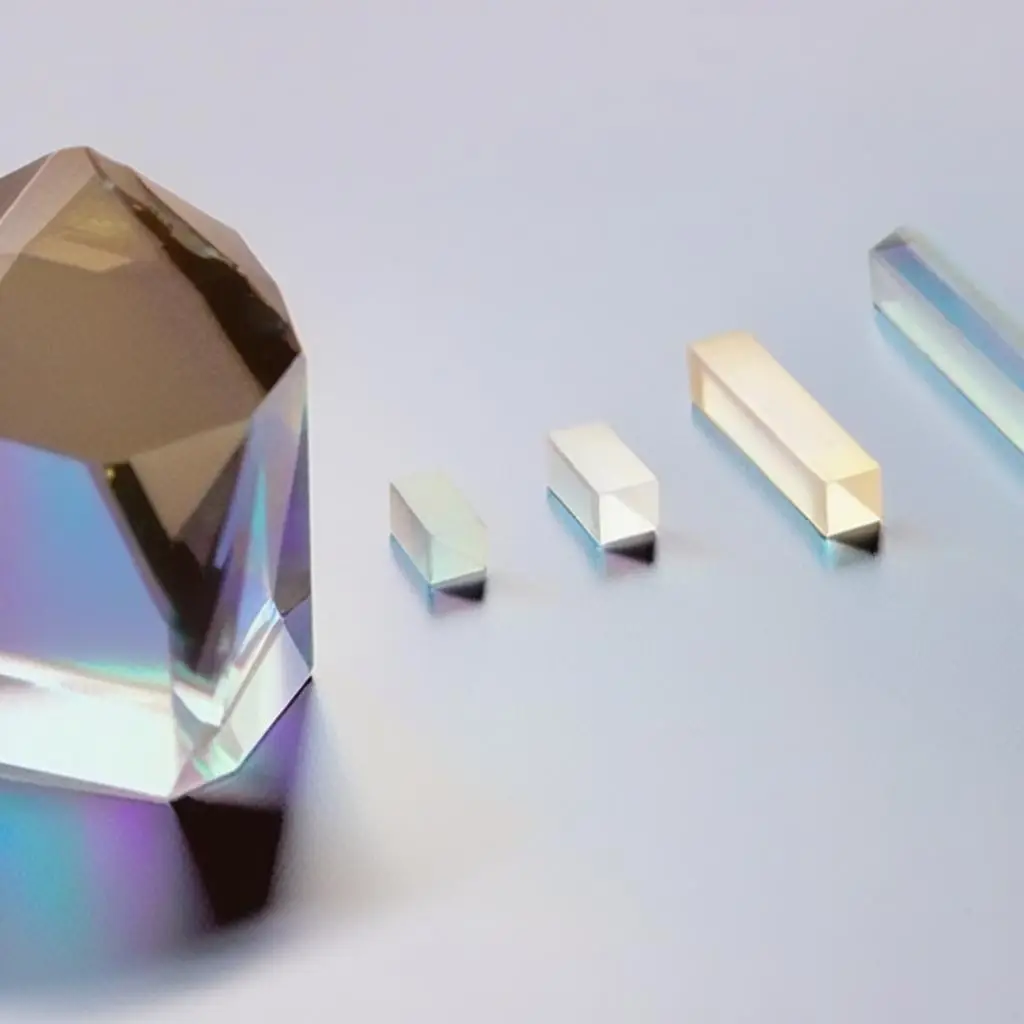
POC-OC-122506-Optical Grade Single Crystal Diamond Crystal

  • Exceptional ultraviolet-to-infrared transmission with negligible absorption.
  • Low scattering loss (less than 0.02% at 1064 nm) and outstanding optical clarity.
  • Low absorption coefficient with high purity (nitrogen content below 5 ppb).
  • Excellent thermal and mechanical stability, suitable for high-power laser applications.
  • Customizable sizes and shapes available upon request.

Customizable Components Available for This Material to Meet Your Specific Needs!

General Description

Single Crystal Diamond Crystal is synthesized using advanced chemical vapor deposition (CVD) techniques. These crystals are characterized by high optical transparency across a broad spectral range, from ultraviolet (UV) to far-infrared (IR). Due to their unique atomic arrangement and low defect density, they offer minimal scattering and absorption, making them ideal for precision optical applications. Single-crystal diamonds are produced with low nitrogen and other impurities, achieving superior optical clarity and thermal conductivity compared to conventional materials. Their low birefringence and high mechanical strength allow for usage in demanding environments, such as high-power laser systems or spectroscopy.

General Application and Examples

Single Crystal Diamond Crystals are extensively used in high-performance optical systems due to their unmatched optical properties:

  1. High-Power Laser Systems: Ideal as output couplers and laser windows due to their low absorption and high damage threshold.
  2. Infrared Optics: Highly suited for IR spectrometers, beam splitters, and lenses, offering minimal absorption at wavelengths up to 2.5 μm.
  3. UV Applications: Perfect for ultraviolet photonics due to high UV transmission and resistance to radiation damage.
  4. X-ray and Gamma-ray Detectors: Low absorption and high structural integrity make them suitable for extreme energy photon applications.
  5. High-Energy Optics: Excellent for precision machining, such as laser cutting and drilling systems.

Chemical and Structural Properties

PropertyValue
Crystal StructureCubic
Density3.52 g/cm³
Refractive Index (at 1 μm)2.38
Thermal Conductivity>2,000 W/m·K
Melting Point>4,000 °C
Absorption Coefficient<0.02 cm⁻¹ (at 1064 nm)
Transparency Range220 nm to 2.5 μm
Hardness10 (Mohs Scale)
Nitrogen Impurity Content<5 ppb

Optical Properties

Optical PropertyValue
Transmission Range225 nm to 2.5 μm
Absorption Coefficient<0.02 cm⁻¹
Scattering Loss<0.02%
Laser Damage Threshold>10 J/cm² (10 ns pulse at 1064 nm)
BirefringenceNegligible
Reflection LossMinimal with AR coating

Standard Fabrication Specifications

ParameterSpecification
Maximum SizeUp to 100 mm diameter
Surface Flatness<λ/10 @ 632.8 nm
Surface Roughness<5 nm RMS
Thickness Tolerance±0.02 mm
Parallelism<3 arcsec
Clear Aperture>90%

Spectrum Transmission Curve

The transmission curve showcases high transparency over a broad spectral range from 220 nm to 2.5 μm. Transmission efficiency exceeds 95% when an anti-reflective coating is applied, making it optimal for IR and UV applications.

Coating Specification

  • Available coatings: AR (anti-reflective) coatings for wavelengths ranging from 220 nm to 2.5 μm.
  • Coating Durability: Withstands high-power laser systems with no damage.
  • Adhesion Test: Compliant with MIL-C-675C military standards, an adhesion test involved applying a tape that meets LT-90 specifications onto the lens film layer. The tape was affixed fully and then removed vertically. This procedure was performed three times, resulting in no blistering or peeling.
  • Temperature Test: In line with MIL-C-675C specifications, test pieces were subjected to temperatures of -62±1℃ and 71±1℃. After maintaining them at room temperature (16℃~32℃) for two hours, the adhesion test was repeated, confirming no film detachment.
  • Abrasion Resistance Test: Conforming to MIL-C-675C and CCC-C-440 standards, the abrasion resistance test involved a gauze tester applying a minimum force of 1.0 lbs (0.45 kg) to the film. This was repeated 25 times with gauze widths of 1/4 inch (6.4mm) and 3/8 inch (9.5mm), ensuring no damage occurred to the film surface.
  • Humidity Test: Under MIL-C-675C criteria, the test piece was placed in a controlled temperature and humidity chamber set to 49 ±2℃ and 95%~100% humidity for 24 hours. The film remained intact, with no peeling, scratches, or other defects.
  • Solvent and Cleaning Testing: Following MIL-C-675C specifications, test pieces were exposed to room temperature conditions (16℃~32℃) and tested with acetone and alcohol for at least 10 minutes each. After air drying and subsequent cleaning with a cotton cloth soaked in alcohol, the film surface showed no signs of peeling or scratches.
  • Salt Spray Test: After 100 hours in a 35°C environment with a 5% saltwater concentration, the film showed no signs of damage.
Size (mm) Thickness (mm) Coating SKU Price (USD)
10 x 10 1 AR (220-2,500 nm) 1001 500
20 x 20 2 AR (220-2,500 nm) 1002 800
50 x 50 5 AR (220-2,500 nm) 1003 2,000
Custom Size Custom AR (optional) Upon Request Quote
//body code