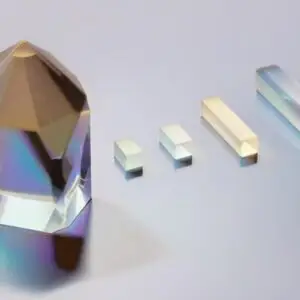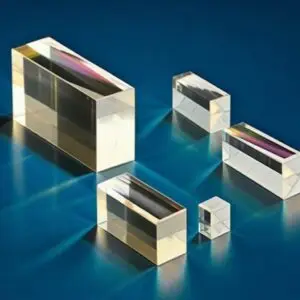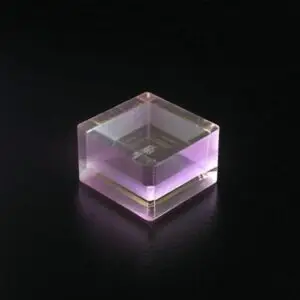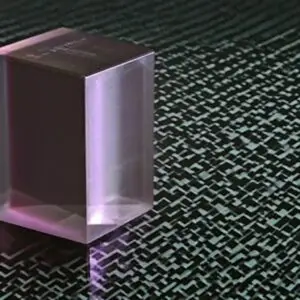
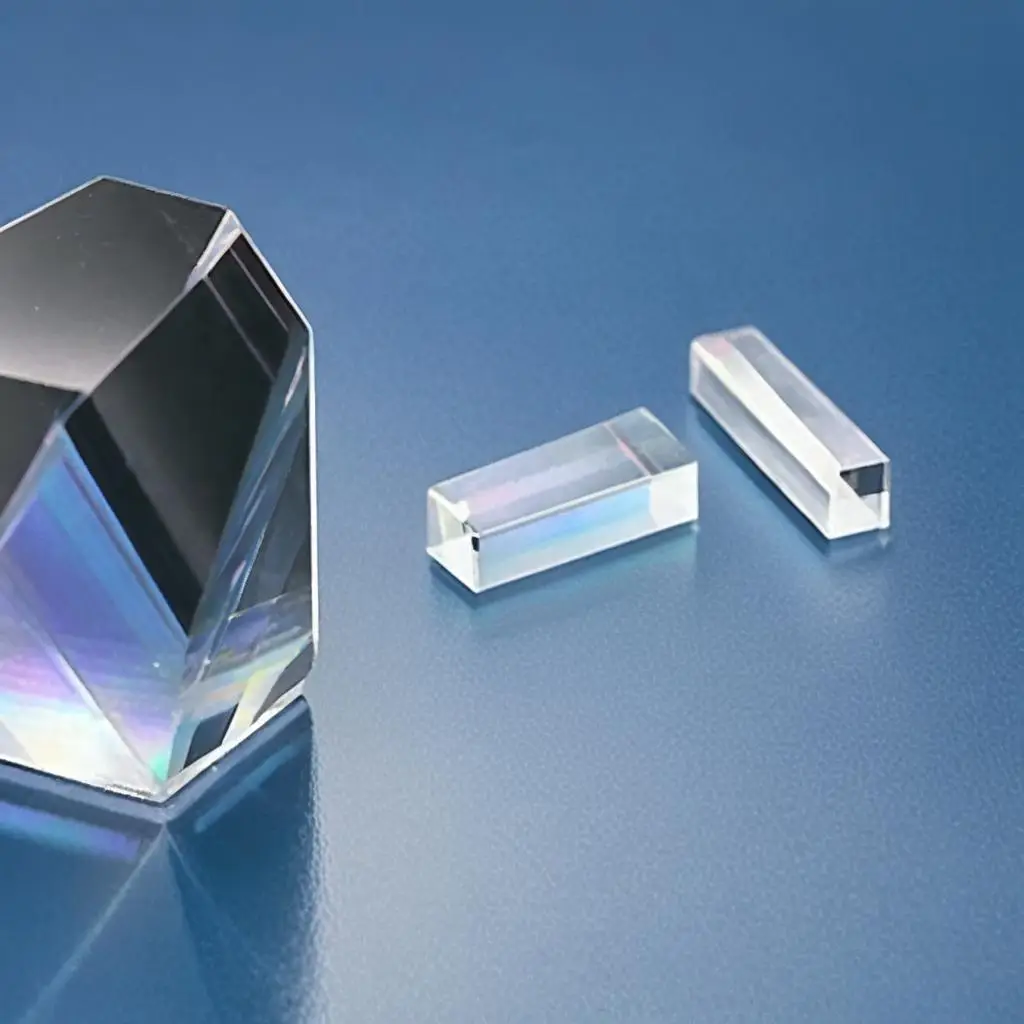
POC-OC-122427-Nd:GdVO4 Crystal

  1. High Stimulated Emission Cross-Section: Offers excellent lasing performance with a value of 7.6 × 10⁻¹⁹ cm² at 1064 nm.
  2. Efficient Energy Absorption: Higher absorption coefficient and broader bandwidth at the pump wavelength (~808 nm) compared to Nd:YVO4.
  3. Superior Thermal Properties: Provides better thermal conductivity and higher power output capabilities than Nd:YVO4 crystals.
  4. Low Lasing Threshold: Enables high slope efficiency for diode-pumped laser systems.
  5. Linearly Polarized Emission: Maintains polarization parallel to the optical axis, minimizing energy loss during lasing.

Customizable Components Available for This Material to Meet Your Specific Needs!

General Description

Neodymium Doped Gadolinium Orthovanadate (Nd:GdVO4) is a high-performance laser host crystal optimized for diode-pumped solid-state lasers (DPSSLs). Its excellent physical and optical properties make it a preferred material for high-power applications. Nd:GdVO4 offers a larger stimulated emission cross-section and higher energy absorption efficiency than Nd:YVO4, with better thermal management capabilities.

This crystal is particularly suitable for applications requiring high power density and efficient energy conversion. Its superior thermal conductivity supports continuous-wave and pulsed laser operations, enabling compact laser designs with high output stability. The uniaxial birefringence of Nd:GdVO4 ensures linearly polarized emission, making it highly effective for frequency doubling and nonlinear processes.

Nd:GdVO4 crystals are widely used in industries such as material processing, medical instrumentation, spectroscopy, and scientific research.

General Applications and Examples

Nd:GdVO4 crystals are versatile and widely used in high-performance laser systems. Some key examples include:

  1. Industrial Applications
  • Laser Cutting and Welding: High-power Nd:GdVO4 lasers enable precision machining of metals and non-metals.
  • Example: Nd:GdVO4 Crystal  Used in micro-machining and electronics manufacturing for intricate designs.
  1. Medical Applications
  • Laser Surgery and Diagnostics: Nd:GdVO4 Crystal  lasers operating at 1064 nm are ideal for soft tissue surgeries and non-invasive diagnostics.
  • Example: Compact laser systems are used in ophthalmic surgeries and dermatological treatments.
  1. Spectroscopy and Sensing
  • Material and Gas Analysis: Nd:GdVO4 Crystal  lasers are used in Raman spectroscopy and gas sensing for material characterization.
  • Example: Effective in detecting trace gases for environmental monitoring.
  1. Display Technology
  • Laser Projection Systems: Nd:GdVO4 lasers offer stable and vivid output for laser displays and projection systems.
  • Example: Commonly used in advanced imaging technologies for stage lighting and entertainment.
  1. Research and Development
  • Quantum Optics: NNd:GdVO4 Crystal  lasers serve as reliable sources for research in quantum mechanics and photon manipulation.
  • Example: Used in experiments requiring single-mode, stable, and high-power laser output.

Chemical and Structural Properties

PropertyValue
Crystal StructureZircon Tetragonal, Space Group D4h
Lattice Constantsa = b = 7.21 Å, c = 6.35 Å
Density5.47 g/cm³
Thermal Conductivity11.7 W/m·K (parallel to <110>)
Thermal Expansiona = 1.5 × 10⁻⁶ /K; c = 7.3 × 10⁻⁶ /K
Melting Point1780 °C
Refractive Index (1064 nm)nₒ = 1.972, nₑ = 2.192

Optical, Laser and Nonlinear Optical Properties

PropertyValue
Lasing Wavelengths1062.9 nm, 1341.3 nm
Stimulated Emission Cross-Section7.6 × 10⁻¹⁹ cm² at 1064 nm
Absorption Cross-Section (808 nm)4.9 × 10⁻¹⁹ cm²
Fluorescence Lifetime~95 µs (1.2% Nd doping)
Absorption Coefficient74 cm⁻¹ at 808 nm
Intrinsic Loss<0.1% at 1064 nm
Gain Bandwidth0.6 nm
Polarized Laser EmissionParallel to optical c-axis
Diode Pumped Efficiency>60%

Standard Fabrication Specifications

SpecificationValue
Dimension Tolerance±0.1 mm (standard); ±0.01 mm (high precision)
Clear ApertureCentral 90% of the diameter
Surface Quality20-10 Scratch-Dig
Surface Flatnessλ/8 at 633 nm
Parallelism<20 arc seconds
Perpendicularity<5 arc minutes
Chamfer0.1 mm at 45°
Damage Threshold>15 J/cm² (10 ns, 10 Hz at 1064 nm)

Spectrum Transmission Curve

Nd:GdVO4 crystals exhibit high transparency in the visible and infrared ranges, with strong absorption at 808 nm and peak lasing performance at 1064 nm. Their high absorption coefficient enables efficient diode pumping.(Graphical transmission curves can be provided upon request.)

Coating Specification

Coating TypeSpecifications
AR CoatingR < 0.2% at 808 nm; R < 0.1% at 1064 nm
Custom CoatingsAvailable upon request
  • Adhesion Test: Compliant with MIL-C-675C military standards, an adhesion test involved applying a tape that meets LT-90 specifications onto the lens film layer. The tape was affixed fully and then removed vertically. This procedure was performed three times, resulting in no blistering or peeling.
  • Temperature Test: In line with MIL-C-675C specifications, test pieces were subjected to temperatures of -62±1℃ and 71±1℃. After maintaining them at room temperature (16℃~32℃) for two hours, the adhesion test was repeated, confirming no film detachment.
  • Abrasion Resistance Test: Conforming to MIL-C-675C and CCC-C-440 standards, the abrasion resistance test involved a gauze tester applying a minimum force of 1.0 lbs (0.45 kg) to the film. This was repeated 25 times with gauze widths of 1/4 inch (6.4mm) and 3/8 inch (9.5mm), ensuring no damage occurred to the film surface.
  • Humidity Test: Under MIL-C-675C criteria, the test piece was placed in a controlled temperature and humidity chamber set to 49 ±2℃ and 95%~100% humidity for 24 hours. The film remained intact, with no peeling, scratches, or other defects.
  • Solvent and Cleaning Testing: Following MIL-C-675C specifications, test pieces were exposed to room temperature conditions (16℃~32℃) and tested with acetone and alcohol for at least 10 minutes each. After air drying and subsequent cleaning with a cotton cloth soaked in alcohol, the film surface showed no signs of peeling or scratches.
  • Salt Spray Test: After 100 hours in a 35°C environment with a 5% saltwater concentration, the film showed no signs of damage.
Product CodeDimensions (mm)Doping Level (Nd)CoatingPrice (USD)
NDGDVO4-013 × 3 × 0.51.0%AR @ 808 nm / 1064 nmRequest Quote
NDGDVO4-026 × 6 × 11.0%CustomizableRequest Quote
NDGDVO4-0310 × 10 × 20.5%CustomizableRequest Quote
Custom-NDGDVO4CustomizableCustomizableCustomizableRequest Quote
//body code