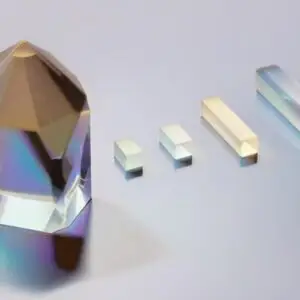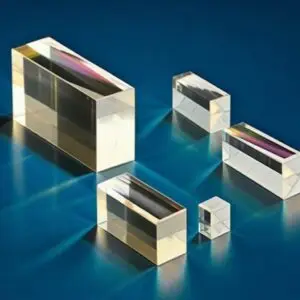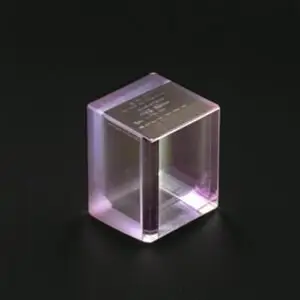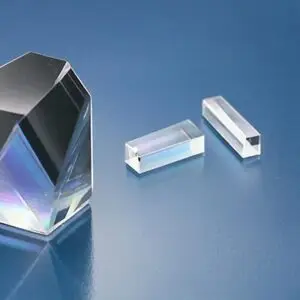
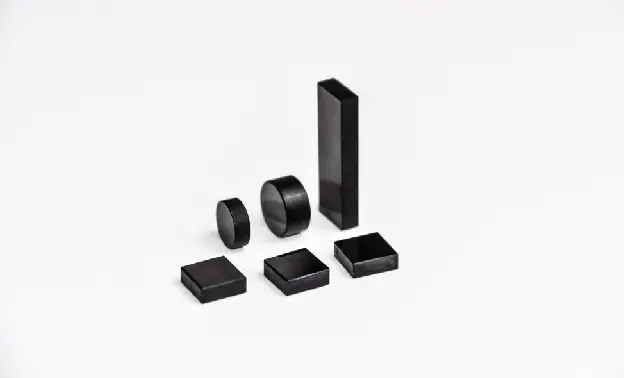
Cr⁴⁺:YAG Crystal is an advanced material designed for passive Q-switching in solid-state lasers, such as Nd:YAG, Nd:YLF, and Nd:YVO₄. Its cubic garnet structure ensures durability, high thermal conductivity, and excellent damage threshold. Cr4+:YAG Crystal can efficiently operate without active electronic components, reducing system complexity and cost.
Photonics On Crystals provides Cr⁴⁺:YAG crystals with doping levels between 0.03 and 0.05 mol%. Available sizes range from 2 × 2 mm² to 14 × 14 mm² with lengths from 0.1 mm to 12 mm. Initial transmission can be tailored from 10% to 92% per customer requirements.
Cr⁴⁺:YAG crystals are widely used for passive Q-switching, enabling compact laser designs for high-energy pulse generation. Examples include:
| Property | Specification |
|---|---|
| Chemical Formula | Cr⁴⁺:Y₃Al₅O₁₂ |
| Crystal Structure | Cubic Garnet |
| Dopant Concentration | 0.03–0.05 mol% |
| Mohs Hardness | 8.5 |
| Refractive Index | 1.82 at 1064 nm |
| Damage Threshold | >500 MW/cm² at 1064 nm |
| Melting Point | 1970°C |
| Property | Value |
|---|---|
| Transmission Range | 950–1200 nm |
| Refractive Index (1064 nm) | 1.82 |
| Damage Threshold | >500 MW/cm² |
| Ground-State Absorption (σₐ) | 4.4 × 10⁻¹⁹ cm² at 1064 nm |
| Emission Cross-Section (σₑ) | 8.2 × 10⁻²⁰ cm² at 1064 nm |
| Recovery Time (τ) | 3.4 µs |
| Specification | Value |
|---|---|
| Dimensions | 3 × 3 mm² to 20 × 20 mm² |
| Length | 0.1 mm to 12 mm |
| Dimensional Tolerance | ±0.05 mm |
| Surface Flatness | < λ/10 @ 632 nm |
| Parallelism | <20 arc seconds |
| Perpendicularity | <15 arc minutes |
| Surface Quality (Scratch/Dig) | 20–10 |
Cr⁴⁺:YAG exhibits a wide absorption band extending from 950 to 1200 nm with prominent peaks around 1020–1070 nm. The material is optimized for high-energy Nd and Yb laser pumping.
AR Coating (1064 nm): Reflection <0.2%
Dual AR Coating: Reflection optimized for 1064 and 1070 nm
Adhesion Test: Compliant with MIL-C-675C military standards, an adhesion test involved applying a tape that meets LT-90 specifications onto the lens film layer. The tape was affixed fully and then removed vertically. This procedure was performed three times, resulting in no blistering or peeling.
Temperature Test: In line with MIL-C-675C specifications, test pieces were subjected to temperatures of -62±1℃ and 71±1℃. After maintaining them at room temperature (16℃~32℃) for two hours, the adhesion test was repeated, confirming no film detachment.
Abrasion Resistance Test: Conforming to MIL-C-675C and CCC-C-440 standards, the abrasion resistance test involved a gauze tester applying a minimum force of 1.0 lbs (0.45 kg) to the film. This was repeated 25 times with gauze widths of 1/4 inch (6.4mm) and 3/8 inch (9.5mm), ensuring no damage occurred to the film surface.
Humidity Test: Under MIL-C-675C criteria, the test piece was placed in a controlled temperature and humidity chamber set to 49 ±2℃ and 95%~100% humidity for 24 hours. The film remained intact, with no peeling, scratches, or other defects.
Solvent and Cleaning Testing: Following MIL-C-675C specifications, test pieces were exposed to room temperature conditions (16℃~32℃) and tested with acetone and alcohol for at least 10 minutes each. After air drying and subsequent cleaning with a cotton cloth soaked in alcohol, the film surface showed no signs of peeling or scratches.
Salt Spray Test: After 100 hours in a 35°C environment with a 5% saltwater concentration, the film showed no signs of damage.
| Face Dimensions | Initial Transmission | Coating | SKU | Price (USD) |
|---|---|---|---|---|
| 6 × 6 mm² | 10% | AR @1064 nm | 7201 | $220 |
| 6 × 6 mm² | 50% | AR @1064 nm | 7202 | $230 |
| 6 × 6 mm² | 90% | AR @1064 nm | 7203 | $240 |
| 3 × 3 mm² | 50% | Dual AR Coating | 7210 | $210 |
| Custom Dimensions | Custom | Custom Coating | Custom | Request Quote |