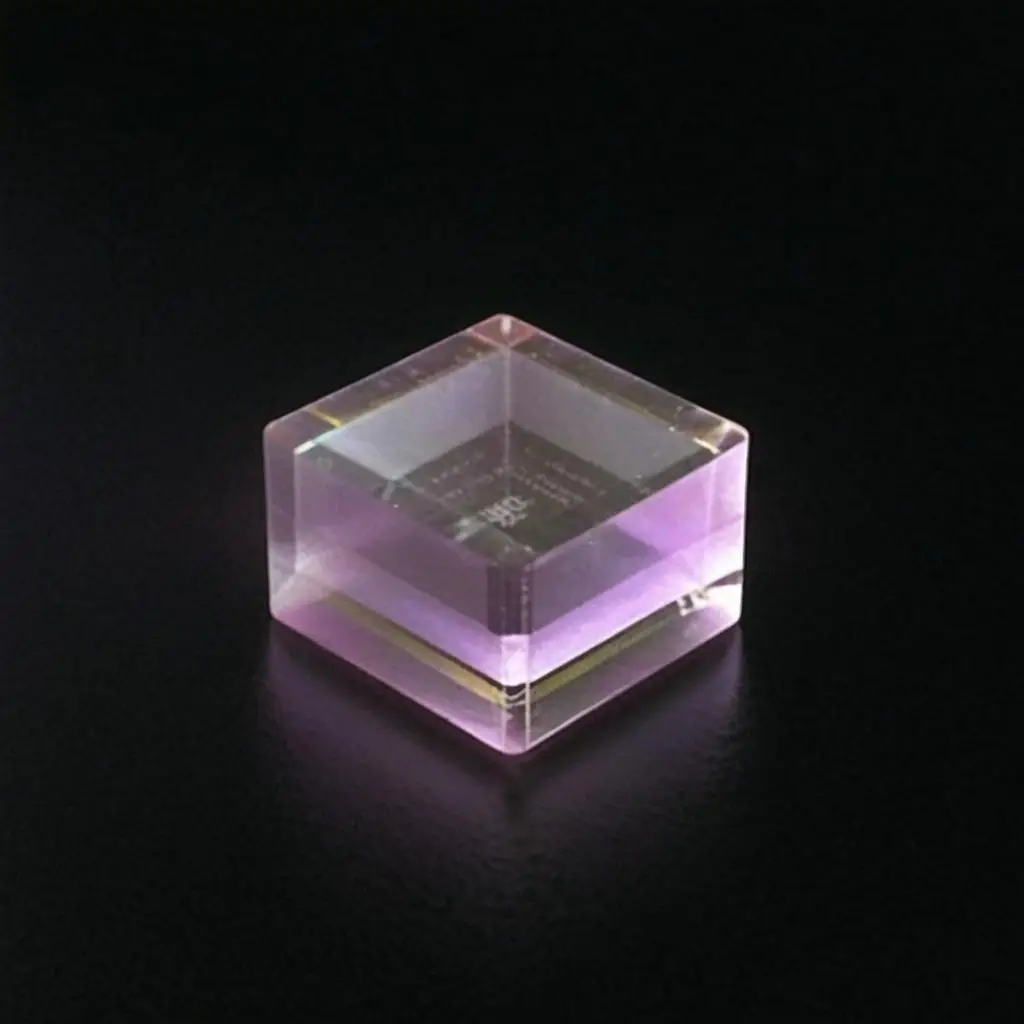
POC-OC-122437-Er:YAG Crystal

  • Exceptional slope efficiency and stable room-temperature operation.
  • Strong absorption at the hydroxyl absorption peak (2940 nm).
  • High emission cross-section supporting efficient laser operation.
  • Robust isotropic crystal structure with high thermal conductivity.
  • Ideal for applications in the eye-safe wavelength range.

Customizable Components Available for This Material to Meet Your Specific Needs!

General Description

Er:YAG Crystal (Erbium-doped Yttrium Aluminum Garnet) crystals are renowned for their robust performance in laser systems operating in the near-infrared spectrum, particularly at the 2940 nm wavelength. This wavelength corresponds to the hydroxyl absorption peak, allowing excellent absorption in biological tissues, making Er:YAG Crystal a preferred choice for medical, dental, and surgical laser applications. The cubic symmetry and high thermal conductivity make it thermally stable and highly reliable. The crystals are manufactured to deliver high optical quality and are suitable for both continuous-wave (CW) and pulsed operations, maintaining stable performance even under high thermal loads.

General Applications

Er:YAG Crystals have diverse applications across multiple fields:

1. Medical and Dental Applications

  • Efficient at 2940 nm, suitable for cutting and ablating hard tissues like bone and teeth in dentistry and orthopedics.
  • Eye-safe wavelengths enable use in non-invasive surgery.

2. Industrial Applications

  • High-energy pulses from Er:YAG Crystal  are ideal for material processing, engraving, and thin-film ablation.

3. Military and Remote Sensing

  • Eye-safe wavelengths are ideal for military applications such as rangefinders and LiDAR systems.
  • Low thermal load and high stability make them useful in rugged environments.

Examples

  • Hard tissue ablation (dental surgery, orthopedics).
  • Non-invasive laser treatment for skin rejuvenation.
  • High-precision cutting in industrial applications

Chemical and Structural Properties

PropertyValue
Chemical FormulaEr:Y3Al5O12
Crystal StructureCubic Garnet
Dopant ConcentrationEr: 50 at.%
Density4.56 g/cm³
Refractive Index1.79 (at 2940 nm)
Melting Point1970°C
Mohs Hardness8.5
Thermal Conductivity13 W/m·K (at 1064 nm)
Thermal Expansion Coefficient7.8 × 10^-6 /K
Damage Threshold>500 MW/cm² (1064 nm, 10 ns, 10 Hz)

Optical, Laser and Nonlinear Optical Properties

Optical ParameterValue
Laser Wavelength2940 nm
Photon Energy6.75 × 10^-20 J
Emission Cross Section3 × 10^-20 cm²
Refractive Index1.79 (at 2940 nm)
Pump Bands600-800 nm
Lifetime of Er Energy Level6.0 ms
Absorption Peaks960, 1470, 1532 nm

Standard Fabrication Specifications

ParameterValue
Rod DimensionsDiameter: 3-6 mm; Length: 50-120 mm
Surface Quality10/5 Scratch/Dig
Wavefront Distortion< λ/8 @ 633 nm
Flatnessλ/10 @ 633 nm
Parallelism20 arc sec
Perpendicularity15 arc min
Chamfer0.2 mm × 45°
AR CoatingR < 0.2% @ 2940 nm

Spectrum Transmission Curve

For 2940 nm, Er:YAG demonstrates strong absorption near the hydroxyl peak and a broad emission spectrum. Customized absorption and emission curves are available upon request to optimize for specific applications.
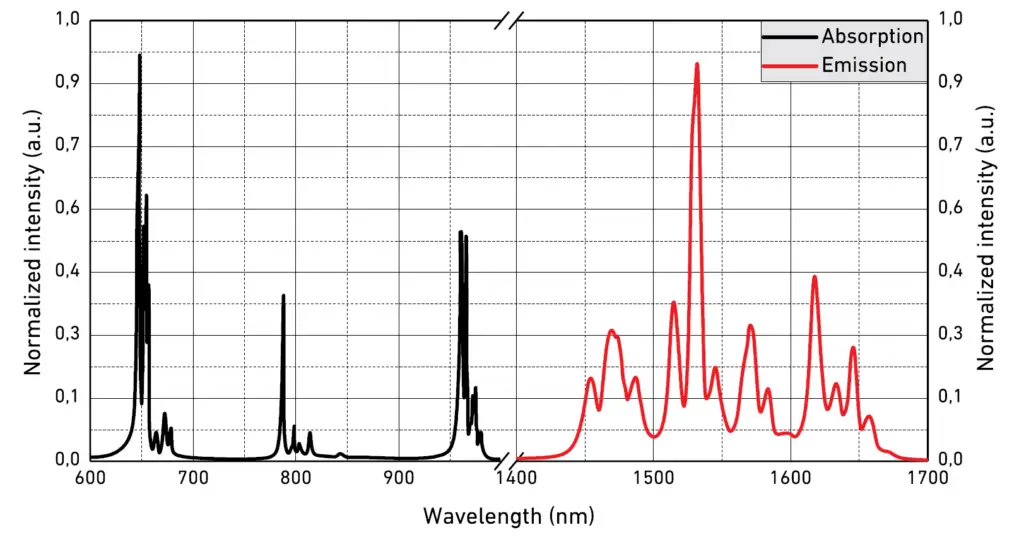
POC-Er YAG Crystal Spectrum Absorption and emission Curve

Coating Specification

  • AR Coating: Anti-reflective coating at 2940 nm with reflectivity R < 0.2%.
  • Custom coatings available upon request.
  • Adhesion Test: Compliant with MIL-C-675C military standards, an adhesion test involved applying a tape that meets LT-90 specifications onto the lens film layer. The tape was affixed fully and then removed vertically. This procedure was performed three times, resulting in no blistering or peeling.
  • Temperature Test: In line with MIL-C-675C specifications, test pieces were subjected to temperatures of -62±1℃ and 71±1℃. After maintaining them at room temperature (16℃~32℃) for two hours, the adhesion test was repeated, confirming no film detachment.
  • Abrasion Resistance Test: Conforming to MIL-C-675C and CCC-C-440 standards, the abrasion resistance test involved a gauze tester applying a minimum force of 1.0 lbs (0.45 kg) to the film. This was repeated 25 times with gauze widths of 1/4 inch (6.4mm) and 3/8 inch (9.5mm), ensuring no damage occurred to the film surface.
  • Humidity Test: Under MIL-C-675C criteria, the test piece was placed in a controlled temperature and humidity chamber set to 49 ±2℃ and 95%~100% humidity for 24 hours. The film remained intact, with no peeling, scratches, or other defects.
  • Solvent and Cleaning Testing: Following MIL-C-675C specifications, test pieces were exposed to room temperature conditions (16℃~32℃) and tested with acetone and alcohol for at least 10 minutes each. After air drying and subsequent cleaning with a cotton cloth soaked in alcohol, the film surface showed no signs of peeling or scratches.
  • Salt Spray Test: After 100 hours in a 35°C environment with a 5% saltwater concentration, the film showed no signs of damage.
Face DimensionsLengthEnd FacesDopingCoatingsPrice (USD)
5 × 5 mm3 mmBrewster-angle cut0.15%UncoatedRequest
5 × 5 mm2 mmBrewster-angle cut50%Uncoated500
CustomizationAs requiredUpon requestUp to 50%Custom coatingsOn Request

//body code