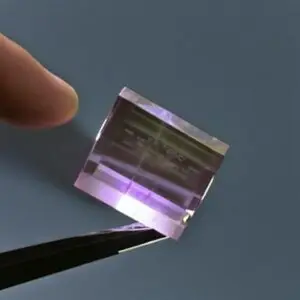
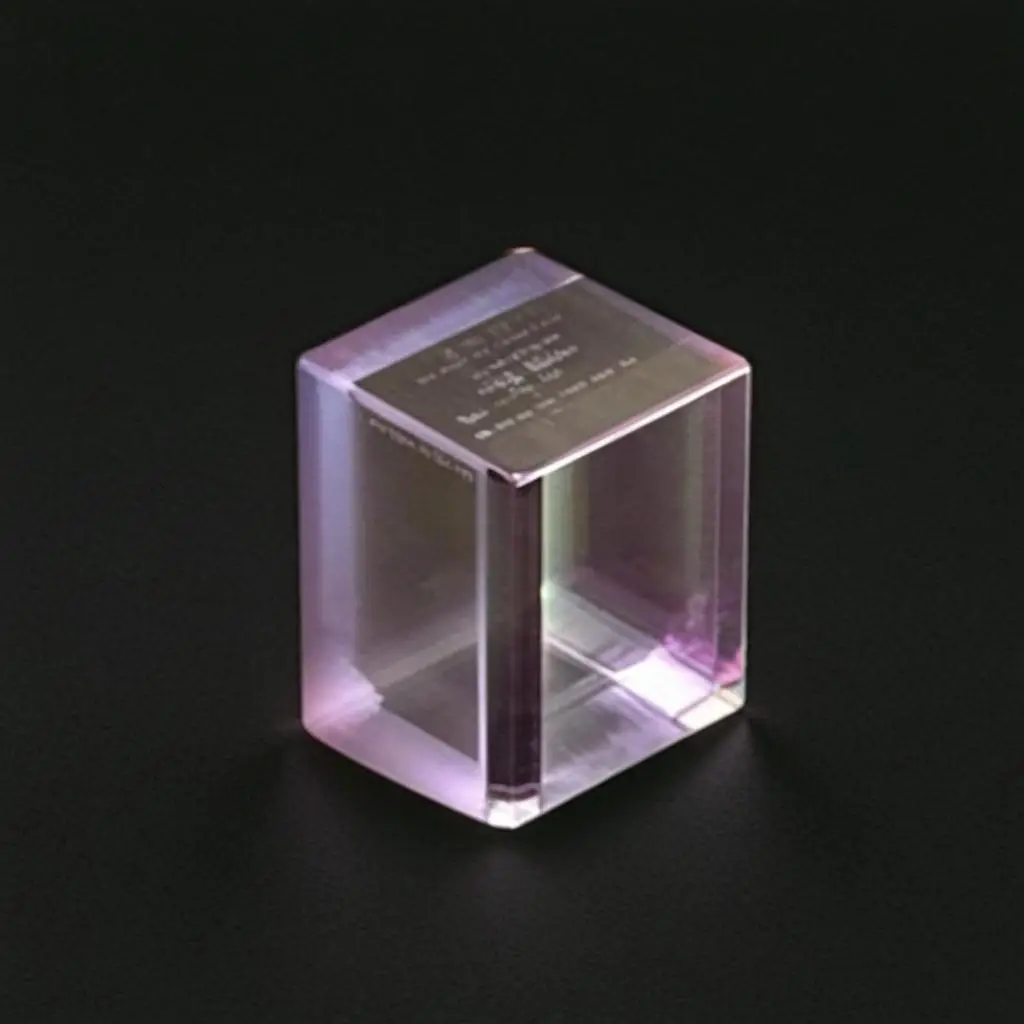
POC-OC-122442-Ti:Sapphire Crystal

  • Wide tunable wavelength range from 660 to 1050 nm for versatile laser applications.
  • High thermal conductivity of 52 W/mK ensuring excellent heat dissipation.
  • Strong laser gain with a high fluorescence lifetime of 3.2 μs at 300 K.
  • Robust optical and mechanical properties with a high damage threshold.
  • Applicable in femtosecond lasers, ultrashort-pulse generation, and regenerative amplifiers.

Customizable Components Available for This Material to Meet Your Specific Needs!

General Description

Ti:Sapphire Crystal (Ti³⁺:Al₂O₃) is a titanium-doped sapphire material known for its tunability and high optical gain. It is extensively used in femtosecond mode-locked oscillators and amplifiers, enabling ultrashort pulse generation below 10 fs. Its high thermal conductivity and superior mechanical strength make it suitable for high-power laser applications. Grown using the Temperature Gradient Technique (TGT), the crystal is free of scattering and dislocations, ensuring premium optical quality and high damage thresholds. The absorption band of Ti:Sapphire, centered at 490 nm, allows efficient pumping by Nd:YAG, Nd:YLF, and Nd:YVO₄ lasers.

General Applications and Examples

  • Mode-Locked Oscillators and Amplifiers: Ti:Sapphire is the preferred crystal for ultrafast pulse lasers used in applications such as time-resolved spectroscopy, optical coherence tomography, and frequency comb generation.
  • Tunable Lasers: The broad tuning range from 660 to 1050 nm makes it an excellent choice for spectroscopy, material processing, and nonlinear optics.
  • Ultrafast Pulsed Lasers: Doubling with NLO crystals like BBO, it produces UV and DUV radiation for advanced scientific research and micromachining.
  • Medical Imaging: Used in biomedical imaging systems such as multiphoton microscopy.
  • Scientific Research: Ti:Sapphire Crystal As a pump source for Optical Parametric Oscillators (OPOs), Ti:Sapphire facilitates a wide range of experiments requiring tunable wavelengths and high power outputs.

Chemial and Structural Properties

PropertyValue
Chemical FormulaTi³⁺:Al₂O₃
Crystal StructureHexagonal
Lattice Parametersa=4.758 Å, c=12.991 Å
Density3.98 g/cm³
Melting Point2040°C
Mohs Hardness9
Thermal Conductivity52 W/mK
Specific Heat0.42 J/g·K
Thermal Expansion8.4 × 10⁻⁶/°C

Optical, Laser and Nonlinear Optical Properties

PropertyValue
Tuning Range660 – 1050 nm
Absorption Range400 – 600 nm
Absorption Peak488 nm
Emission Peak795 nm
Fluorescence Lifetime3.2 μs (T = 300 K)
Refractive Index1.76 @800 nm
Laser Action4-Level Vibronic
Peak Cross-Section3–4 × 10⁻¹⁹ cm²

Standard Fabrication Specifications

ParameterSpecification
Dopant Concentration0.06 – 0.26 atm%
Diameter2 – 30 mm
Length2 – 30 mm
Surface Quality (Scratch/Dig)40/20 to MIL-PRF-13830B
Flatnessλ/8 @633 nm
Wavefront Distortionλ/4 @633 nm
Parallelism<20 arc sec
Perpendicularity<15 arc min
Chamfer0.1 mm × 45°

Spectrum Transmission Curve

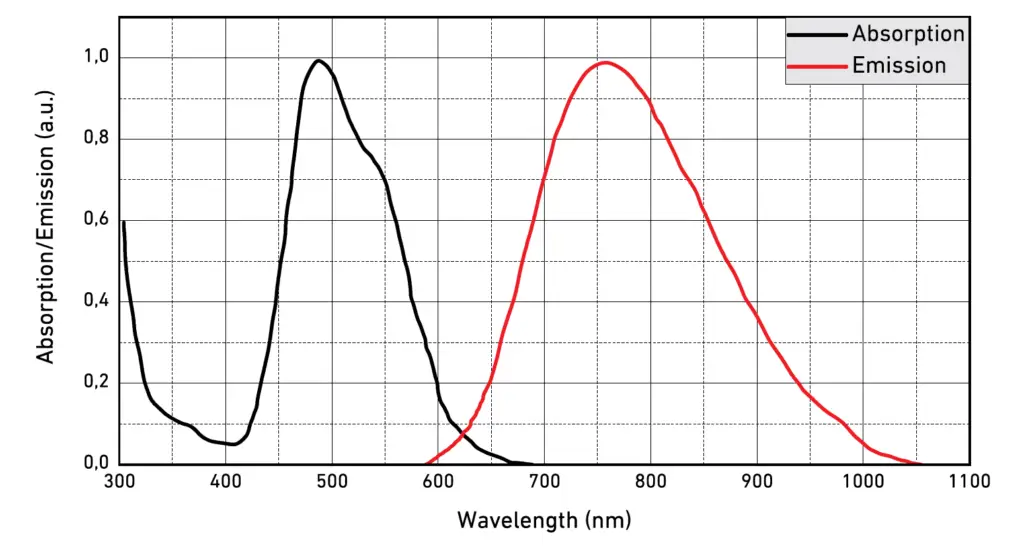
POC-TI Sapphire Crystal Spectrum Transmission Curve

Absorption and emission spectra confirm strong peaks at 488 nm and 795 nm, respectively, with broad tunability.

Coating Specification

  • AR-Coating: Available upon request for specified wavelengths (e.g., 532 nm, 750–850 nm).
  • Custom Coatings: Options for tailored coatings depending on application requirements.
  • Adhesion Test: Compliant with MIL-C-675C military standards, an adhesion test involved applying a tape that meets LT-90 specifications onto the lens film layer. The tape was affixed fully and then removed vertically. This procedure was performed three times, resulting in no blistering or peeling.
  • Temperature Test: In line with MIL-C-675C specifications, test pieces were subjected to temperatures of -62±1℃ and 71±1℃. After maintaining them at room temperature (16℃~32℃) for two hours, the adhesion test was repeated, confirming no film detachment.
  • Abrasion Resistance Test: Conforming to MIL-C-675C and CCC-C-440 standards, the abrasion resistance test involved a gauze tester applying a minimum force of 1.0 lbs (0.45 kg) to the film. This was repeated 25 times with gauze widths of 1/4 inch (6.4mm) and 3/8 inch (9.5mm), ensuring no damage occurred to the film surface.
  • Humidity Test: Under MIL-C-675C criteria, the test piece was placed in a controlled temperature and humidity chamber set to 49 ±2℃ and 95%~100% humidity for 24 hours. The film remained intact, with no peeling, scratches, or other defects.
  • Solvent and Cleaning Testing: Following MIL-C-675C specifications, test pieces were exposed to room temperature conditions (16℃~32℃) and tested with acetone and alcohol for at least 10 minutes each. After air drying and subsequent cleaning with a cotton cloth soaked in alcohol, the film surface showed no signs of peeling or scratches.
  • Salt Spray Test: After 100 hours in a 35°C environment with a 5% saltwater concentration, the film showed no signs of damage.
Face DimensionsLengthEnd FacesCoatingsPrice (USD)
3 × 3 mm5 mmBrewster-angle cutUncoated$880
3 × 3 mm5 mmRight-angle cutAR@532 nm + 750–850 nm$600
6 × 6 mm15 mmBrewster-angle cutUncoated$1000
12 × 12 mm25 mmRight-angle cutAR@532 nm + 750–850 nm$2150
50 × 50 mm30 mmRight-angle cutCustom Coating Options AvailableRequest Quote

//body code