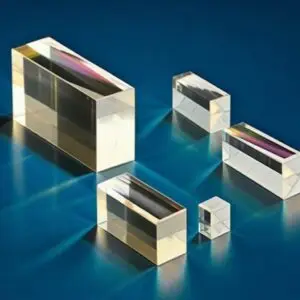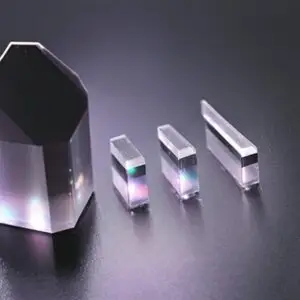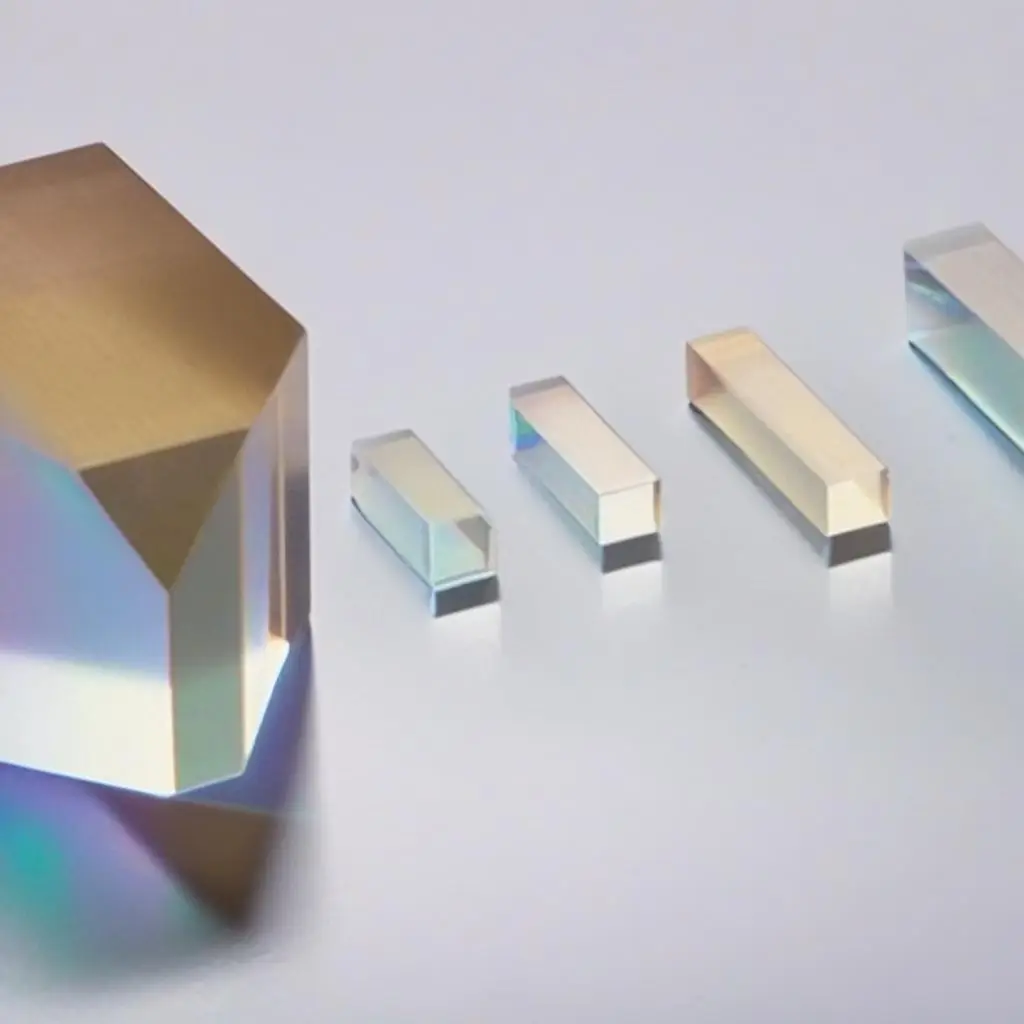
POC-OC-122444-Pr:YLF Crystal

  • High absorption and emission cross-sections (~10^-19 cm²).
  • Exceptional overlap with InGaN laser diode and 2ω-OPSL emission lines.
  • Customizable configurations available upon request.
  • Excellent thermal and mechanical stability for high-power applications.
  • Wide emission range for visible and UV lasers.

Customizable Components Available for This Material to Meet Your Specific Needs!

General Description

Praseodymium-doped Lithium Yttrium Fluoride (Pr:YLF) crystal is a robust and versatile material for producing visible solid-state lasers. With its high absorption cross-section in the blue spectral region and overlapping emission lines of InGaN diodes, Pr:YLF  is widely used for both research and industrial applications. The material features excellent thermal conductivity and a tetragonal structure, providing stability under high-power operations. The unique energy level transitions of Pr³⁺ allow generation of red, orange, green, and blue lasers, making it ideal for multicolor and high-intensity laser systems.

General Applications and Examples

Pr:YLF crystals are essential for diode-pumped solid-state lasers and have a broad spectrum of applications, such as:

  • Industrial Applications: Efficient processing of metals like copper or gold, precision machining, and material marking.
  • Scientific Research: Generation of multicolor lasers for spectroscopy and imaging.
  • Entertainment: Laser shows with visible colors from red to blue.
  • Medical Technology: High-precision laser tools for diagnostics and surgery.
  • UV Laser Generation: Pr:YLF supports second harmonic generation (SHG) to produce ultraviolet laser light.

Pr:YLF crystals are particularly advantageous for lasing in the visible spectrum, with transitions at:

  • Red: 640 nm
  • Orange: 607 nm
  • Green: 523 nm
  • Blue: 480 nm

These unique properties make Pr:YLF Crystal  indispensable for visible laser generation directly from solid-state systems.

Chemical and Structural Properties

Property Value
Chemical Formula Pr³⁺:LiYF₄
Crystal Structure Tetragonal
Refractive Index (at 1064 nm) n_o = 1.448, n_e = 1.470
Density 3.95 g/cm³
Mohs Hardness 5
Thermal Conductivity 6 W/m·K
Thermal Expansion Coefficient -1.6 x 10^-6 /K
Typical Doping Level <1.3%

Optical, Laser and Nonlinear Optical Properties

Parameter Value
Absorption Peak Wavelength 444 nm
Absorption Cross-section 8 x 10^-19 cm²
Absorption Bandwidth ~5 nm
Emission Wavelengths 523 nm, 607 nm, 640 nm
Emission Cross-section 20 x 10^-19 cm²
Fluorescence Lifetime 50 µs

Standard Fabrication Specifications

Specification Value
Orientation c-cut
Clear Aperture >90%
Face Dimensions Tolerance +0.0/-0.1 mm
Length Tolerance ±0.1 mm
Surface Quality (Scratch/Dig) 20-10
Surface Flatness λ/8 @ 633 nm
Parallelism Error <20 arcsec
Perpendicularity Error <10 arcmin
Chamfer <0.1 mm at 45°
Laser Damage Threshold >5 J/cm² @ 532 nm, 10 ns

Spectrum Transmission Curve

The  transmission spectrum is available, showing high absorption and emission peaks at visible wavelengths, particularly in the red, green, and blue regions. This curve confirms the crystal’s efficiency for multicolor laser operations.
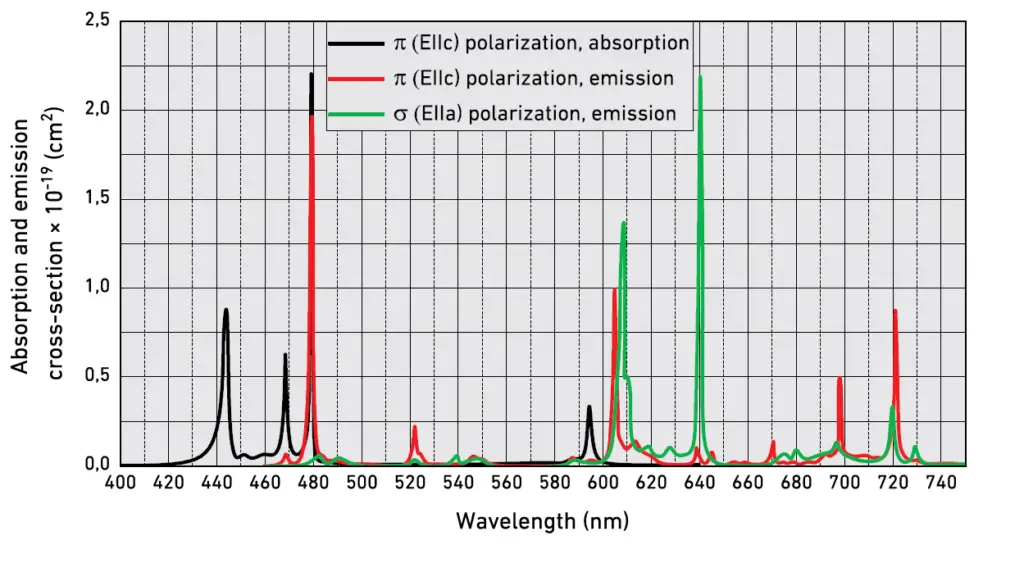
POC-Pr YLF Crystal Spectrum Transmission Curve

Coating Specification

  • Standard Coatings:
    • AR coating for 444-725 nm on both faces.
    • Reflectivity: <0.2% across the operational wavelength range.
  • Custom Coatings: Available upon request for optimized performance in specific applications.


  • Adhesion Test: Compliant with MIL-C-675C military standards, an adhesion test involved applying a tape that meets LT-90 specifications onto the lens film layer. The tape was affixed fully and then removed vertically. This procedure was performed three times, resulting in no blistering or peeling.
  • Temperature Test: In line with MIL-C-675C specifications, test pieces were subjected to temperatures of -62±1℃ and 71±1℃. After maintaining them at room temperature (16℃~32℃) for two hours, the adhesion test was repeated, confirming no film detachment.
  • Abrasion Resistance Test: Conforming to MIL-C-675C and CCC-C-440 standards, the abrasion resistance test involved a gauze tester applying a minimum force of 1.0 lbs (0.45 kg) to the film. This was repeated 25 times with gauze widths of 1/4 inch (6.4mm) and 3/8 inch (9.5mm), ensuring no damage occurred to the film surface.
  • Humidity Test: Under MIL-C-675C criteria, the test piece was placed in a controlled temperature and humidity chamber set to 49 ±2℃ and 95%~100% humidity for 24 hours. The film remained intact, with no peeling, scratches, or other defects.
  • Solvent and Cleaning Testing: Following MIL-C-675C specifications, test pieces were exposed to room temperature conditions (16℃~32℃) and tested with acetone and alcohol for at least 10 minutes each. After air drying and subsequent cleaning with a cotton cloth soaked in alcohol, the film surface showed no signs of peeling or scratches.
  • Salt Spray Test: After 100 hours in a 35°C environment with a 5% saltwater concentration, the film showed no signs of damage.
Face Dimensions (mm)Length (mm)End FacesDoping (%)CoatingsPrice (USD)
2 x 26Right-angle cut0.5AR @ 440-725 nm480
3 x 36Right-angle cut0.5AR @ 440-725 nm540
5 x 56Right-angle cut0.5AR @ 440-725 nm640
Custom SizeUpon RequestBrewster/Right CutUpon RequestCustom coatings availableUpon Request

//body code