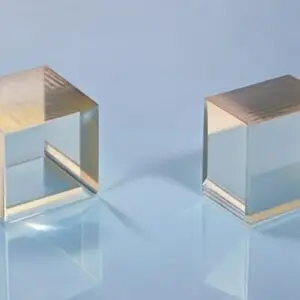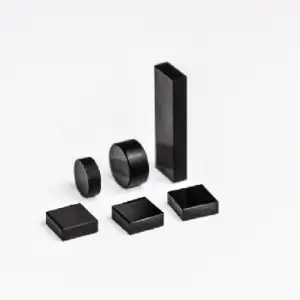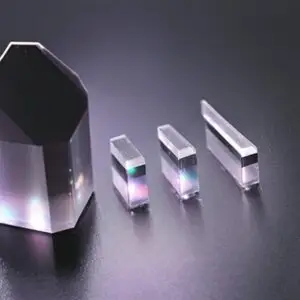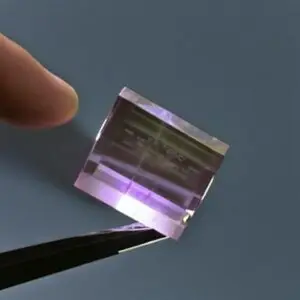
POC-OC-122456-Yb:YVO4 Crystal

  • Broad and smooth emission spectrum with a wide tuning range.
  • High absorption cross-section and efficiency.
  • Low quantum defect minimizes thermal effects.
  • Excellent thermal conductivity for high-power operation.
  • Custom crystal solutions available upon request.

Customizable Components Available for This Material to Meet Your Specific Needs!

General Description

Yb:YVO4 crystals, doped with ytterbium ions, are widely recognized for their superior optical and thermal properties, making them ideal for laser applications requiring high efficiency and power stability. These crystals offer a broad emission spectrum and a low quantum defect, significantly reducing thermal effects during operation. The simple electronic structure of Yb:YVO4 Crystal eliminates excited-state absorption and quenching processes, ensuring consistent performance. Due to their excellent thermal conductivity, these crystals are suitable for use in high-power thin-disk lasers, providing robust solutions for industrial and scientific applications. Additionally, their stable mechanical properties allow for precision fabrication and integration into complex optical systems.

General Application and Examples

Yb:YVO4 crystals are used across a range of laser-based applications, including:

  • High-Power Lasers: Yb:YVO4 Crystal  is used in continuous wave (CW) and Q-switched lasers for precision material processing and scientific research.
  • Mode-Locked Lasers: Their broad emission spectrum supports the generation of ultrashort pulses, critical for femtosecond laser technology.
  • Thin-Disk Lasers: Ideal for generating high-power laser beams with excellent beam quality in industrial applications.
  • Telecommunications: Utilized as a gain medium in fiber amplifiers for optical signal amplification.
  • Scientific Research: Deployed in experimental setups requiring reliable and stable laser operation, such as spectroscopy and nonlinear optics.

Chemical and Structural Properties

PropertyValue
Absorption peak wavelength985 nm
Absorption cross-section7.5 * 10^-20 cm²
Absorption bandwidth5 nm
Laser wavelength1027 nm
Lifetime of Yb³⁺ energy level250 µs
Emission cross-section10.5 * 10^-20 cm²
Refractive index @ 1064 nmnₐ = 1.993, nₑ = 2.01
Density4.22 g/cm³
Mohs hardness5
Thermal conductivity~5 W/m·K
dn/dT8.41 * 10^-6 K⁻¹
Thermal expansion coefficient1.5 * 10^-6 K⁻¹ (a), 8.2 * 10^-6 K⁻¹ (c)
Typical doping level1–3 at.%

Optical, Laser and Nonlinear Optical Properties

ParameterValue
Emission spectrum range~960–1020 nm
Quantum defectLow
BirefringenceModerate
Optical transparency range400–5000 nm
Optical damage threshold>10 J/cm²

Standard Fabrication Specifications

ParameterSpecification
Dimensions tolerance±0.01 mm
Parallelism error<20 arcsec
Perpendicularity error<10 arcmin
Surface flatnessλ/10 @ 632.8 nm
Surface quality20-10 S-D
Protective chamfers<0.1 mm at 45°
Clear aperture>90%

Spectrum Transmission Curve

The spectrum demonstrates strong absorption and emission peaks centered around 985 nm and 1027 nm, respectively. These features make Yb:YVO4 suitable for applications requiring high beam quality and stability.
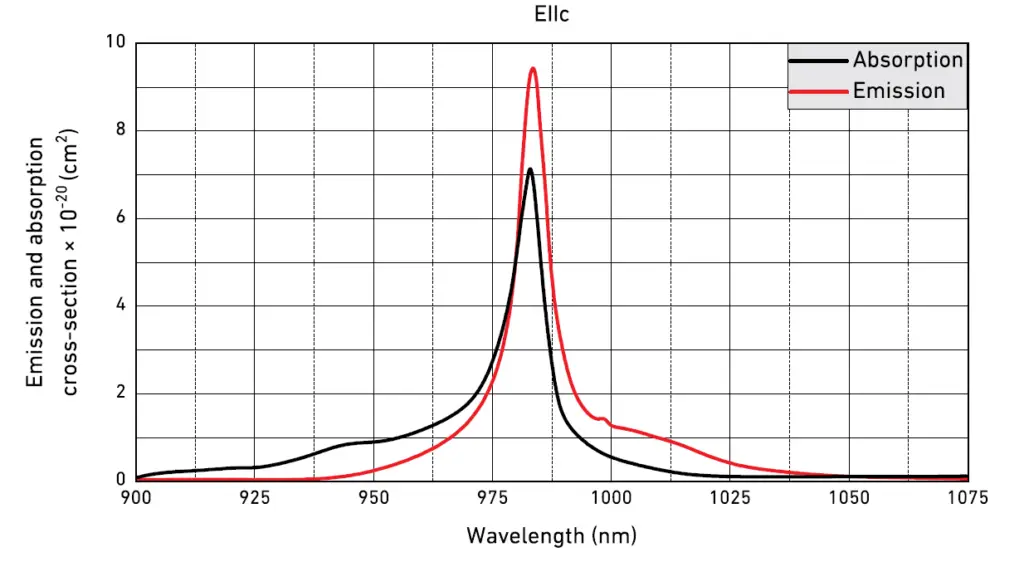
POC-Yb YVO4 Crystal Spectrum Absorption and emission Curve

Coating Specification

  • AR Coatings: Anti-reflective coatings are optimized for the 960–1060 nm range, with reflectivity values below 0.2%.
  • Customization: Additional coatings available upon request for specific laser wavelengths or applications.
  • Adhesion Test: Compliant with MIL-C-675C military standards, an adhesion test involved applying a tape that meets LT-90 specifications onto the lens film layer. The tape was affixed fully and then removed vertically. This procedure was performed three times, resulting in no blistering or peeling.
  • Temperature Test: In line with MIL-C-675C specifications, test pieces were subjected to temperatures of -62±1℃ and 71±1℃. After maintaining them at room temperature (16℃~32℃) for two hours, the adhesion test was repeated, confirming no film detachment.
  • Abrasion Resistance Test: Conforming to MIL-C-675C and CCC-C-440 standards, the abrasion resistance test involved a gauze tester applying a minimum force of 1.0 lbs (0.45 kg) to the film. This was repeated 25 times with gauze widths of 1/4 inch (6.4mm) and 3/8 inch (9.5mm), ensuring no damage occurred to the film surface.
  • Humidity Test: Under MIL-C-675C criteria, the test piece was placed in a controlled temperature and humidity chamber set to 49 ±2℃ and 95%~100% humidity for 24 hours. The film remained intact, with no peeling, scratches, or other defects.
  • Solvent and Cleaning Testing: Following MIL-C-675C specifications, test pieces were exposed to room temperature conditions (16℃~32℃) and tested with acetone and alcohol for at least 10 minutes each. After air drying and subsequent cleaning with a cotton cloth soaked in alcohol, the film surface showed no signs of peeling or scratches.
  • Salt Spray Test: After 100 hours in a 35°C environment with a 5% saltwater concentration, the film showed no signs of damage.
Face DimensionsLengthEnd FacesDopingCoatingsPrice (USD)
3 × 3 mm8 mmRight-angle5%AR@960–1060 nm640
3 × 3 mm4 mmBrewster-angle5%Uncoated540
8 × 8 mm8 mmRight-angle10%AR@960–1060 nm680
Custom SizesCustomCustomUp to 20%Coating options availableContact us
//body code