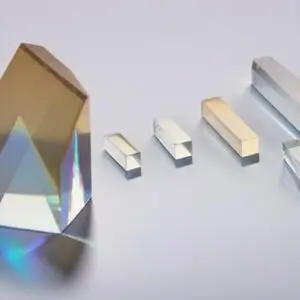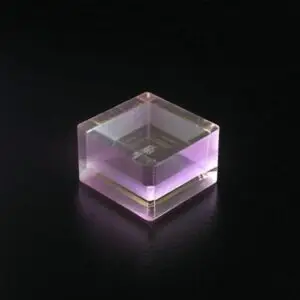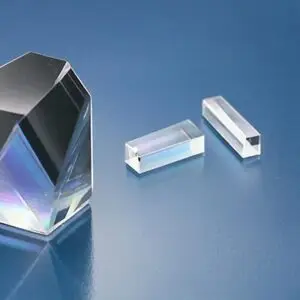
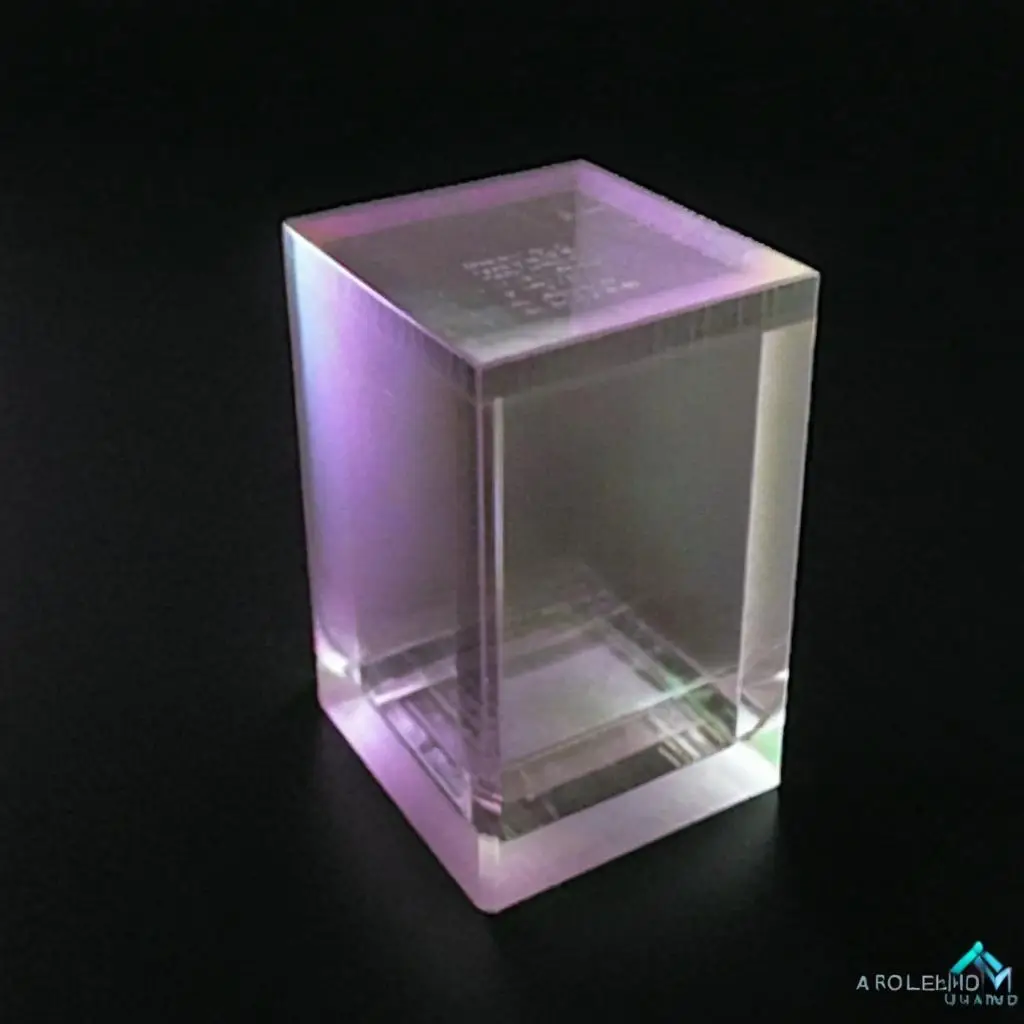
POC-OC-122457-Er:YLF Crystal

  • Low phonon frequency reduces the likelihood of non-radiative relaxations.
  • Long lifetimes of laser emitting levels improve energy storage for Q-switched lasers.
  • Wide transparency range (VUV to 10 µm) suitable for multiple applications.
  • Negative thermo-optic coefficient minimizes thermal-lensing effects.
  • Custom crystals available upon request for tailored specifications.

Customizable Components Available for This Material to Meet Your Specific Needs!

General Description

Er:YLF crystals are a highly efficient gain medium for laser systems due to their low phonon frequency, which enhances luminescence quantum efficiency by minimizing non-radiative relaxations. These crystals exhibit a long laser-emitting level lifetime, making them suitable for high-energy storage in Q-switched laser systems. Furthermore, their broad transparency range, extending from the vacuum ultraviolet (VUV) to the mid-infrared region (~10 µm), enables diverse optical applications. The negative thermo-optic coefficient of Er:YLF crystals provides a critical advantage in thermal management by reducing thermal-lensing effects, thus ensuring beam stability even under high-pump-power conditions.

General Applications and Examples

Er:YLF crystals find applications across various domains due to their versatile optical and thermal properties:

  1. Medical Applications:
    • CW and Q-switched ~3 µm lasers for dental and implant procedures.
    • Effective in otolaryngology and oral surgeries for precise incisions and treatments.
  2. Industrial Applications:
    • Used in material processing with ultrafast lasers.
    • Ideal for marking and engraving systems operating in the mid-IR range.
  3. Display and Diagnostic Technology:
    • Up-conversion visible lasers for high-resolution display systems.
    • Useful in diagnostic devices for medical imaging and spectroscopy.
  4. Research Applications:
    • Er:YLF Crystal Pump source for visible lasers using up-conversion techniques.
    • Laser medium in scientific experiments requiring high precision and stability.

Chemical and Structural Properties

PropertyValue
Orientationa-cut
Clear Aperture>90%
Face Dimensions Tolerance±0.01 mm
Length Tolerance±0.1 mm
Parallelism Error<20 arcsec
Perpendicularity Error<10 arcmin
Protective Chamfers<0.1 mm at 45°
Surface Quality20–10 S-D
Surface Flatnessλ/10 @ 632.8 nm
Density3.95 g/cm³
Mohs Hardness5
Thermal Conductivity5 W·m⁻¹·K⁻¹
dn/dT-2 × 10⁻⁶ K⁻¹
Thermal Expansion Coefficient8 × 10⁻⁶ K⁻¹
Refractive Index (@2070 nm)nₐ = 1.442; nₑ = 1.446
Typical Doping Level15 at.%

Optical, Laser and Nonlinear Optical Properties

PropertyValue
Absorption Peak Wavelength972 nm
Absorption Cross-Section28 × 10⁻²⁰ cm²
Absorption Bandwidth~1 nm
Laser Wavelength2810 nm
Lifetime of Er³⁺ Energy Level4 ms
Emission Cross-Section (@2800 nm)1.5 × 10⁻²⁰ cm²
Crystal StructureTetragonal

Standard Fabrication Specifications

SpecificationValue
Face Dimensions Tolerance±0.01 mm
Length Tolerance±0.1 mm
Surface Flatnessλ/10 @ 632.8 nm
Parallelism Error<20 arcsec
Perpendicularity Error<10 arcmin
Clear Aperture>90%
Protective Chamfers<0.1 mm at 45°
Surface Quality20–10 S-D

Spectrum Transmission Curve

The transmission spectrum demonstrates excellent transparency across a wide range from VUV to ~10 µm, facilitating various optical and laser applications. Specific transmission curves can be provided upon request based on user requirements.
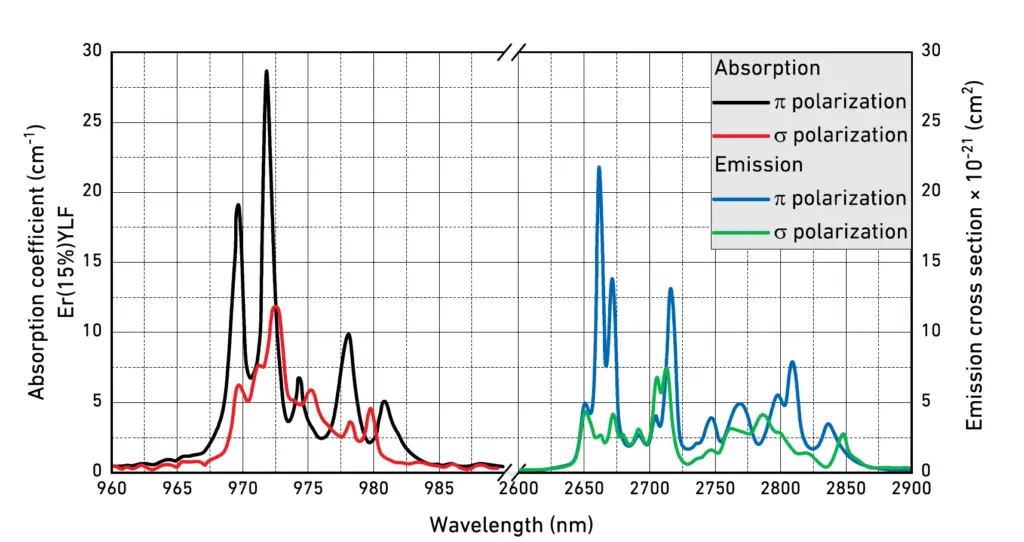
POC-Er YLF Crystal Spectrum Absorption and emission Curve

Coating Specification

  • Uncoated: Default configuration for user-specific coatings.
  • Custom Coatings Available: Anti-reflective (AR) coatings for optimized performance can be provided upon request.
  • Adhesion Test: Compliant with MIL-C-675C military standards, an adhesion test involved applying a tape that meets LT-90 specifications onto the lens film layer. The tape was affixed fully and then removed vertically. This procedure was performed three times, resulting in no blistering or peeling.
  • Temperature Test: In line with MIL-C-675C specifications, test pieces were subjected to temperatures of -62±1℃ and 71±1℃. After maintaining them at room temperature (16℃~32℃) for two hours, the adhesion test was repeated, confirming no film detachment.
  • Abrasion Resistance Test: Conforming to MIL-C-675C and CCC-C-440 standards, the abrasion resistance test involved a gauze tester applying a minimum force of 1.0 lbs (0.45 kg) to the film. This was repeated 25 times with gauze widths of 1/4 inch (6.4mm) and 3/8 inch (9.5mm), ensuring no damage occurred to the film surface.
  • Humidity Test: Under MIL-C-675C criteria, the test piece was placed in a controlled temperature and humidity chamber set to 49 ±2℃ and 95%~100% humidity for 24 hours. The film remained intact, with no peeling, scratches, or other defects.
  • Solvent and Cleaning Testing: Following MIL-C-675C specifications, test pieces were exposed to room temperature conditions (16℃~32℃) and tested with acetone and alcohol for at least 10 minutes each. After air drying and subsequent cleaning with a cotton cloth soaked in alcohol, the film surface showed no signs of peeling or scratches.
  • Salt Spray Test: After 100 hours in a 35°C environment with a 5% saltwater concentration, the film showed no signs of damage.
Face DimensionsLengthEnd FacesCoatingsPrice (USD)
3 × 3 mm8 mmRight-angle cutUncoated$540
3 × 3 mm8 mmBrewster-angle cutAR (custom request)$540
8 mm × 8 mm2 mmRight-angle cutAR (custom request)$680
//body code