
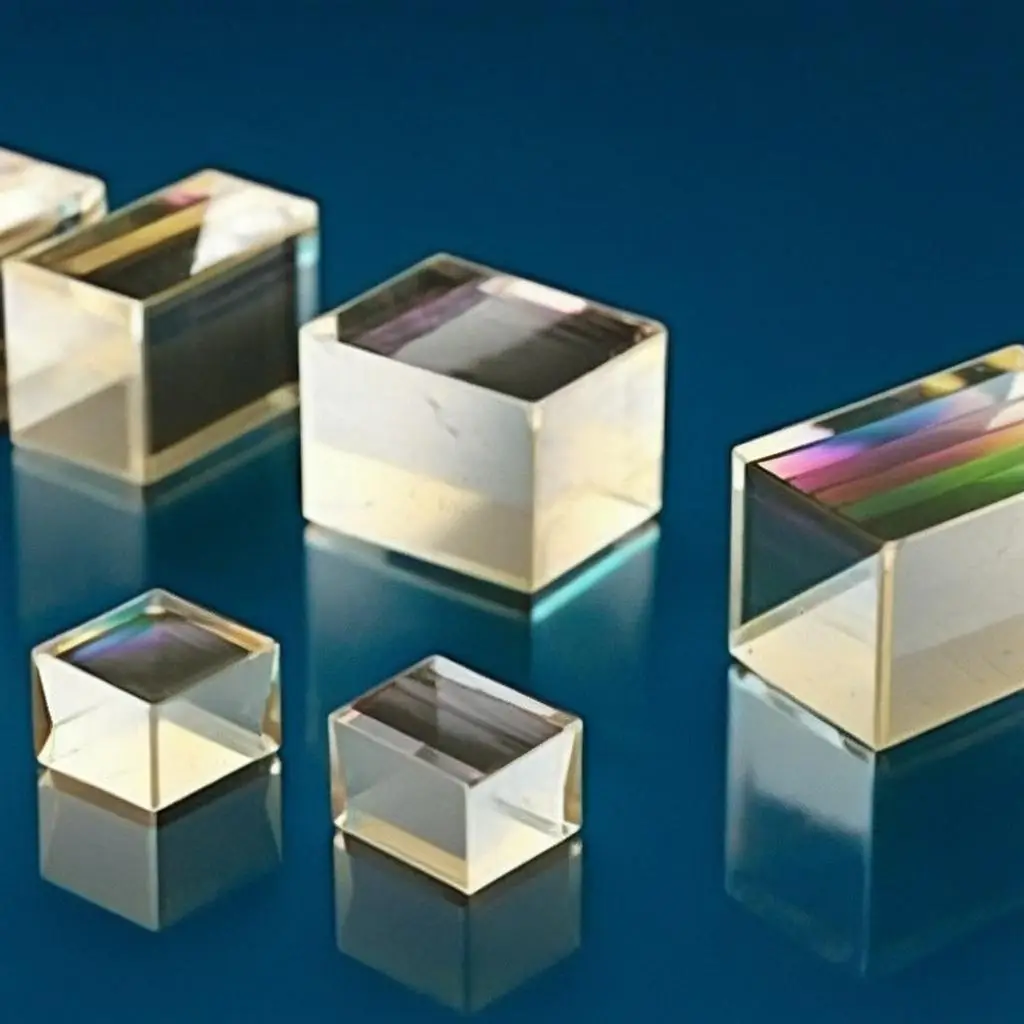
POC-OC-122465-TSAG Crystal

  • Large Verdet constant (48 Rad·T^-1·m^-1 at 1064 nm), approximately 20-30% higher than TGG crystals.
  • Low absorption (<3000 ppm/cm at 1064 nm), 30% less than TGG crystals.
  • High power compliance with minimal thermally-induced birefringence.
  • Superior thermal and mechanical properties.
  • Ideal for compact magneto-optical devices such as isolators and Faraday rotators.

Customizable Components Available for This Material to Meet Your Specific Needs!

General Description

Terbium Scandium Aluminum Garnet (TSAG) is an advanced magneto-optical crystal designed for next-generation fiber lasers and other optical devices. With a high Verdet constant and low absorption rate, TSAG excels in visible and infrared wavelength applications. These characteristics enable TSAG to support high power operations while minimizing optical losses and thermally-induced birefringence. TSAG Crystal  is well-suited for compact magneto-optical devices like isolators and Faraday rotators, where space and thermal considerations are critical. TSAG Crystal  also exhibits robust thermal and mechanical stability, making it an ideal choice for high-power applications across the spectral range of 400–1600 nm.

General Applications and Examples

TSAG crystals are widely used in:

  • Faraday Rotators and Isolators: Key components in optical systems requiring polarization control, particularly for fiber lasers and high-power laser setups. TSAG provides improved efficiency and compact design.
  • Laser Systems: Used as magneto-optical elements in laser cavity designs to ensure unidirectional light propagation and suppress feedback, critical in high-power fiber lasers.
  • High-Power Lasers: Due to its high damage threshold (>1 GW/cm^2) and minimal optical loss (<0.1%/cm), TSAG Crystal  supports applications requiring reliable and stable operation under extreme conditions.
  • Infrared Devices: Supports wavelengths up to 1600 nm, making it suitable for optical isolators used in long-range communication systems.
  • Compact Optical Devices: With its low thermal expansion and birefringence properties, TSAG enables the miniaturization of magneto-optical devices while maintaining high performance.

Chemical and Structural Properties

PropertyValue
Chemical FormulaTb3Sc2Al3O12
Crystal StructureCubic, Space Group Ia3d
Lattice Parametera = 12.3 Å
Density5.91 g/cm³
Melting Point1970°C ± 10°C
Mohs Hardness8.0
Verdet Constant48 Rad·T^-1·m^-1 at 1064 nm
Absorption Loss<0.1%/cm
Thermal Conductivity7.4 W·m^-1·K^-1
Laser Damage Threshold>1 GW/cm²
Refractive Index1.95 at 1064 nm

Optical Properties

PropertyValue
Transparency Range400–1600 nm
Verdet Constant48 Rad·T^-1·m^-1 at 1064 nm
Absorption Coefficient<0.003 cm^-1
Extinction Ratio>30 dB
BirefringenceNegligible
Laser-Induced Damage Threshold>1 GW/cm²

Standard Fabrication Specifications

SpecificationValue
Orientation[111] within ±15′
Extinction Ratio>30 dB
Diameter Tolerance±0.1 mm
Length Tolerance±0.2 mm
Surface Quality (Scratch/Dig)10/5 to MIL-PRF-13830B
Flatness<λ/8 @ 633 nm
Wavefront Distortion<λ/8 @ 633 nm
Parallelism20 arc sec
Perpendicularity<5 arc min
Chamfer0.2 mm × 45°

Specification

Value

Orientation

[111] within ±15′

Extinction Ratio

>30 dB

Diameter Tolerance

±0.1 mm

Length Tolerance

±0.2 mm

Surface Quality (Scratch/Dig)

10/5 to MIL-PRF-13830B

Flatness

<λ/8 @ 633 nm

Wavefront Distortion

<λ/8 @ 633 nm

Parallelism

20 arc sec

Perpendicularity

<5 arc min

Chamfer

0.2 mm × 45°

Spectrum Transmission Curve

Transmission characteristics are optimized for wavelengths between 400 nm and 1600 nm, ensuring minimal loss and high transmission efficiency for Faraday rotation and isolation applications. A detailed curve can be obtained on request.
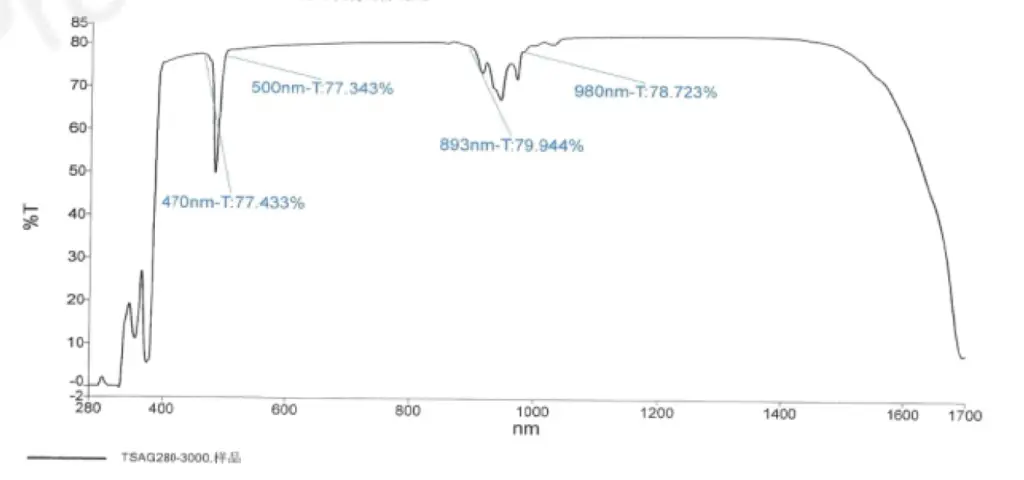
POC-TSAG Crystal Spectrum Transmission Curve

Coating Specification

  • Standard AR Coatings: <0.2% reflection at 1064 nm.

Custom coatings available upon request for specific wavelengths or spectral ranges

  • Adhesion Test: Compliant with MIL-C-675C military standards, an adhesion test involved applying a tape that meets LT-90 specifications onto the lens film layer. The tape was affixed fully and then removed vertically. This procedure was performed three times, resulting in no blistering or peeling.
  • Temperature Test: In line with MIL-C-675C specifications, test pieces were subjected to temperatures of -62±1℃ and 71±1℃. After maintaining them at room temperature (16℃~32℃) for two hours, the adhesion test was repeated, confirming no film detachment.
  • Abrasion Resistance Test: Conforming to MIL-C-675C and CCC-C-440 standards, the abrasion resistance test involved a gauze tester applying a minimum force of 1.0 lbs (0.45 kg) to the film. This was repeated 25 times with gauze widths of 1/4 inch (6.4mm) and 3/8 inch (9.5mm), ensuring no damage occurred to the film surface.
  • Humidity Test: Under MIL-C-675C criteria, the test piece was placed in a controlled temperature and humidity chamber set to 49 ±2℃ and 95%~100% humidity for 24 hours. The film remained intact, with no peeling, scratches, or other defects.
  • Solvent and Cleaning Testing: Following MIL-C-675C specifications, test pieces were exposed to room temperature conditions (16℃~32℃) and tested with acetone and alcohol for at least 10 minutes each. After air drying and subsequent cleaning with a cotton cloth soaked in alcohol, the film surface showed no signs of peeling or scratches.
  • Salt Spray Test: After 100 hours in a 35°C environment with a 5% saltwater concentration, the film showed no signs of damage.
Dimensions (mm)CoatingPrice (USD)
3 × 3 × 5AR@1064 nm350
5 × 5 × 10AR@1064 nm600
Custom SizesAR coatings upon requestContact us
//body code