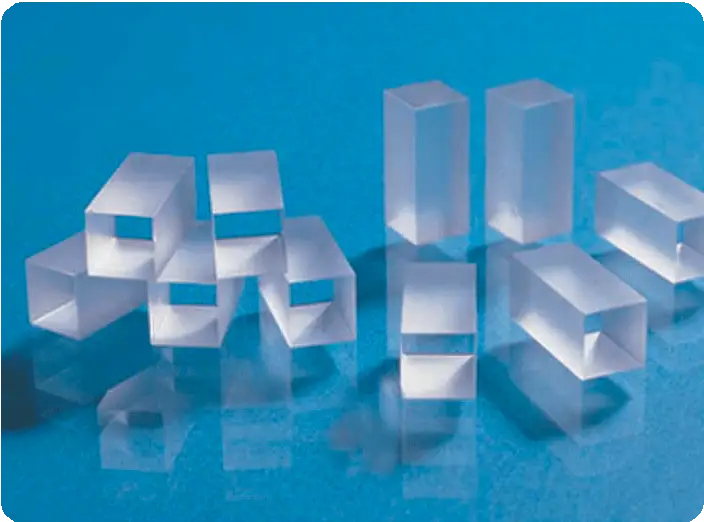
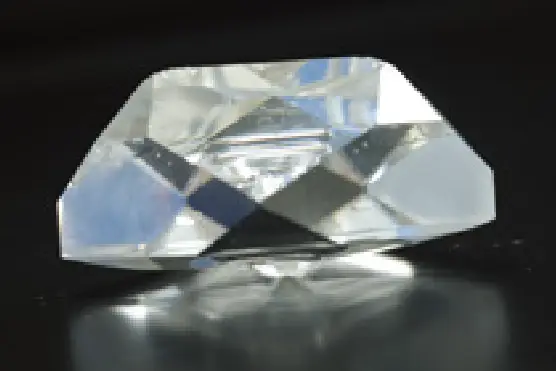

POC-OC-122402-LBO Crystals

  • Wide Transparency RangeExceptional transparency from 160 nm to 2600 nm, suitable for diverse photonics applications.
  • High Nonlinear Coefficients: Ideal for second-harmonic generation (SHG) and third-harmonic generation (THG) with high optical homogeneity.
  • Temperature and Angle Tolerance: Wide acceptance angle and excellent temperature bandwidth for operational flexibility.
  • Superior Damage Threshold: Excellent resistance to laser-induced damage, ensuring durability in high-power systems.
  • Customizable Solutions: Tailored dimensions, coatings, and mounts available to meet specific application needs.

Customizable Components Available for This Material to Meet Your Specific Needs!

General Description

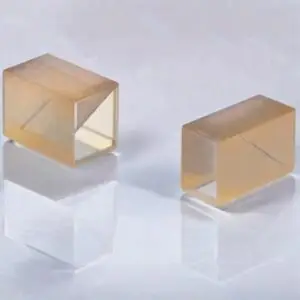
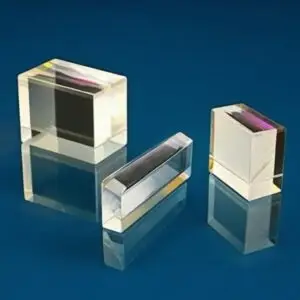
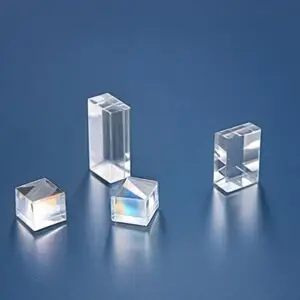
Lithium Triborate (LBO) crystals are versatile nonlinear optical materials offering unparalleled transparency across the wavelength range of 160–2600 nm. Known for their high optical homogeneity and absence of photorefractive damage, LBO crystals are a leading choice in photonics for SHG, THG, and optical parametric oscillation (OPO). These crystals exhibit a high damage threshold, ensuring stability in high-intensity laser setups.

LBO’s orthorhombic crystal structure and non-critical phase-matching (NCPM) capabilities further enhance its suitability for applications requiring precise wavelength generation and harmonic conversion. Its broad acceptance angle and minimal walk-off make it particularly effective in maintaining beam quality. POC offers LBO crystals fabricated to stringent standards, ensuring reliability and customization options for various industries, including medical imaging, industrial processing, and defense.
LBO or Lithium Triborate (LiB3O5)

General Applications and Examples

  • Second-Harmonic Generation (SHG): Efficiently doubles the frequency of Nd:YAG and Ti:Sapphire lasers for high-power laser systems using LBO Crystals .
  • Third-Harmonic Generation (THG): Generates ultraviolet wavelengths for advanced scientific research.
  • Optical Parametric Oscillators (OPO): Enables tunable wavelengths across a broad spectrum for spectroscopy and metrology.
  • Frequency Doubling and Mixing: High conversion efficiency in green laser systems for industrial processing and cutting.
  • Medical Imaging: Produces ultraviolet light for high-resolution imaging and diagnostics.
  • Defense and Aerospace: Powers lidar, rangefinding, and optical communication systems with precise wavelength outputs.
  • Scientific Research: LBO Crystals Facilitates nonlinear optical experiments and laser system development.

Chemical Property

PropertyValue
Crystal StructureOrthorhombic, Pna21
Lattice Parameters (Å)a=8.4473, b=7.3788, c=5.1395
Density (g/cm³)2.47
Melting Point (°C)~834
Mohs Hardness6
Thermal Conductivity (W/m·K)3.5
Thermal Expansion Coefficientsa=10.8×10⁻⁶, b=8.8×10⁻⁶, c=3.4×10⁻⁶

Optical and Nonlinear Optical Properties

ParameterType I SHGType II SHG
Transparency Range (nm)160–2600160–2600
SHG Phase Match Range (nm)551–2600790–2150
Effective NLO Coefficients (pm/V)d11=0.05±0.009d11=0.05±0.006
Walk-Off Angle (°)0.60.12
Thermal-Optic Coefficient (K⁻¹)dn/dt=3.9×10⁻⁶dn/dt=6.3×10⁻⁶
Damage Threshold (GW/cm²)>10>5

Standard Fabrication Specification

ParameterSpecification
Dimension Tolerance±0.1 mm
Surface Flatnessλ/8 at 633 nm
Clear Aperture>90%
Surface Quality10/5 Scratch/Dig
Parallelism≤20 arc seconds
Perpendicularity≤5 arc minutes
Damage Threshold>10 GW/cm² at 1064 nm

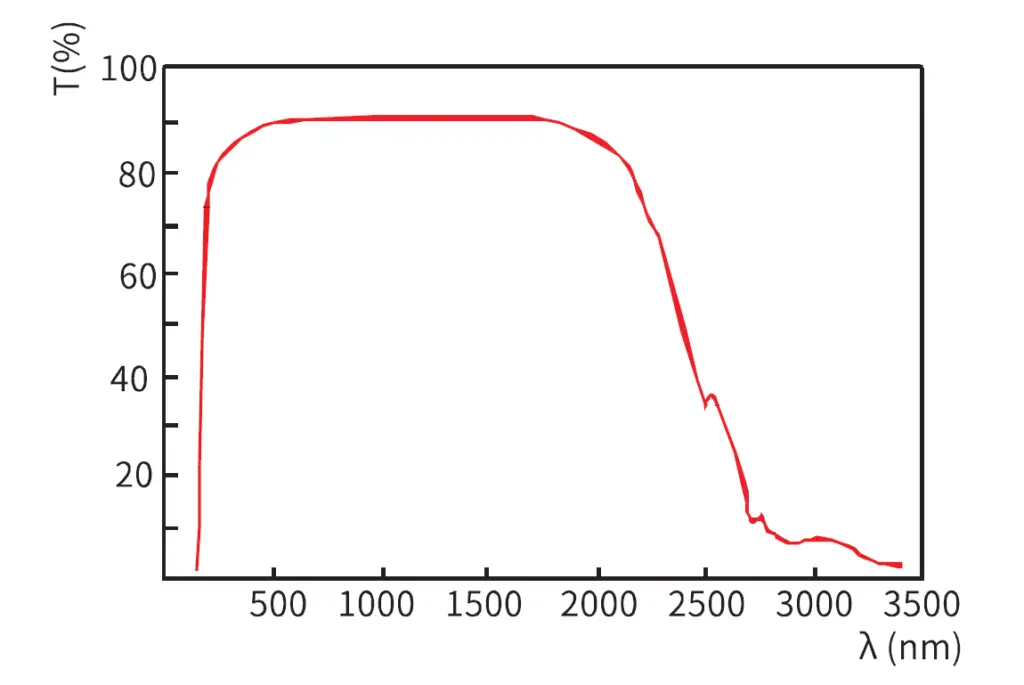
Spectrum Transmission Curve

LBO crystals feature a transmission spectrum with excellent transparency from 160 nm to 2600 nm. The curve demonstrates >80% transmission efficiency across the operating range, ensuring optimal performance for nonlinear optical applications. (Include graphical representation)

POC-LBO Crystal Spectrum Transmission Curve

Coating Specification

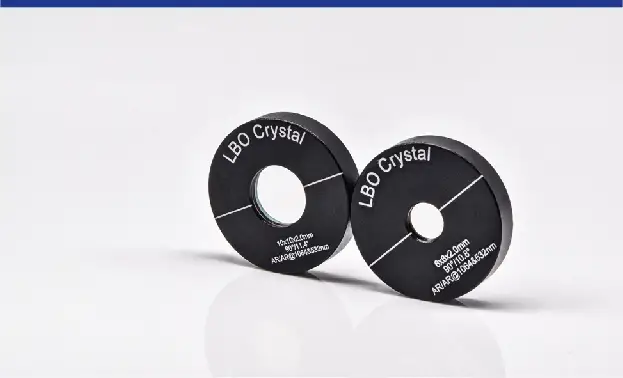
  • Dual AR Coating: <0.2% reflectivity for SHG at 1064 nm.
  • Broadband AR Coating: Optimized for 532 nm and 355 nm applications.
  • Durable DLC Coating: Optional for extended durability in harsh environments.
  • Custom Coatings: Available upon request for specific wavelength ranges.
  • Adhesion Test: Compliant with MIL-C-675C military standards, an adhesion test involved applying a tape that meets LT-90 specifications onto the lens film layer. The tape was affixed fully and then removed vertically. This procedure was performed three times, resulting in no blistering or peeling.
  • Temperature Test: In line with MIL-C-675C specifications, test pieces were subjected to temperatures of -62±1℃ and 71±1℃. After maintaining them at room temperature (16℃~32℃) for two hours, the adhesion test was repeated, confirming no film detachment.
  • Abrasion Resistance Test: Conforming to MIL-C-675C and CCC-C-440 standards, the abrasion resistance test involved a gauze tester applying a minimum force of 1.0 lbs (0.45 kg) to the film. This was repeated 25 times with gauze widths of 1/4 inch (6.4mm) and 3/8 inch (9.5mm), ensuring no damage occurred to the film surface.
  • Humidity Test: Under MIL-C-675C criteria, the test piece was placed in a controlled temperature and humidity chamber set to 49 ±2℃ and 95%~100% humidity for 24 hours. The film remained intact, with no peeling, scratches, or other defects.
  • Solvent and Cleaning Testing: Following MIL-C-675C specifications, test pieces were exposed to room temperature conditions (16℃~32℃) and tested with acetone and alcohol for at least 10 minutes each. After air drying and subsequent cleaning with a cotton cloth soaked in alcohol, the film surface showed no signs of peeling or scratches.
  • Salt Spray Test: After 100 hours in a 35°C environment with a 5% saltwater concentration, the film showed no signs of damage.
Dimension (mm)CoatingApplicationPrice (USD)
3×3×3AR@1064 nmSHG Type I230
5×5×5AR@532 nmTHG Applications320
10×10×10Broadband AR CoatingOPO and OPA Systems470
Custom SizesUpon RequestTailored SolutionsCustom Quote
//body code