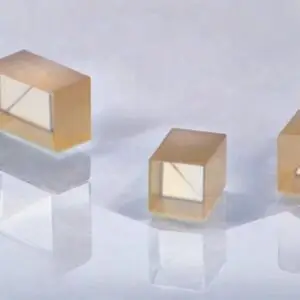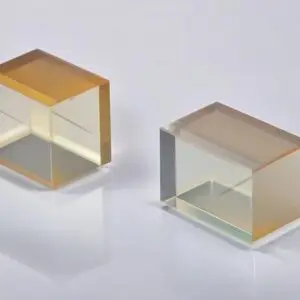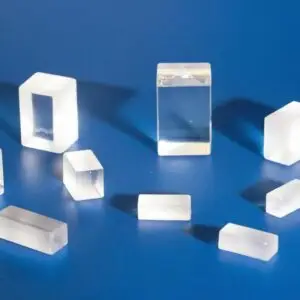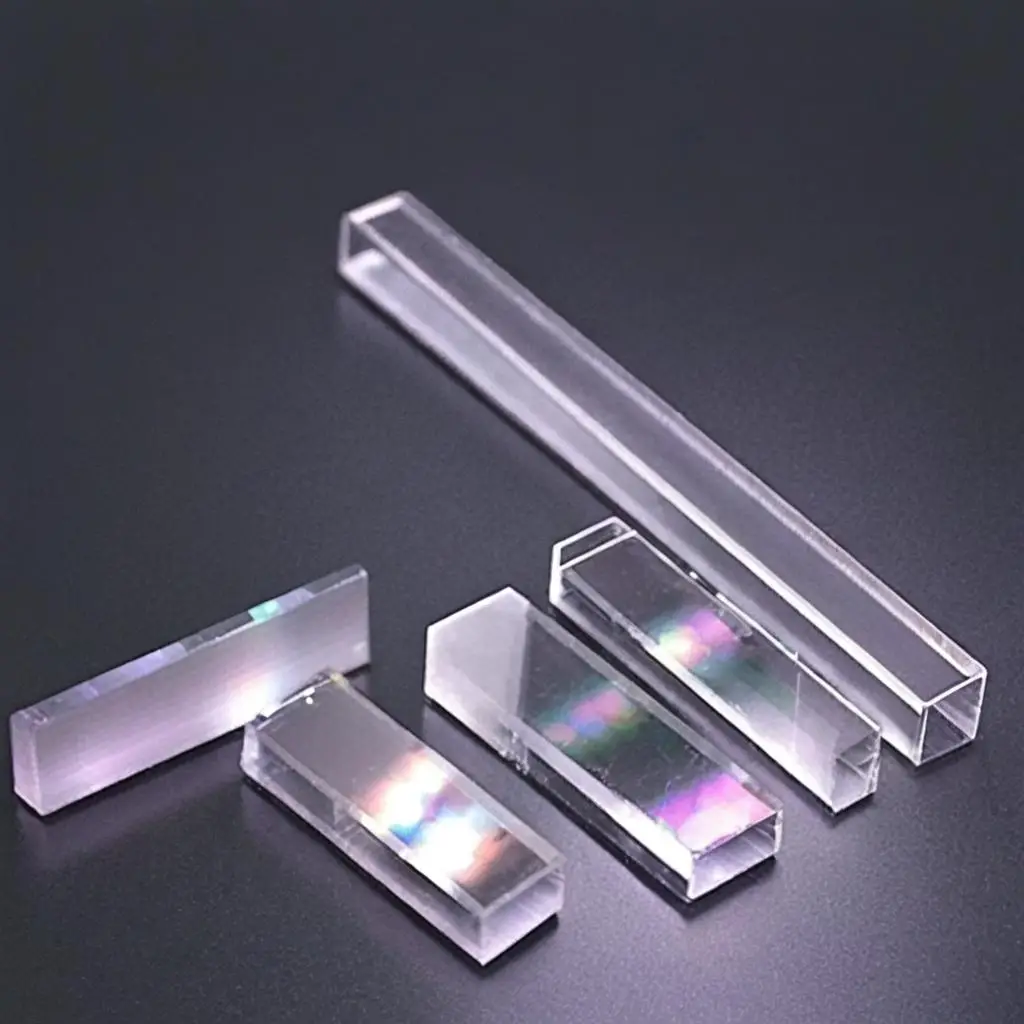
POC-OC-122407-GTR-KTP Crystal

  • High gray tracking resistance, making it ideal for high repetition rate and high-power laser systems.
  • Superior damage threshold compared to conventional KTP crystals, ensuring reliability in demanding applications.
  • Optimized for second harmonic generation (SHG), optical parametric oscillators (OPO), and other nonlinear optical applications.
  • Enhanced bulk absorption properties, reducing IR absorption and improving overall optical performance.
  • Precision fabrication with strict quality control for dimensions, coatings, and surface flatness.

Customizable Components Available for This Material to Meet Your Specific Needs!

General Description

Gray Tracking Resistance Potassium Titanyl Phosphate (GTR-KTP) crystals are advanced nonlinear optical materials engineered to overcome the limitations of conventional KTP crystals, particularly their susceptibility to gray tracking. This phenomenon leads to increased IR absorption, reducing the efficiency and lifespan of the crystal in high-power laser systems. GTR-KTP crystals, developed with innovative manufacturing processes, exhibit significantly higher resistance to gray tracking and lower absorption in the UV and visible regions, making them suitable for a wide range of applications such as frequency doubling, parametric oscillation, and laser amplification.

GTR-KTP crystals maintain the desirable properties of conventional KTP, such as a high nonlinear optical coefficient, wide angular and temperature bandwidths, and low walk-off angle. Additionally, these crystals boast a higher laser damage threshold, making them reliable for high-energy and high-repetition laser applications. These unique properties, combined with high durability and chemical stability, position GTR-KTP crystals as a superior choice for industrial, scientific, and medical laser systems.

General Applications and Examples

GTR-KTP crystals are widely utilized in applications that demand high-performance nonlinear optical materials with improved durability and resistance to gray tracking. Some notable applications include:

  1. Laser Frequency Doubling (SHG):
  • The  crystals are commonly used to double the frequency of Nd:YAG and Nd:YVO₄ lasers, generating visible green laser output (532 nm) from the fundamental 1064 nm wavelength.
  • Example: Efficient SHG processes with improved damage thresholds for high-power continuous-wave (CW) and pulsed laser systems.
  1. Optical Parametric Oscillators (OPO):
  • The crystals are integral to optical parametric oscillators for generating tunable laser outputs in the visible and near-infrared (IR) ranges.
  • Example: Tunable outputs covering wavelengths from 700 nm to 4500 nm, utilized in scientific research and spectroscopy.
  1. Medical and Biomedical Applications:
  • The crystals are used in medical lasers for procedures such as laser surgery, tattoo removal, and skin resurfacing, where stable and reliable laser performance is essential.
  1. High-Power Laser Systems:
  • Ideal for high-repetition-rate lasers, GTR-KTP crystals are employed in laser-based industrial machining, precision cutting, and marking systems.
  1. Spectroscopy and Imaging:
  • With their broad spectral range and low IR absorption, GTR-KTP crystals are well-suited for spectroscopic instruments and advanced imaging technologies.

GTR-KTP’s unique properties ensure higher conversion efficiencies, longer crystal lifespans, and reduced maintenance, making them a preferred choice for demanding applications.

Chemical and Structural Properties

PropertySpecification
Crystal StructureOrthorhombic, Space group Pna2₁
Lattice Parametersa = 6.404 Å, b = 10.616 Å, c = 12.814 Å
Density3.01 g/cm³
Melting PointApproximately 1172 °C
Thermal Expansion Coefficientsa₁ = 11 × 10⁻⁶/°C, a₂ = 9 × 10⁻⁶/°C, a₃ = 0.6 × 10⁻⁶/°C
Thermal Conductivity13 W/m·K
Chemical StabilityNon-hygroscopic, resistant to environmental degradation

Optical and Nonlinear Optical Properties

PropertySpecification
Transparency Range350–4500 nm
SHG Phase Matching Range497–1800 nm (Type II)
Nonlinear Coefficients (pm/V)d₃₁ = 6.5, d₃₂ = 5.5, d₃₃ = 13.7
Damage Threshold>1.8 GW/cm² at 1064 nm (10 ns, 1 Hz)
Walk-off Angle0.55° at 1064 nm
Absorption Coefficients<0.1% at 1064 nm, <1% at 532 nm
Refractive Index (n)nₓ = 1.807, nᵧ = 1.841, n𝓏 = 1.899
Thermal-Optic Coefficients (°C⁻¹)dnₓ/dT = 1.1 × 10⁻⁵, dnᵧ/dT = 1.3 × 10⁻⁵, dn𝓏/dT = 1.6 × 10⁻⁵

Standard Fabrication Specifications

ParameterSpecification
Dimension Tolerance±0.1 mm × ±0.1 mm × ±0.1 mm
Angle ToleranceΔθ < 0.25°, Δφ < 0.25°
Surface Quality10/5 to MIL-PRF-13830B
Flatnessλ/8 @ 633 nm
Parallelism<20 arc seconds
Perpendicularity<15 arc minutes
Clear Aperture>90% of the diameter
Damage Threshold>1 GW/cm² @ 1064 nm, >0.3 GW/cm² @ 532 nm
WarrantyOne year under proper use

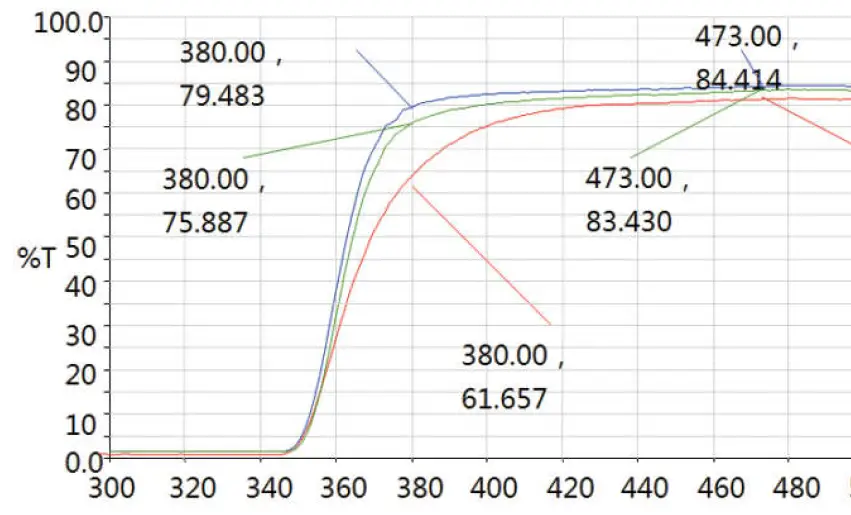
Spectrum Transmission Curve

  • The transmission curves illustrate low absorption in the visible and UV regions, ensuring high optical transmission and efficiency for SHG and OPO processes.
POC-GTR-KTP Crystal Spectrum Transmission Curve

Coating Specification

Base MaterialAR CoatingReflectance
GTR-KTPDual Band AR (1064/532 nm)R < 0.2% @ 1064 nm, R < 0.5% @ 532 nm
HR Coating (1064 nm)R > 99.8% @ 1064 nm
Broad Band AR (OPO Range)R < 2% @ 1064–266 nm
  • Adhesion Test: Compliant with MIL-C-675C military standards, an adhesion test involved applying a tape that meets LT-90 specifications onto the lens film layer. The tape was affixed fully and then removed vertically. This procedure was performed three times, resulting in no blistering or peeling.
  • Temperature Test: In line with MIL-C-675C specifications, test pieces were subjected to temperatures of -62±1℃ and 71±1℃. After maintaining them at room temperature (16℃~32℃) for two hours, the adhesion test was repeated, confirming no film detachment.
  • Abrasion Resistance Test: Conforming to MIL-C-675C and CCC-C-440 standards, the abrasion resistance test involved a gauze tester applying a minimum force of 1.0 lbs (0.45 kg) to the film. This was repeated 25 times with gauze widths of 1/4 inch (6.4mm) and 3/8 inch (9.5mm), ensuring no damage occurred to the film surface.
  • Humidity Test: Under MIL-C-675C criteria, the test piece was placed in a controlled temperature and humidity chamber set to 49 ±2℃ and 95%~100% humidity for 24 hours. The film remained intact, with no peeling, scratches, or other defects.
  • Solvent and Cleaning Testing: Following MIL-C-675C specifications, test pieces were exposed to room temperature conditions (16℃~32℃) and tested with acetone and alcohol for at least 10 minutes each. After air drying and subsequent cleaning with a cotton cloth soaked in alcohol, the film surface showed no signs of peeling or scratches.
  • Salt Spray Test: After 100 hours in a 35°C environment with a 5% saltwater concentration, the film showed no signs of damage.
Face Dimensions (mm)Length (mm)CoatingsApplicationPrice (USD)
3 × 35AR@1064/532 nmSHG of Nd:YAG lasers350
5 × 510HR@1064 nmHigh-power laser systems500
7 × 715BBAR (OPO range)OPO and parametric gain750
CustomCustomUpon RequestCustom ApplicationsTBD
//body code