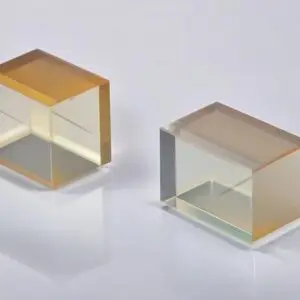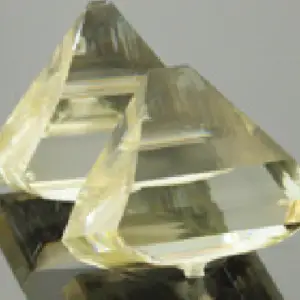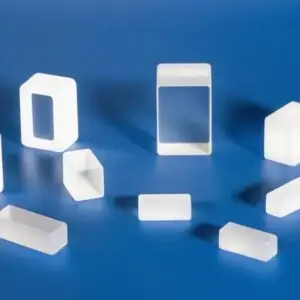
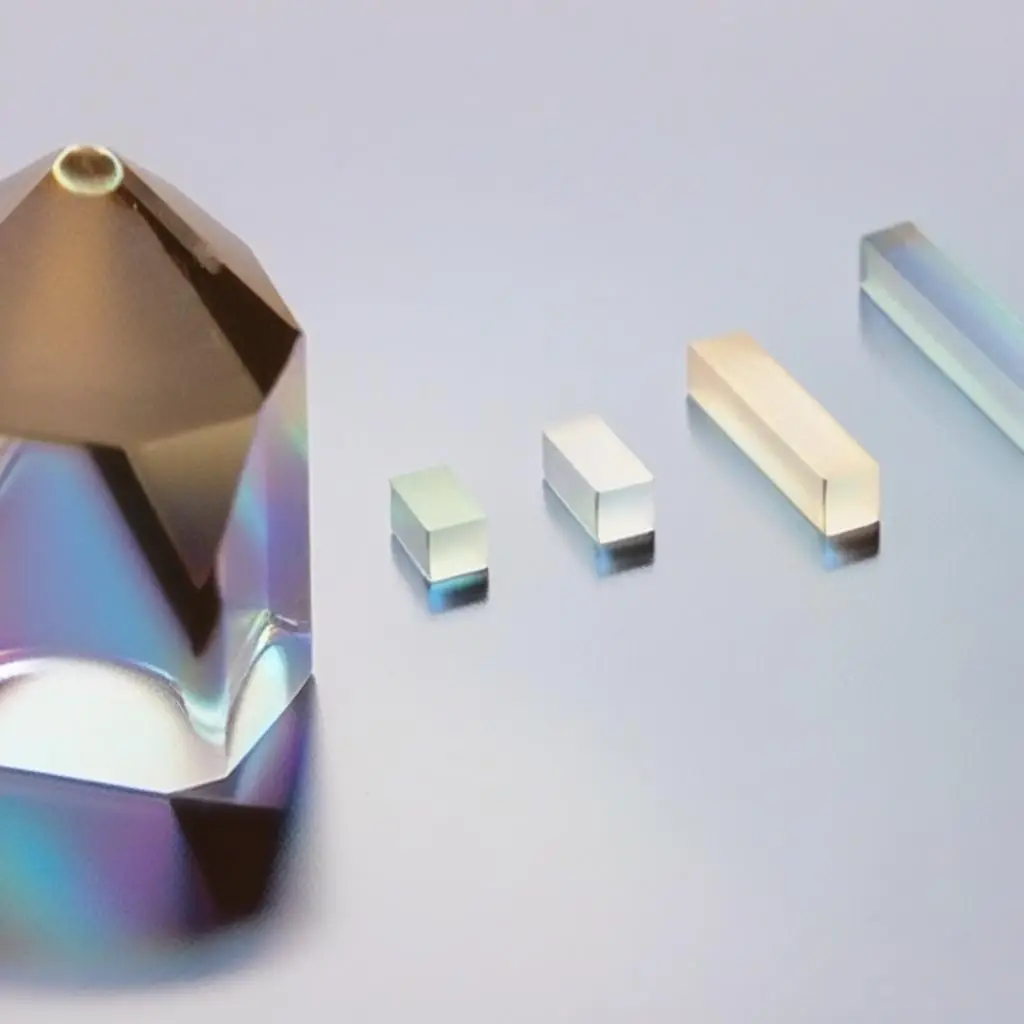
POC-OC-122414-CdSe Crystal

  • Wide transparency range from 0.7 to 24 µm, ideal for infrared applications.
  • Reasonably high nonlinearity for efficient laser radiation conversion.
  • Small walk-off angle, minimizing beam distortion.
  • High thermal conductivity for enhanced heat dissipation.
  • Suitable for far-infrared and laser mixing applications.

Customizable Components Available for This Material to Meet Your Specific Needs!

General Description

Cadmium Selenide (CdSe) crystals are a highly versatile nonlinear optical material with an extensive transparency range of 0.7 to 24 µm. Known for their positive uniaxial symmetry and large nonlinear coefficients, CdSe crystals are widely utilized in difference frequency generation (DFG) and optical parametric oscillation (OPO) for producing far-infrared laser radiation. Their small walk-off angle ensures minimized beam distortion, making them an optimal choice for critical optical applications. With high thermal conductivity and a laser damage threshold of 60 MW/cm² (10.6 µm, 200 ns), CdSe is ideal for laser systems requiring precision and durability. Photonics On Crystals (POC) ensures the highest quality standards in crystal growth and fabrication to meet diverse industry needs

General Applications and Examples

  1. Far-Infrared Wavelength Generation
    CdSe crystals are extensively used in generating far-infrared wavelengths via DFG and OPO methods. This is particularly effective for scientific research, spectroscopy, and defense applications.
    Example: Generating 12 µm radiation from pump sources operating at 2 µm and 10 µm.
  2. Infrared Optical Components
    With their broad transparency range and mechanical stability, CdSe crystals are utilized in creating infrared optical elements such as substrates, polarizers, and waveplates.
    Example: Infrared waveplates for high-precision polarization control in spectroscopy.
  3. Laser Mixing Applications
    CdSe’s high nonlinearity supports efficient wavelength mixing for high-power laser systems in industrial and medical applications.
    Example: Combining wavelengths in the mid-infrared region to achieve tunable laser output.

Chemical and Structural Properties

PropertyValue
Chemical FormulaCdSe
Crystal StructureHexagonal, 6mm
Lattice Parametersa = 4.2985 Å, c = 7.0150 Å
Density (@ 288 K)5.81 g/cm³
Mohs Hardness3.25
Thermal Conductivity (@ 293 K)6.9 (IIc), 6.2 (Uc) W·m^-1·K^-1
Transparency Range0.7–24 µm (at 0 transmittance level)

Optical and Nonlinear Optical Properties

PropertyValue
Dispersion Equation for nₒn² = 4.2243 + 1.7680 λ² / (λ² – 0.2270) + 3.1200 λ² / (λ² – 3380)
Dispersion Equation for nₑn² = 4.2009 + 1.8875 λ² / (λ² – 0.2171) + 3.4641 λ² / (λ² – 3629)
Refractive Indices (@ 10.0 µm)nₒ = 2.431, nₑ = 2.452
Laser-Induced Damage Threshold60 MW/cm² (10.6 µm, 200 ns)
Nonlinear CoefficientPositive uniaxial (nₒ > nₑ)

Standard Fabrication Specification

SpecificationValue
Dimension Tolerance (mm)W ± 0.1 × H ± 0.1 × L ± 0.2
Surface Flatnessλ/4 @ 633 nm
Surface Quality (Scratch/Dig)20/10 to MIL-PRF-13830B
Parallelism< 30 arc sec
Perpendicularity≤ 15 arc min
Angle Tolerance (°)Δθ ≤ 0.5
Quality Warranty PeriodOne year under proper use

Spectrum Transmission Curve

Spectrum transmission curves for CdSe crystals are available upon request and demonstrate the material’s excellent performance across the IR spectrum.

Coating Specification

  • AR Coatings: Anti-reflective coatings for infrared wavelengths (e.g., 0.7–24 µm) to reduce reflection losses.
  • Custom Coatings: Options like BBAR or HR coatings are available for specific wavelength ranges based on application requirements.
  • Adhesion Test: Compliant with MIL-C-675C military standards, an adhesion test involved applying a tape that meets LT-90 specifications onto the lens film layer. The tape was affixed fully and then removed vertically. This procedure was performed three times, resulting in no blistering or peeling.
  • Temperature Test: In line with MIL-C-675C specifications, test pieces were subjected to temperatures of -62±1℃ and 71±1℃. After maintaining them at room temperature (16℃~32℃) for two hours, the adhesion test was repeated, confirming no film detachment.
  • Abrasion Resistance Test: Conforming to MIL-C-675C and CCC-C-440 standards, the abrasion resistance test involved a gauze tester applying a minimum force of 1.0 lbs (0.45 kg) to the film. This was repeated 25 times with gauze widths of 1/4 inch (6.4mm) and 3/8 inch (9.5mm), ensuring no damage occurred to the film surface.
  • Humidity Test: Under MIL-C-675C criteria, the test piece was placed in a controlled temperature and humidity chamber set to 49 ±2℃ and 95%~100% humidity for 24 hours. The film remained intact, with no peeling, scratches, or other defects.
  • Solvent and Cleaning Testing: Following MIL-C-675C specifications, test pieces were exposed to room temperature conditions (16℃~32℃) and tested with acetone and alcohol for at least 10 minutes each. After air drying and subsequent cleaning with a cotton cloth soaked in alcohol, the film surface showed no signs of peeling or scratches.
  • Salt Spray Test: After 100 hours in a 35°C environment with a 5% saltwater concentration, the film showed no signs of damage.
Product CodeDimensions (mm)CoatingApplication
POC-CdSe-24-1010 × 10 × 10AR @ 0.7–24 µmFar-Infrared Radiation Generation
POC-CdSe-Infrared12 × 12 × 12BBAR @ Mid-IRInfrared Waveplates
POC-CdSe-CustomCustomizableOn RequestAll Infrared Applications

//body code