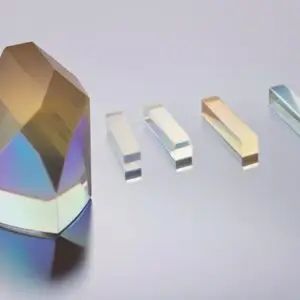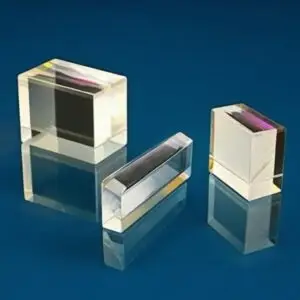
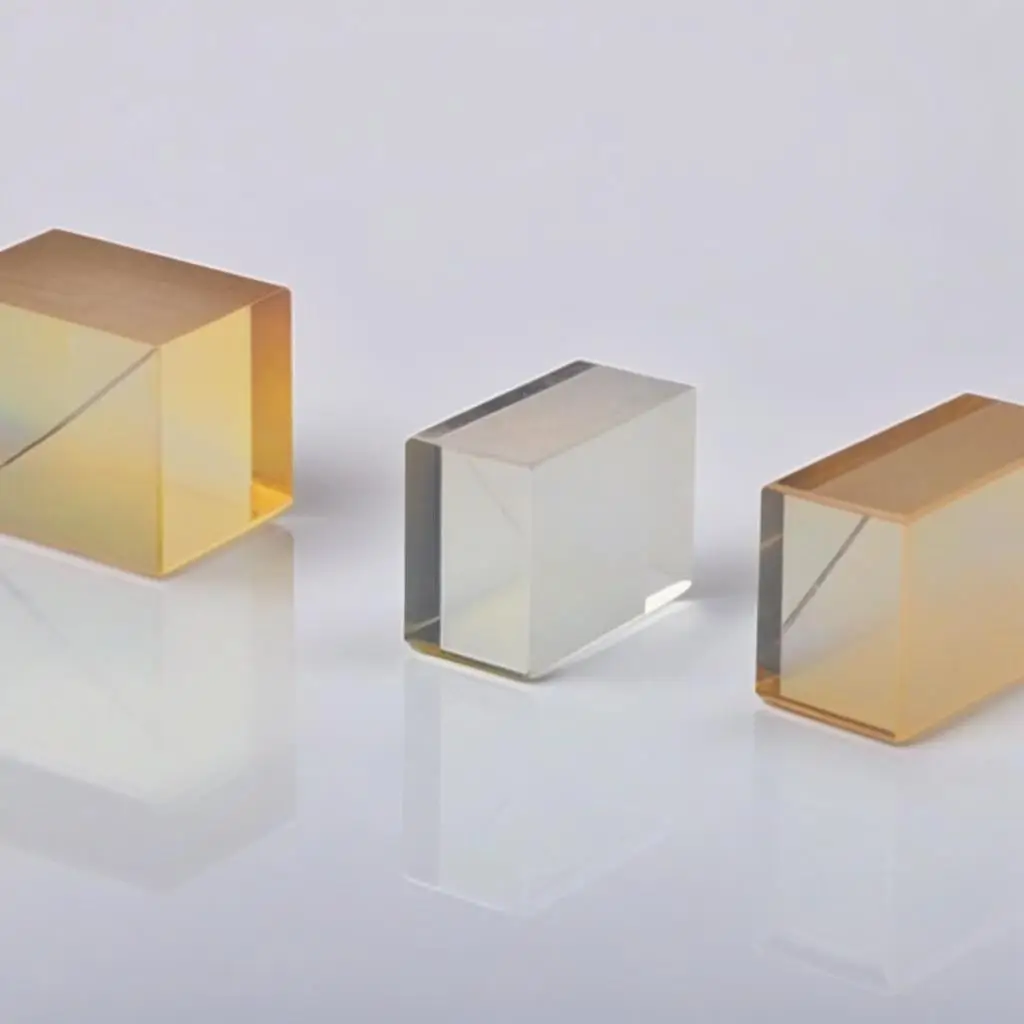
POC-OC-122421-HgGa2S4 Crystal

  • Wide transparency range: 0.55–13 μm.
  • High nonlinear optical coefficient: d36 approximately 1.8 times that of AgGaS2.
  • Exceptional damage threshold: 60 MW/cm² (1064 nm, 10 ns).
  • Negative uniaxial crystal with no > ne configuration.
  • Ideal for nonlinear optical applications such as OPO and OPA.

Customizable Components Available for This Material to Meet Your Specific Needs!

General Description

HgGa2S4 is a highly efficient nonlinear optical crystal with an exceptional nonlinear coefficient (d36), approximately 1.8 times that of AgGaS2. With a broad transparency range of 0.55–13 μm, it is particularly well-suited for mid-IR and near-IR applications, including optical parametric oscillation (OPO) and amplification (OPA). The crystal demonstrates excellent damage threshold properties and is chemically stable, making it ideal for high-power laser systems. Its broad wavelength tuning range makes it a competitive option alongside other crystals such as AgGaS2, ZnGeP2, and GaSe.

General Applications and Examples

HgGa2S4 Crystals are widely utilized in advanced photonics and laser technologies. Specific examples include:

  1. Laser Frequency Conversion:
    • Effective in optical parametric oscillators (OPO) and optical parametric amplifiers (OPA).
    • Supports broad wavelength tuning, enabling frequency conversion in high-power laser systems.
  2. Spectroscopic Analysis:
    • Used in mid-IR spectroscopy for environmental sensing and atmospheric studies.
  3. Medical Imaging and Biophotonics:
    • Provides accurate and efficient imaging in medical diagnostics.
  4. High-Power Lasers:
    • Suited for defense applications and laser material processing due to its damage threshold.
  5. Research and Development:
    • Extensively used in the study of nonlinear optical effects for high-energy applications.

Chemical and Structural Properties

PropertyValue
Transparency Range0.55–13 μm
Bandgap Energy2.34 eV
Density4.95 g/cm³
Mohs Hardness3–3.5
Crystal ConfigurationNegative Uniaxial (no > ne)
Refractive Indices
  • no = 2.6592, ne = 2.5979 @ 0.5495 μm
  • no = 2.5796, ne = 2.5264 @ 0.6500 μm
  • no = 2.4774, ne = 2.4324 @ 1.0760 μm
  • no = 2.4386, ne = 2.3979 @ 3.5400 μm
  • no = 2.3690, ne = 2.3290 @ 11.000 μm

Optical and Nonlinear Optical Properties

PropertyValue
Transparency Range0.55–13 μm
Nonlinear Coefficient (d36)1.8 × d36 of AgGaS2
Refractive Indices (no, ne)See below
Damage Threshold60 MW/cm² (1064 nm, 10 ns)

Standard Fabrication Specification

SpecificationValue
Dimension Tolerance±0.1 mm
Surface Quality (Scratch/Dig)40-20
Flatnessλ/8 @ 632.8 nm
Parallelism<30 arc sec
Perpendicularity<10 arc min
Edge Bevel<0.2 mm × 45°

Spectrum Transmission Curve

Spectrum transmission curves for HgGa2S4 Crystals can be provided upon request, highlighting its broad transmission properties and efficiency across IR ranges

Coating Specification

  • AR Coatings: Optimized for mid-IR wavelengths (0.8–1.2 μm, 3–5 μm, and 8–12 μm).
  • Customized Coatings: Available upon request for specific wavelength applications.
  • Adhesion Test: Compliant with MIL-C-675C military standards, an adhesion test involved applying a tape that meets LT-90 specifications onto the lens film layer. The tape was affixed fully and then removed vertically. This procedure was performed three times, resulting in no blistering or peeling.
  • Temperature Test: In line with MIL-C-675C specifications, test pieces were subjected to temperatures of -62±1℃ and 71±1℃. After maintaining them at room temperature (16℃~32℃) for two hours, the adhesion test was repeated, confirming no film detachment.
  • Abrasion Resistance Test: Conforming to MIL-C-675C and CCC-C-440 standards, the abrasion resistance test involved a gauze tester applying a minimum force of 1.0 lbs (0.45 kg) to the film. This was repeated 25 times with gauze widths of 1/4 inch (6.4mm) and 3/8 inch (9.5mm), ensuring no damage occurred to the film surface.
  • Humidity Test: Under MIL-C-675C criteria, the test piece was placed in a controlled temperature and humidity chamber set to 49 ±2℃ and 95%~100% humidity for 24 hours. The film remained intact, with no peeling, scratches, or other defects.
  • Solvent and Cleaning Testing: Following MIL-C-675C specifications, test pieces were exposed to room temperature conditions (16℃~32℃) and tested with acetone and alcohol for at least 10 minutes each. After air drying and subsequent cleaning with a cotton cloth soaked in alcohol, the film surface showed no signs of peeling or scratches.
  • Salt Spray Test: After 100 hours in a 35°C environment with a 5% saltwater concentration, the film showed no signs of damage.
Face Dimensions (mm) Length (mm) Orientation (Theta/Phi) Coating Application Price (USD)
10 × 10 10 0°/0° AR @ 3–5 μm Mid-IR spectroscopy Request
20 × 20 20 0°/0° AR @ 8–12 μm Frequency conversion Request
Custom Custom Custom Custom Custom Request
//body code