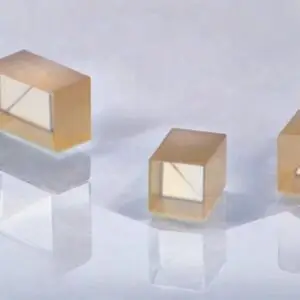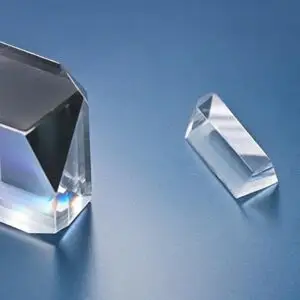
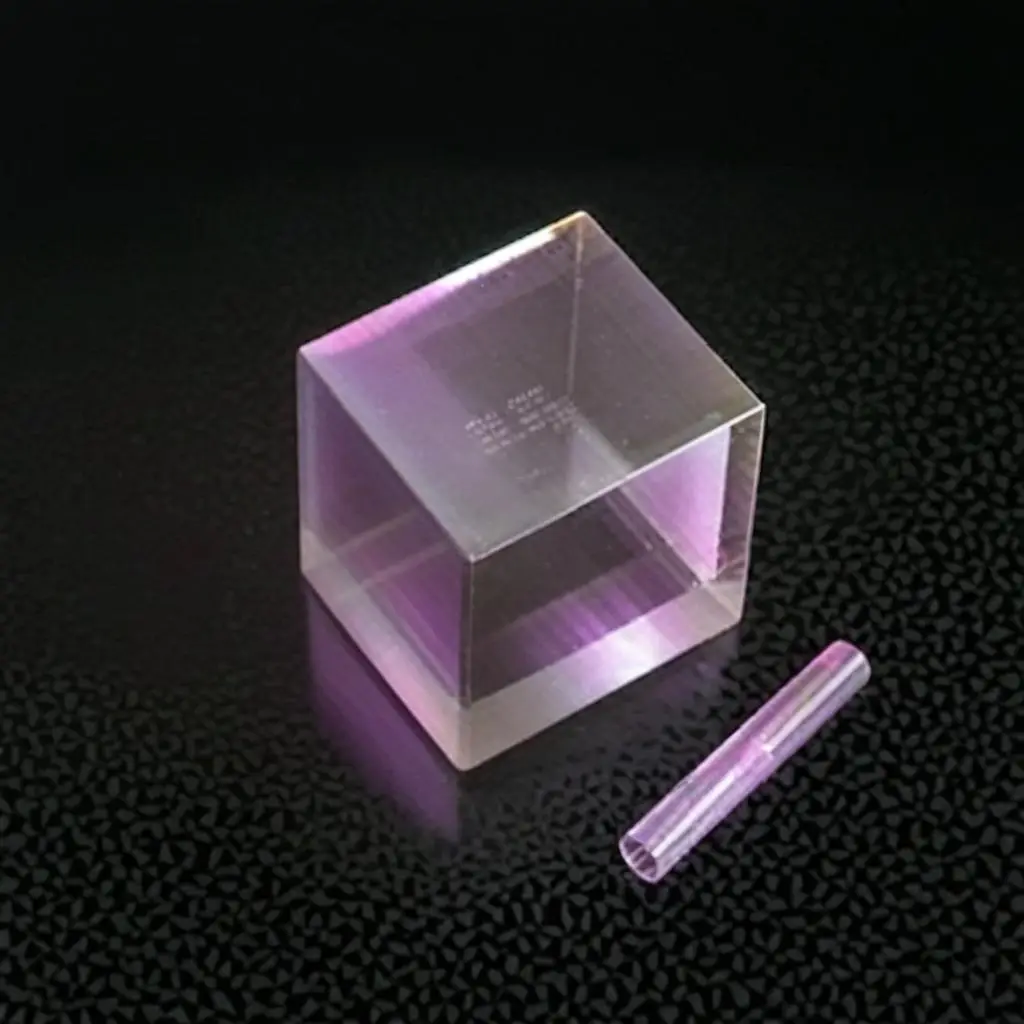
POC-OC-122422-PPKTP Crystal

  • Wide Transparency Range: Effective transmission from 350 nm to 4000 nm for versatile applications.
  • Efficient Nonlinear Conversion: Optimized for Quasi-Phase Matching (QPM) with minimal phase mismatching.
  • High Conversion Efficiency: Ideal for second-harmonic generation (SHG), sum-frequency generation (SFG), and spontaneous parametric down-conversion (SPDC).
  • Robust and Stable: Resistant to temperature variations, ensuring long-term performance and reliability.
  • Customizable Specifications: Suitable for specific wavelengths and applications as per user requirements.

Customizable Components Available for This Material to Meet Your Specific Needs!

General Description

Periodically Poled Potassium Titanyl Phosphate (PPKTP) is a nonlinear crystal widely used in photonic applications for its exceptional ability to achieve high-efficiency frequency conversion through Quasi-Phase Matching (QPM). This crystal is engineered with a unique structure featuring alternating self-polarized domains that facilitate QPM processes. The key advantage of PPKTP is its capacity to correct non-collinear phase mismatches, enabling robust nonlinear optical interactions across its broad transparency range (350–4000 nm).

Due to its high nonlinear coefficient and broad transparency range, PPKTP is an ideal choice for demanding photonics applications such as second-harmonic generation (SHG), sum-frequency generation (SFG), and spontaneous parametric down-conversion (SPDC). These properties, combined with its robust structural stability, make PPKTP crystals versatile for laser technology, quantum optics, spectroscopy, and biomedical imaging applications

General Applications and Examples

PPKTP crystals have a wide range of applications in photonics, particularly in areas requiring efficient nonlinear optical processes. Some notable applications include:

  1. Spontaneous Parametric Down-Conversion (SPDC):
    • PPKTP is a key material for SPDC processes in quantum optics. It enables the generation of entangled photon pairs, a critical resource for quantum key distribution, quantum computing, and quantum imaging.
    • Example: A single PPKTP crystal can be used in a quantum entanglement setup to create pairs of photons with high efficiency and purity.
  2. Second-Harmonic Generation (SHG):
    • Widely used for generating visible green laser light from infrared lasers, SHG applications in PPKTP often operate near the 1 μm wavelength range.
    • Example: PPKTP crystals are employed in green laser pointers and compact solid-state lasers used in spectroscopy.
  3. Sum-Frequency Generation (SFG):
    • SFG in PPKTP is utilized in various spectroscopic and imaging techniques, including biomedical imaging and chemical sensing.
    • Example: SFG microscopy combines infrared and visible light to provide highly sensitive, label-free imaging of biological samples.
  4. Frequency Conversion Applications:
    • PPKTP crystals facilitate frequency doubling and tripling in laser systems, enabling the creation of tunable laser outputs for industrial and scientific uses.
  5. Broadband Applications:
    • PPKTP crystals support a wide transparency range, making them suitable for multi-wavelength optical communication and high-precision laser-based instrumentation.

Chemical and Structural Properties

PropertyValue
Chemical FormulaKTiOPO4
Crystal StructureOrthorhombic
Transparency Range350–4000 nm
Nonlinear Coefficientsd33 = 16.9 pm/V, d31 = 4.1 pm/V
Damage Threshold> 5 GW/cm² (at 1064 nm, 10 ns pulse)
Thermal Conductivity~2 W/m·K
Refractive Index (1064 nm)n_o = 1.824, n_e = 1.742

Optical and Nonlinear Optical Properties

PropertyValue
Nonlinear ProcessQuasi-Phase Matching (QPM)
Conversion EfficiencyUp to 50%
Phase Matching TypeType I and Type II
Coherence Length~30 μm
Effective Nonlinear Coefficient (deff)9.5 pm/V (typical for QPM)

Standard Fabrication Specifications

SpecificationValue
Dimensions2 × 2 × 10 mm (standard)
Poling Periods4.2 μm, 6.8 μm, custom sizes available
Surface Flatnessλ/10
Parallelism< 10 arc seconds
Perpendicularity< 15 arc minutes
Surface Quality10-5 Scratch-Dig

Spectrum Transmission Curve: N.A

Coating Specification

Coating TypeSpecifications
Anti-Reflective (AR) CoatingR < 0.2% for specific wavelengths
Broadband CoatingSuitable for 700–2000 nm
Custom CoatingsAvailable upon request

  • Adhesion Test: Compliant with MIL-C-675C military standards, an adhesion test involved applying a tape that meets LT-90 specifications onto the lens film layer. The tape was affixed fully and then removed vertically. This procedure was performed three times, resulting in no blistering or peeling.
  • Temperature Test: In line with MIL-C-675C specifications, test pieces were subjected to temperatures of -62±1℃ and 71±1℃. After maintaining them at room temperature (16℃~32℃) for two hours, the adhesion test was repeated, confirming no film detachment.
  • Abrasion Resistance Test: Conforming to MIL-C-675C and CCC-C-440 standards, the abrasion resistance test involved a gauze tester applying a minimum force of 1.0 lbs (0.45 kg) to the film. This was repeated 25 times with gauze widths of 1/4 inch (6.4mm) and 3/8 inch (9.5mm), ensuring no damage occurred to the film surface.
  • Humidity Test: Under MIL-C-675C criteria, the test piece was placed in a controlled temperature and humidity chamber set to 49 ±2℃ and 95%~100% humidity for 24 hours. The film remained intact, with no peeling, scratches, or other defects.
  • Solvent and Cleaning Testing: Following MIL-C-675C specifications, test pieces were exposed to room temperature conditions (16℃~32℃) and tested with acetone and alcohol for at least 10 minutes each. After air drying and subsequent cleaning with a cotton cloth soaked in alcohol, the film surface showed no signs of peeling or scratches.
  • Salt Spray Test: After 100 hours in a 35°C environment with a 5% saltwater concentration, the film showed no signs of damage.
Product CodeDimensions (mm)Poling Period (μm)Price (USD)
PPKTP-012 × 2 × 104.2600
PPKTP-022 × 2 × 156.8750
Custom-PPTKPCustomizableCustomizableRequest Quote
//body code