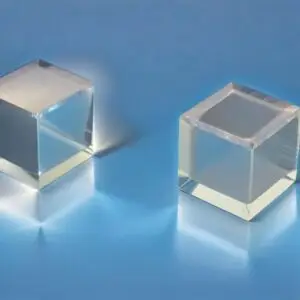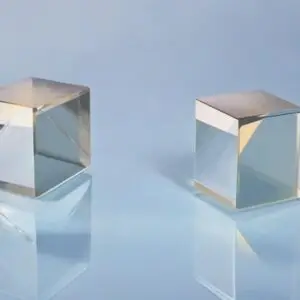
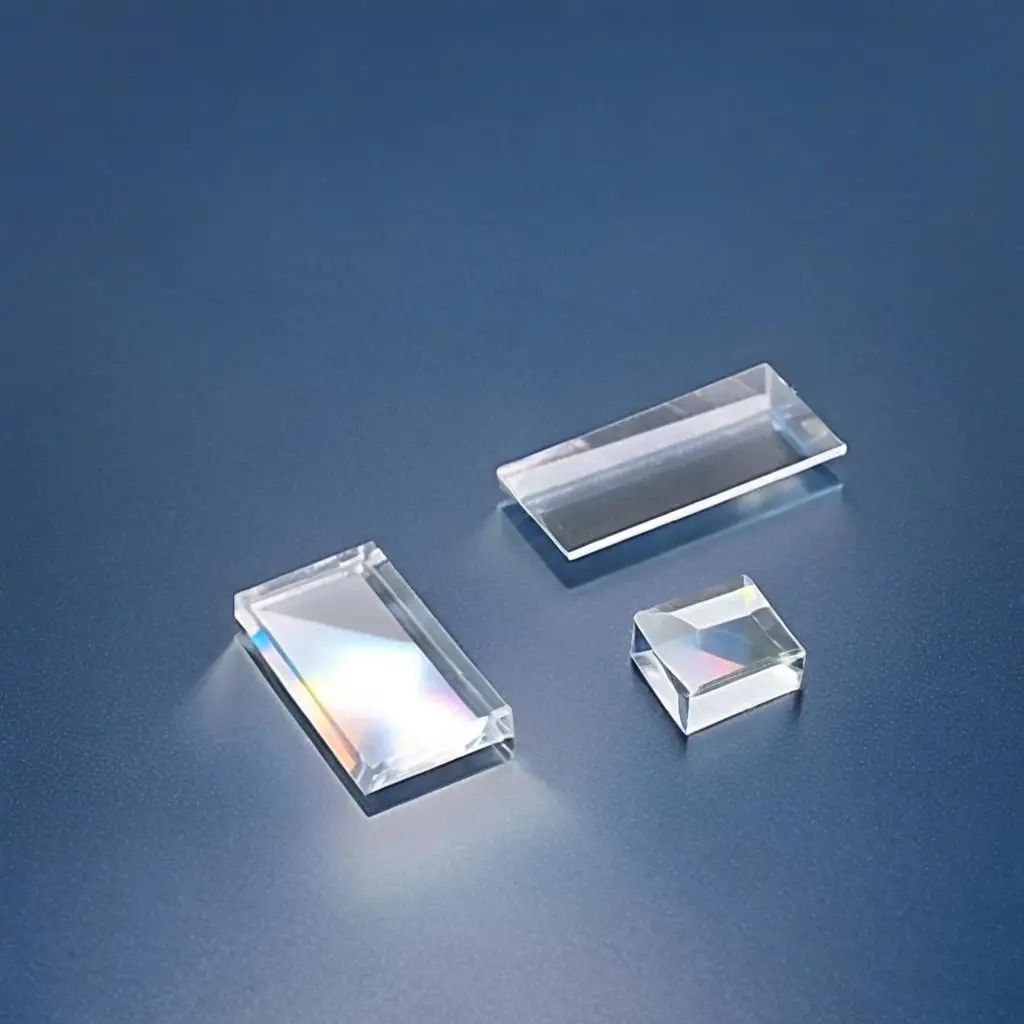
Barium Nitrate Crystal (Ba(NO₃)₂) is a cubic crystal known for its high Raman gain coefficient, making it one of the most efficient materials for Raman laser applications in nanosecond steady-state regimes. The material exhibits a broad transparency range (350 nm to 1800 nm) and moderate damage thresholds, making it suitable for applications requiring “eye-safe” radiation in the 1.59 µm range. Despite its advantages, its relatively low thermal conductivity (1.17 W·m⁻¹·K⁻¹) and high thermo-optic coefficient (dn/dT = -20 × 10⁻⁶/K) can lead to thermal lensing, requiring careful thermal management during operation. Barium Nitrate Crystal is hygroscopic and should be handled with care.
Barium Nitrate Crystals are used in a range of Raman laser systems. Typical applications include:
For these applications, the Crystal high transparency and Raman frequency shift make it an indispensable material for advanced photonics solutions.
| Property | Value |
|---|---|
| Chemical Formula | Ba(NO₃)₂ |
| Crystal Structure | Cubic, P-2₁3 |
| Lattice Parameters | a = b = c = 8.11 Å |
| Density | 3.25 g/cm³ |
| Mohs Hardness | 2.5–3 |
| Transparency Range | 0.33–1.8 µm |
| Refractive Index @ 1064 nm | 1.5559 |
| Thermal Conductivity | 1.17 W·m⁻¹·K⁻¹ |
| Thermal Expansion Coefficient | 13 × 10⁻⁶ / K |
| Thermo-Optic Coefficient (dn/dT) | -20 × 10⁻⁶ / K |
| Raman Frequency Shift | 1048 cm⁻¹ |
| Raman Linewidth | 0.4 cm⁻¹ |
| Raman Gain | 47 cm/GW @ 532 nm |
| Laser-Induced Damage Threshold | > 10 J/cm² @ 1064 nm, 10 ns |
| Optical Property | Value |
|---|---|
| Raman Frequency Shift | 1048 cm⁻¹ |
| Raman Gain | 47 cm/GW @ 532 nm, 11 cm/GW @ 1064 nm |
| Transparency Range | 0.33 µm – 1.8 µm |
| Damage Threshold | 10 J/cm² @ 1064 nm, 10 ns |
| Refractive Index | 1.5559 @ 1064 nm |
| Optical Property | Value |
|---|---|
| Raman Frequency Shift | 1048 cm⁻¹ |
| Raman Gain | 47 cm/GW @ 532 nm, 11 cm/GW @ 1064 nm |
| Transparency Range | 0.33 µm – 1.8 µm |
| Damage Threshold | 10 J/cm² @ 1064 nm, 10 ns |
| Refractive Index | 1.5559 @ 1064 nm |
The transparency curve for Barium Nitrate Crystals reveals a broad operational range from 350 nm to 1800 nm, ideal for applications in visible and near-infrared wavelengths.
AR Coating: <0.2% reflectance at 500-700 nm
| Face Dimensions | Length | Coatings | Price (USD) |
|---|---|---|---|
| 5 × 5 mm | 15 mm | AR @ 500–700 nm | $870 |
| 5 × 5 mm | 30 mm | AR @ 500–700 nm | $1050 |
| 8 × 8 mm | 45 mm | AR @ 500–700 nm | $1240 |
| 8 × 8 mm | 75 mm | AR @ 500–700 nm | $1410 |
| Custom | Custom | Upon Request | Upon Request |