POC-OC-122512-SBN Crystal

  • High optical and photorefractive properties with Ce-doped and pure variants.
  • Supports efficient phase-conjugation applications.
  • Customizable size, doping levels, and antireflective coatings available.
  • Poling and electrode customization options.
  • Inclusion-free, homogenous structure for consistent optical performance.

Customizable Components Available for This Material to Meet Your Specific Needs!

General Description

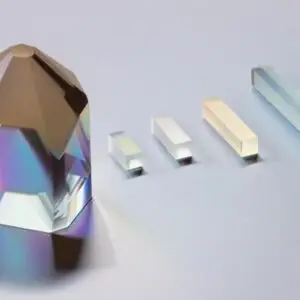
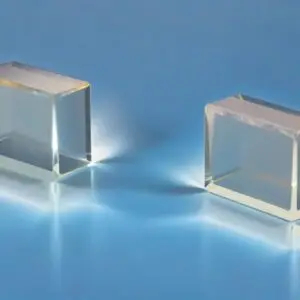
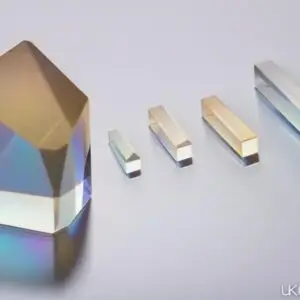
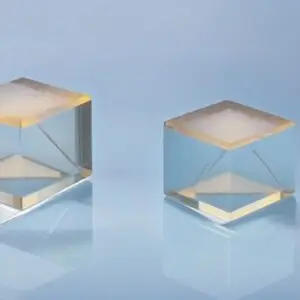
Strontium-Barium Niobate (SBN:61) is a ferroelectric crystal with exceptional optical and photorefractive properties. Its high photorefractive sensitivity makes it a preferred material in electro-optics and nonlinear optics applications. The material features a tetragonal crystal structure with lattice parameters of a = 12.46 Å and c = 3.946 Å, ensuring uniformity and stability. SBN crystals are grown using the Modified Stepanov method to achieve a high-quality, inclusion-free product with dimensions up to 40 mm. They can be doped with Cerium (Ce) to enhance photorefractive efficiency, expanding their application potential in advanced optical devices.

General Applications and Examples

  • Optical Information Recording: SBN crystals are widely used in holographic data storage and photonic memory systems, offering high-resolution capabilities and long-term stability.
  • Pyroelectric Detectors: Their pyroelectric coefficients make them suitable for thermal imaging and infrared detection.
  • Nonlinear Optics: Efficient phase-conjugation properties allow SBN crystals to be used in optical correlators and signal processing devices.
  • Acousto-Optic Devices: The high photorefractive sensitivity supports beam deflection and modulation applications.
  • Custom Applications: Self-pumped self-conjugation mirrors and electro-optic modulators benefit from SBN’s exceptional transparency and refractive index.

Chemical and Structural Properties

Property Values
Composition Sr_xBa_(1-x)Nb_2O_6
Crystal Structure Tetragonal (4 mm)
Lattice Parameters a = 12.46 Å, c = 3.946 Å
Density 5.4 g/cm³
Mohs Hardness 5.5
Melting Temperature 1480°C
Curie Temperature 75°C
Transparency Range 0.45–5.5 μm

Optical Properties

Optical Properties Values
Refractive Index (at 633 nm) n_o = 2.3103, n_e = 2.2817
Birefringence Δn -0.0286
Half-Wave Voltage (λ/2) 240 V
Electro-Optic Coefficients r_33 = 250 pm/V
Pyroelectric Coefficient 0.065 μC/cm² K
Dielectric Constant 880

Standard Fabrication Specifications

Specification Details
Orientation Short edge along tetragonal axis
Poling Poled or unpoled
Electrodes Carbon-water or no electrodes
Clear Aperture 85%
Face Dimensions Tolerance ±0.2 mm
Thickness Tolerance ±0.2 mm
Parallelism Error <30 arcsec
Protective Chamfers <0.1 mm at 45°
Surface Quality 40-20 S-D over aperture
Surface Flatness <λ/4 @632.8 nm

Coating Specification

  • Available as uncoated crystals; antireflective coatings available upon request.
  • Custom coatings to enhance performance at specific wavelengths can be provided.
  • Adhesion Test: Compliant with MIL-C-675C military standards, an adhesion test involved applying a tape that meets LT-90 specifications onto the lens film layer. The tape was affixed fully and then removed vertically. This procedure was performed three times, resulting in no blistering or peeling.
  • Temperature Test: In line with MIL-C-675C specifications, test pieces were subjected to temperatures of -62±1℃ and 71±1℃. After maintaining them at room temperature (16℃~32℃) for two hours, the adhesion test was repeated, confirming no film detachment.
  • Abrasion Resistance Test: Conforming to MIL-C-675C and CCC-C-440 standards, the abrasion resistance test involved a gauze tester applying a minimum force of 1.0 lbs (0.45 kg) to the film. This was repeated 25 times with gauze widths of 1/4 inch (6.4mm) and 3/8 inch (9.5mm), ensuring no damage occurred to the film surface.
  • Humidity Test: Under MIL-C-675C criteria, the test piece was placed in a controlled temperature and humidity chamber set to 49 ±2℃ and 95%~100% humidity for 24 hours. The film remained intact, with no peeling, scratches, or other defects.
  • Solvent and Cleaning Testing: Following MIL-C-675C specifications, test pieces were exposed to room temperature conditions (16℃~32℃) and tested with acetone and alcohol for at least 10 minutes each. After air drying and subsequent cleaning with a cotton cloth soaked in alcohol, the film surface showed no signs of peeling or scratches.
  • Salt Spray Test: After 100 hours in a 35°C environment with a 5% saltwater concentration, the film showed no signs of damage.
Material Face Dimensions Length Doping SKU Price (USD)
SBN:61 5 x 5 mm 5 mm Undoped 73 1850
10 mm Undoped 74 2250
15 mm Undoped 75 2750
5 mm CeO₂ 0.002 wt. % 6940 1850
10 mm CeO₂ 0.002 wt. % 6941 2250
15 mm CeO₂ 0.002 wt. % 6942 2750
5 mm CeO₂ 0.01 wt. % 6944 1850
10 mm CeO₂ 0.01 wt. % 6945 2250
15 mm CeO₂ 0.01 wt. % 6946 2750
Customization Available upon request Contact for pricing
//body code