
Germanium is an important infrared optical material used in thermal imaging, infrared sensors, MWIR and LWIR systems, night vision equipment, surveillance systems, and custom optical assemblies.
However, compared with standard optical glass and several other infrared materials, components made from this material are usually more expensive. The main reasons include limited raw material availability, high material value, precision manufacturing requirements, coating processes, inspection, and production waste.
This guide explains the main factors affecting Germanium optics cost and what customers should consider before requesting a quotation.
Why Are Germanium Optics Expensive?
The price of an infrared component is not based only on its outside dimensions. It also depends on the amount of raw material required, the complexity of the design, the manufacturing process, coating specifications, inspection requirements, and order quantity.
For example, a simple flat window is generally easier to manufacture than a precision aspheric lens or optical dome. Likewise, a standard-size component with commercial tolerances normally costs less than a large custom part with tight optical specifications.
Several major factors contribute to the final price.
Germanium Raw Material Is Limited
Germanium is not normally produced in the same way as common optical glass.
Instead, it is often recovered as a by-product of mining and refining activities. Therefore, its availability can depend on the production of other materials and the capacity of the global supply chain.
When supply is limited but demand remains strong, the raw material price may increase. Availability can also affect quotation validity and production lead time.
As a result, material cost is one of the most important factors behind the price of finished infrared optics.
Demand From High-Value Industries
This infrared material is used in many advanced systems, including:
- Thermal imaging cameras
- Infrared sensors
- MWIR and LWIR optical systems
- Night vision equipment
- Security and surveillance systems
- Aerospace optical systems
- Scientific instruments
- Industrial inspection equipment
- Laser and infrared measurement systems
Many of these applications require reliable performance and consistent optical quality. Consequently, customers may require controlled material grades, detailed inspection, special coatings, environmental durability, or documentation.
Strong demand from these industries can place additional pressure on material supply and pricing.
Infrared Optical Quality Requirements Are Higher
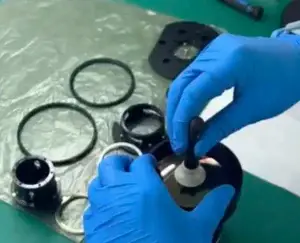
Material intended for optical use must meet more demanding requirements than general-purpose industrial material.
Depending on the application, customers may require control of:
- Material grade
- Infrared transmission
- Internal defects
- Crystal orientation
- Resistivity
- Homogeneity
- Dimensions
- Surface condition
In addition, the selected material must be suitable for the required wavelength range and final optical design.
A thermal imaging lens, for instance, may require more carefully selected material than a basic mechanical blank. Higher material quality and additional certification can therefore increase the quotation.
Precision Manufacturing Requirements
A finished optical component usually goes through several controlled production stages.
These may include:
- Raw material selection
- Cutting or slicing
- Grinding and shaping
- Lapping
- Optical polishing
- Diamond turning, where required
- Chamfering
- Coating
- Final inspection
- Cleaning and packing
Each process requires suitable equipment, experienced operators, and quality control.
Flat windows may have a relatively straightforward geometry. However, lenses, aspheric components, domes, and other curved parts require more complicated machining and measurement.
Therefore, component type has a major influence on Germanium optics cost.
Material Waste Can Affect the Final Price
During fabrication, part of the raw material is removed through cutting, grinding, polishing, or machining.
For example, a finished lens cannot normally be produced from a raw piece with exactly the same dimensions. Additional material is needed for cutting allowance, holding, grinding, polishing, and edge processing.
Material loss may be greater when the component has:
- A large diameter
- High thickness
- Deep curved surfaces
- An unusual shape
- Tight dimensional tolerances
- A small finished size cut from a larger blank
- Complex edge requirements
Because the starting material is valuable, production yield and material utilisation can significantly affect the finished price.
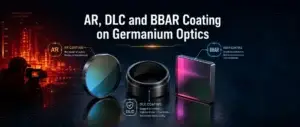
AR, DLC and BBAR Coating Costs
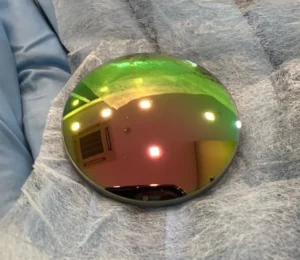
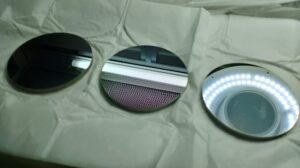
Many Germanium optical components require coating.
Common coating options include:
- AR coating
- DLC coating
- BBAR coating
AR coating helps reduce reflection and improve infrared transmission.
DLC coating helps improve surface protection, especially for outdoor or harsh environment applications.
BBAR coating supports broader infrared wavelength requirements.
Coating adds extra process time, equipment use, inspection, and handling. For demanding coating requirements, the cost can be higher.
Inspection and Quality Control Are Important
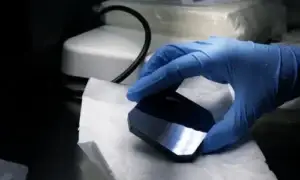
Germanium components often need careful inspection before delivery.
Common inspection items may include:
- Diameter or size
- Thickness
- Surface quality
- Surface flatness
- Parallelism
- Clear aperture
- Coating appearance
- Transmission, if required
- Drawing requirements
For high-performance infrared systems, inspection is important to make sure the component meets the required specification.
This quality control process also adds to the final cost.
Market and Supply Chain Factors
Germanium prices can also be affected by market and supply chain conditions.
These may include:
- Raw material availability
- Global demand
- Export control requirements
- Production capacity
- Lead time
- Quantity ordered
- Material grade and specification
Because of these factors, Germanium prices may change more frequently compared with common optical materials.
What Factors Affect the Price of a Germanium Component?
The final price of a Germanium optical component usually depends on:
| Factor | How It Affects Cost |
|---|---|
| Material size | Larger diameter or thicker parts use more Germanium |
| Component type | Lenses and domes are usually more complex than flat windows |
| Surface quality | Higher surface quality needs more careful polishing |
| Flatness or tolerance | Tighter tolerance increases production difficulty |
| Coating | AR, DLC, BBAR, or custom coating adds process cost |
| Quantity | Prototype quantity is usually more expensive per piece |
| Material availability | Limited raw material can affect price and lead time |
| Inspection requirement | More testing or reports can increase cost |
How to Reduce Germanium Component Cost
Customers can sometimes reduce cost by reviewing the specification carefully.
Useful ways include:
- Avoid over-specifying tolerance if not required
- Confirm whether coating is needed
- Use standard sizes where possible
- Provide clear drawings and application details
- Confirm whether prototype or batch quantity is needed
- Allow reasonable lead time for material preparation and production
A clear specification helps the supplier recommend a suitable and cost-effective manufacturing option.
What Information Should You Provide Before Requesting a Quote?
To request a Germanium optical component quotation, it is helpful to provide:
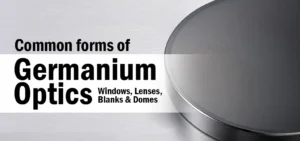
- Component type: window, lens, blank, or dome
- Diameter or size
- Thickness or center thickness
- Material type, if required
- Wavelength range
- Coating requirement
- Surface quality
- Surface flatness
- Parallelism or wedge requirement
- Quantity
- Drawing or specification file
- Application or system type
This information helps us estimate material usage, production process, coating requirement, inspection needs, and lead time.
Example Specification for Germanium Window
| Item | Example Specification |
|---|---|
| Material | Germanium / Ge |
| Component Type | Infrared optical window |
| Shape | Round flat window |
| Diameter | 50.00 mm |
| Thickness | 5.00 mm |
| Wavelength Range | 8–12 µm LWIR |
| Surface Quality | 60/40 scratch-dig |
| Surface Flatness | λ/2 @ 632.8 nm |
| Parallelism | < 3 arc min |
| Clear Aperture | ≥ 90% |
| Coating Requirement | AR coating / DLC coating / Custom coating |
| Edge / Chamfer | Protective chamfer, 0.2 mm × 45° |
| Quantity | 10 pcs |
| Application | Thermal imaging / IR sensor protection / surveillance system |
Conclusion
Germanium is expensive because the raw material supply is limited, the material is used in high-value infrared applications, and the manufacturing process requires precision cutting, polishing, coating, inspection, and careful handling.
The final price depends on the size, thickness, component type, tolerance, coating, quantity, and current material availability.
POC supplies Germanium optical components including Germanium windows, Germanium lenses, Germanium blanks, Germanium domes, coated Germanium optics, and custom Germanium components.
Contact us to discuss your Germanium optical component requirements.
Price Reference Note
Germanium raw material price may fluctuate due to market demand and supply conditions. Customers may refer to public commodity price platforms, such as Trading Economics, to check general Germanium price trends:
https://tradingeconomics.com/gecnybgq:com
However, the final quotation for Germanium windows, lenses, blanks, domes, or coated components will depend on the actual specification, material usage, processing difficulty, coating requirement, quantity, and lead time.