


N-Type Germanium Window for Infrared Applications
An N-Type Germanium window is commonly used in infrared optical systems because Germanium provides good transmission across important MWIR and LWIR wavelength ranges.
These optical windows protect infrared detectors, sensors, lenses, and camera modules while allowing infrared radiation to pass through the system. Therefore, they are widely used in thermal imaging, infrared sensing, surveillance, aerospace and defense equipment, industrial systems, medical instruments, and custom infrared assemblies.
Depending on the application, N-Type Germanium windows can use AR coating, DLC coating, or a custom infrared coating designed for a specific wavelength range and operating environment.
What Is an N-Type Germanium Window?
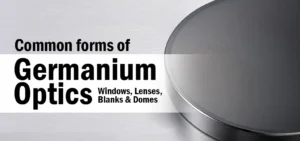
An N-Type Germanium window is a flat optical component manufactured from N-Type monocrystalline Germanium material.
Typically, the window sits in front of an infrared detector, sensor, lens system, or thermal camera module. It protects sensitive internal components while allowing infrared energy to enter the optical system.
In simple terms, an N-Type Germanium window can:
- Transmit infrared radiation
- Protect detectors and internal optics
- Support MWIR and LWIR imaging systems
- Maintain suitable optical performance in infrared applications
- Support AR, DLC, and custom infrared coatings
In addition, manufacturers can customize Germanium windows according to size, thickness, surface quality, flatness, wavelength range, and coating requirements.
Why Is Germanium Used for Infrared Windows?
Germanium is one of the most widely used materials for infrared optical components. Its optical properties make it suitable for many thermal imaging and infrared sensing systems.
For example, Germanium windows are useful when a system requires:
- Good infrared transmission
- Detector or sensor protection
- A protective front optical window
- MWIR or LWIR wavelength transmission
- Custom infrared coatings
- Reliable optical quality
As a result, many thermal cameras and infrared instruments use Germanium as the front protective optical component.
Common Applications of N-Type Germanium Windows
N-Type Germanium windows support a wide range of infrared applications.
Common applications include:
- Thermal imaging systems
- Infrared sensors
- MWIR optical systems
- LWIR optical systems
- Aerospace and defense systems
- Industrial OEM equipment
- Life science and medical instruments
- Surveillance and security systems
- Infrared camera modules
- Custom infrared optical assemblies
In these applications, the window protects the internal optical path while allowing infrared radiation to reach the detector or imaging system.
N-Type Germanium Windows for MWIR and LWIR
Germanium supports several important infrared wavelength bands. However, the final usable wavelength range also depends on the coating design and system requirements.
| Infrared Range | Common Wavelength | Typical Application |
|---|---|---|
| MWIR | 3–5 µm | Cooled infrared systems, sensing, and scientific instruments |
| LWIR | 8–12 µm or 8–14 µm | Thermal imaging, uncooled cameras, and surveillance systems |
| Broadband IR | Custom range | Broadband infrared instruments and custom optical systems |
Therefore, customers should select the wavelength range according to the detector, lens design, coating performance, and final application.
General Specifications of N-Type Germanium Windows
N-Type Germanium windows can be manufactured according to customer drawings and optical specifications.
Typical specifications include:
| Specification | Typical Options |
|---|---|
| Material | N-Type monocrystalline Germanium |
| Shape | Round, square, rectangular, or custom |
| Wavelength Range | MWIR, LWIR, or custom infrared range |
| Surface Quality | 60-40, 40-20, or custom |
| Surface Flatness | According to drawing or application requirement |
| Parallelism | Custom specification available |
| Clear Aperture | According to customer requirement |
| Coating | Uncoated, AR, DLC, or custom IR coating |
Final specifications should always follow the customer drawing, optical design, and application requirements.
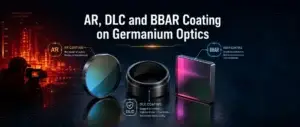
AR Coating on Germanium Windows
Germanium has a high refractive index. Consequently, an uncoated Germanium surface can reflect a significant amount of infrared radiation.
An anti-reflection coating helps reduce this reflection and improve infrared transmission through the window.
Common AR coating options include:
- AR coating for 3–5 µm
- AR coating for 8–12 µm
- AR coating for 8–14 µm
- Broadband infrared AR coating
- Custom AR coating for specific wavelength ranges
For this reason, AR-coated Germanium windows are commonly used in thermal cameras, infrared sensors, MWIR systems, LWIR systems, and scientific instruments.
DLC Coating on Germanium Windows
DLC stands for Diamond-Like Carbon. This coating provides additional surface protection for Germanium windows used in exposed or demanding environments.
A DLC-coated Germanium window is particularly useful for:
- Outdoor thermal cameras
- Surveillance systems
- Harsh-environment infrared equipment
- Front protective windows
- Aerospace and defense infrared systems
- Applications exposed to dust, moisture, and frequent cleaning
For example, a system may use DLC coating on the exposed surface and AR coating on the opposite surface. This combination can improve environmental protection while maintaining good infrared transmission.
However, DLC does not make the optical component completely damage-proof. Proper handling, cleaning, and storage are still important.
AR Coating vs DLC Coating
The correct coating depends on both optical and environmental requirements.
| Coating Type | Main Purpose | Common Use |
|---|---|---|
| AR Coating | Reduce reflection and improve IR transmission | Thermal imaging, MWIR/LWIR sensors, and IR windows |
| DLC Coating | Improve surface protection and durability | Outdoor, exposed, or harsh-environment windows |
| Custom IR Coating | Meet specific wavelength and system requirements | Special optical systems and custom projects |
Therefore, customers should consider wavelength range, coating side, transmission requirement, operating environment, and durability when selecting a coating.
Understand different type of coating
Thermal Considerations for Germanium Windows
Temperature is another important consideration when using Germanium.
As operating temperature increases, the optical transmission of Germanium can decrease. Therefore, designers should review the expected temperature range before integrating a Germanium window into the system.
For high-temperature applications, it is helpful to provide the expected operating temperature, window position, environmental conditions, and required wavelength range. This information allows the optical design and coating requirements to be reviewed more accurately.
How to Select an N-Type Germanium Window
Selecting the correct Germanium window involves more than choosing its diameter and thickness.
First, determine the operating wavelength range. For example, a thermal imaging system may require transmission across 8–12 µm or 8–14 µm.
Next, consider whether the window will operate indoors or outdoors. An indoor system may only require an AR coating, while an exposed outdoor system may benefit from DLC protection.
In addition, review the required surface quality, flatness, clear aperture, parallelism, operating temperature, and mechanical dimensions.
By considering these factors together, the window can be designed to match both the optical system and its working environment.
What Information Should You Provide Before Requesting a Quote?
To request a quotation for an N-Type Germanium window, please provide as much of the following information as possible:
- Germanium material type, such as N-Type
- Diameter, length, and width
- Dimensional tolerances
- Thickness
- Operating wavelength range
- Coating requirement: uncoated, AR, DLC, or custom
- Coating side requirement
- Surface quality
- Surface flatness
- Parallelism or wedge requirement
- Clear aperture
- Operating temperature
- Application
- Quantity
- Drawing or optical specification, if available
If the coating requirement is not yet defined, simply provide the wavelength range, operating environment, and application. Our team can then review whether an AR coating, DLC coating, or custom infrared coating is more suitable.
Example N-Type Germanium Window Specification
The following example shows how a typical Germanium window requirement may be defined:
| Parameter | Example Requirement |
|---|---|
| Material | N-Type Germanium |
| Diameter | 25 mm |
| Thickness | 2 mm |
| Wavelength Range | 8–14 µm |
| Surface Quality | 60-40 |
| Clear Aperture | ≥90% |
| Coating | AR/AR or DLC/AR |
| Quantity | According to project requirement |
This is only an example. Actual specifications should follow the optical design and customer drawing.
Custom N-Type Germanium Windows
Not every infrared system uses a standard-size window. Therefore, custom Germanium windows can be manufactured according to specific mechanical, optical, and environmental requirements.
Customization may include:
- Custom diameter or rectangular dimensions
- Different thicknesses
- Special surface quality and flatness
- Custom clear aperture
- MWIR or LWIR AR coatings
- DLC protective coatings
- Custom broadband infrared coatings
- Special edge or chamfer requirements
Providing a drawing is the most effective way to confirm manufacturability and quotation requirements.
Conclusion
N-Type Germanium windows are widely used in infrared optical systems because they support important MWIR and LWIR applications while protecting detectors, sensors, and internal optics.
They are suitable for thermal imaging systems, infrared sensors, surveillance equipment, aerospace and defense systems, industrial OEM products, medical instruments, and custom infrared assemblies.
Furthermore, different coatings can optimize the window for specific applications. AR coatings help improve infrared transmission, while DLC coatings provide additional protection for exposed surfaces.
Shape Optics Technologies supplies N-Type Germanium windows, AR-coated Germanium windows, DLC-coated Germanium windows, and custom Germanium optical components based on customer drawings and application requirements.
Contact us to discuss your N-Type Germanium window requirements.