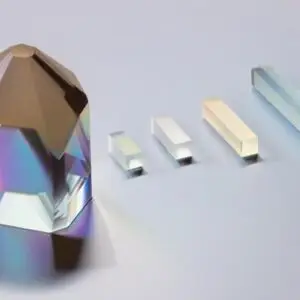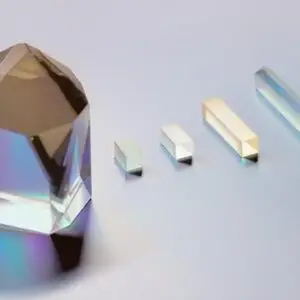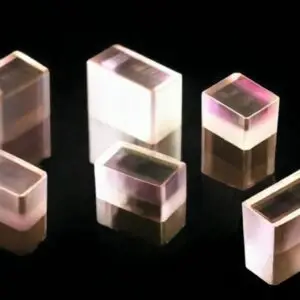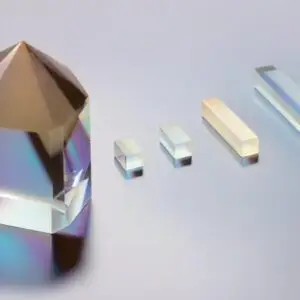
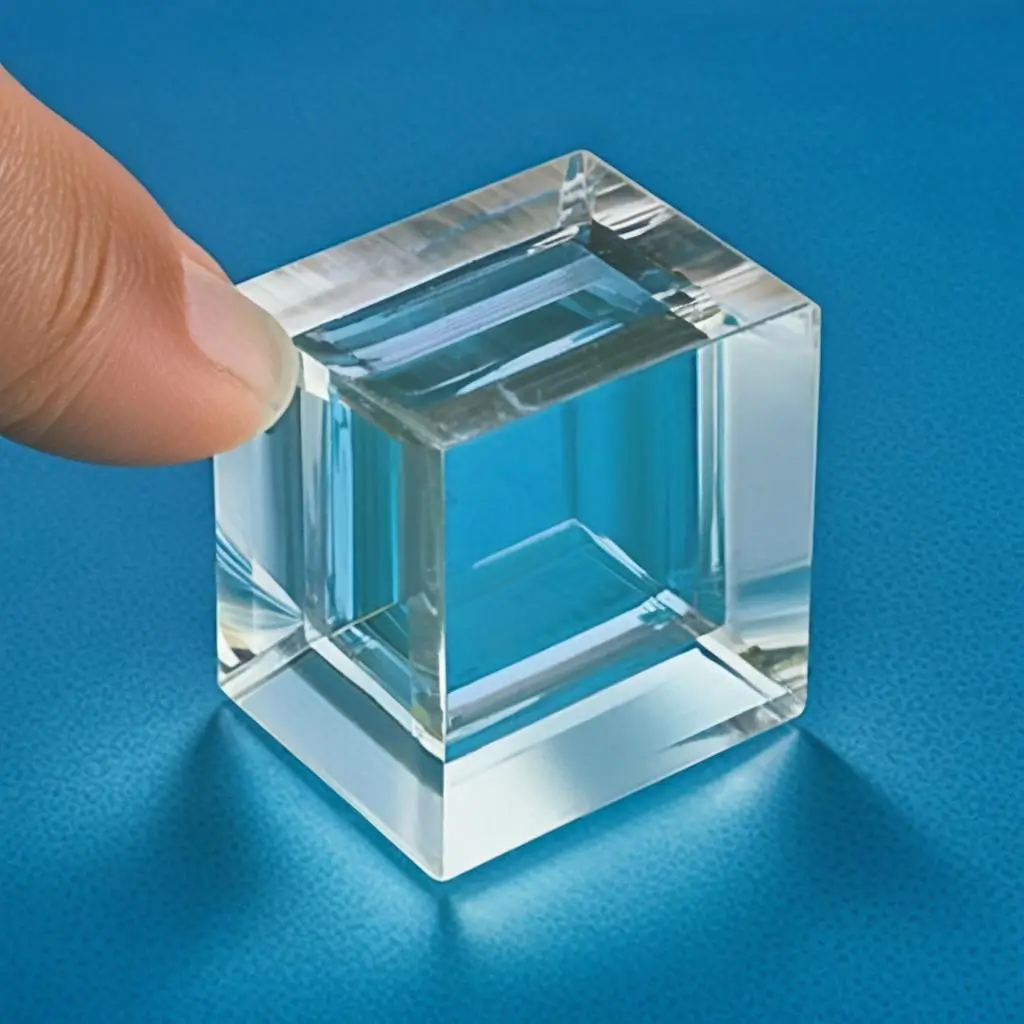
POC-OC-122507-Raman Diamond Crystal

  • High Raman gain coefficient, achieving exceptional Raman frequency shifts of 1332 cm⁻¹.
  • Superior thermal conductivity (>2000 W/m·K) for high-power laser applications.
  • Excellent optical transparency and low scattering loss in broad spectral ranges.
  • Stable crystal quality with high durability and resistance to environmental sensitivity.

Customizable dimensions and anti-reflective coatings tailored for specific applications

Customizable Components Available for This Material to Meet Your Specific Needs!

General Description

Raman Diamond, synthesized through Chemical Vapor Deposition (CVD), is an advanced optical material known for its exceptional Raman scattering properties and optical clarity. Featuring a Raman frequency shift of 1332 cm⁻¹ and a linewidth of 1.5 cm⁻¹, it enables precise frequency modulation and efficient Raman amplification. Compared to other Raman materials, such as KGW and YVO₄, Raman Diamond offers significantly higher gain and superior thermal conductivity, ensuring reliable performance under high-power conditions. Its low defect density, combined with extraordinary thermal and mechanical properties, makes it an ideal choice for laser and spectroscopic systems requiring both efficiency and stability.

General Applications and Examples

Raman Diamond is extensively used in high-end optical applications due to its unique properties:

  1. Raman Lasers: Effective for wavelength-shifting and frequency-stabilized lasers, offering enhanced efficiency with reduced sensitivity to environmental changes.
  2. Spectroscopy: Ideal for Raman spectroscopy systems requiring high-resolution Raman shifts with minimal noise interference.
  3. High-Power Laser Systems: Applied as Raman amplifiers in industrial and scientific high-power laser systems, capable of handling demanding thermal and mechanical stresses.
  4. Quantum Optics: Raman Diamond Crystal Suitable for single-photon experiments and other advanced quantum applications.
  5. Nonlinear Optics: Utilized in harmonic generation and frequency mixing due to its exceptional optical properties.

Chemical and Structural Properties

Property Value
Raman Frequency Shift 1332 cm⁻¹
Linewidth 1.5 cm⁻¹
Thermal Conductivity >2000 W/m·K
Raman Gain 15
Crystal Size 8 mm
Refractive Index 2.41
Density 3.52 g/cm³

Optical Properties

Parameter CVD Raman Diamond KGW YVO₄ Ba(NO₃)₂
Raman Gain 15 4 5 11
Raman Frequency (cm⁻¹) 1332 901 892 1047
Thermal Conductivity (W/m·K) >2000 5 5.2 1.2
Crystal Factor 1440 3 20 1
Size (mm) 8 25 25 25

Standard Fabrication Specifications

Parameter Specification
Crystal Dimensions 6 x 2 x 2 mm
Surface Flatness <λ/10 at 632.8 nm
Parallelism <3 arcseconds
Clear Aperture >90%
Surface Roughness <3 nm

Spectrum Transmission Curve

The absorption curve highlights a low-loss characteristic in Raman Diamond. Its superior optical clarity across UV to IR wavelengths makes it indispensable in high-performance laser and spectroscopic systems.

Coating Specification

  • Anti-Reflective (AR) Coating for optimal transmission at 532 nm, 1064 nm, and other custom wavelengths.
  • Coating durability: Designed to withstand high laser power and extended operational lifetimes.
  • Adhesion Test: Compliant with MIL-C-675C military standards, an adhesion test involved applying a tape that meets LT-90 specifications onto the lens film layer. The tape was affixed fully and then removed vertically. This procedure was performed three times, resulting in no blistering or peeling.
  • Temperature Test: In line with MIL-C-675C specifications, test pieces were subjected to temperatures of -62±1℃ and 71±1℃. After maintaining them at room temperature (16℃~32℃) for two hours, the adhesion test was repeated, confirming no film detachment.
  • Abrasion Resistance Test: Conforming to MIL-C-675C and CCC-C-440 standards, the abrasion resistance test involved a gauze tester applying a minimum force of 1.0 lbs (0.45 kg) to the film. This was repeated 25 times with gauze widths of 1/4 inch (6.4mm) and 3/8 inch (9.5mm), ensuring no damage occurred to the film surface.
  • Humidity Test: Under MIL-C-675C criteria, the test piece was placed in a controlled temperature and humidity chamber set to 49 ±2℃ and 95%~100% humidity for 24 hours. The film remained intact, with no peeling, scratches, or other defects.
  • Solvent and Cleaning Testing: Following MIL-C-675C specifications, test pieces were exposed to room temperature conditions (16℃~32℃) and tested with acetone and alcohol for at least 10 minutes each. After air drying and subsequent cleaning with a cotton cloth soaked in alcohol, the film surface showed no signs of peeling or scratches.
  • Salt Spray Test: After 100 hours in a 35°C environment with a 5% saltwater concentration, the film showed no signs of damage.
Size (mm) Coating SKU Price (USD)
6 x 2 x 2 AR (532 nm) 2001 900
8 x 8 x 2 AR (1064 nm) 2002 1,200
Custom Size Upon Request Custom Quote
//body code