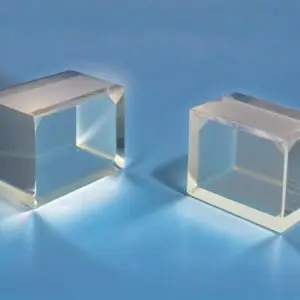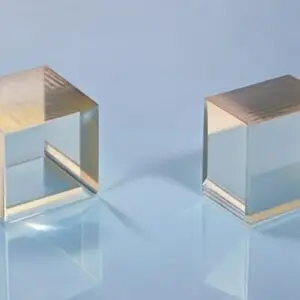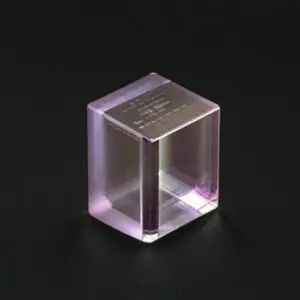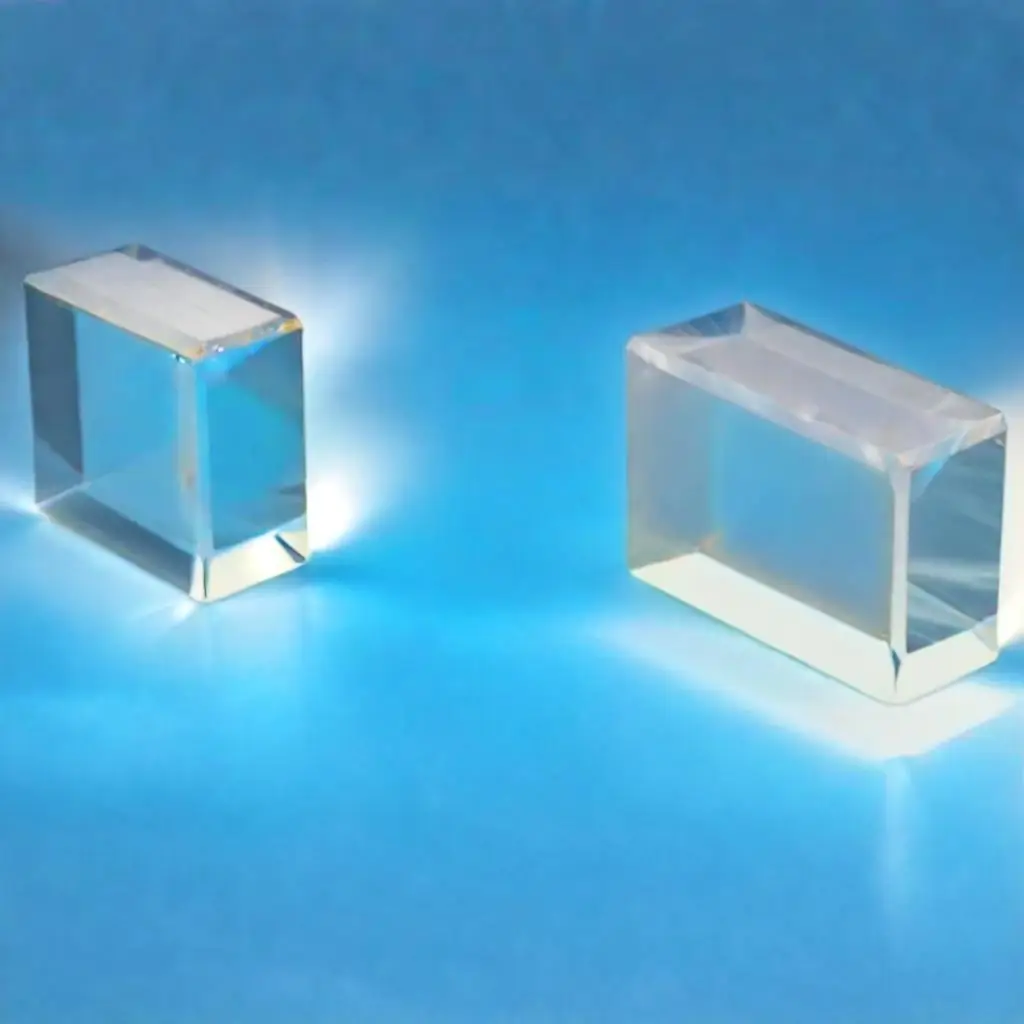
Er,Yb:Phosphate Glass is a co-doped glass known for its excellent laser performance in the “eye-safe” spectral range of 1.5–1.6 µm. The material combines an extended erbium upper laser level lifetime (~8 ms) with a short lifetime (~2–3 ms) of the energy transfer stage between Yb and Er ions. This unique configuration allows efficient energy transfer, minimizing back-energy losses and improving overall system efficiency. Additionally, phosphate glass exhibits a low phonon energy, reducing non-radiative relaxations and enhancing luminescence quantum efficiency. Due to its superior optical and mechanical properties, Er,Yb:Phosphate Glass is widely used for creating compact, energy-efficient lasers operating in demanding applications.
| Property | Unit | Value |
|---|---|---|
| Absorption Peak Wavelength | nm | 970 |
| Absorption Cross-Section | cm² | 1.7 × 10⁻²⁰ |
| Absorption Bandwidth | nm | 20 |
| Laser Wavelength | nm | 1534 |
| Emission Cross-Section | cm² | 8 × 10⁻²⁰ |
| Density | g/cm³ | 2.93 |
| Mohs Hardness | – | 6 |
| Thermal Conductivity | W/m·K | 0.65 |
| dn/dT (Refractive Index Change) | K⁻¹ | -2.1 × 10⁻⁶ |
| Thermal Expansion Coefficient | K⁻¹ | 0.3–1.3 × 10⁻⁶ |
| Typical Doping Levels | – | 0.1–1.0% (Er), 1.7–4% (Yb) |
| Property | Value |
|---|---|
| Refractive Index at 1534 nm | 1.52 |
| Yb to Er Energy Transfer Efficiency | High |
| Emission Lifetime (4I11/2 level) | ~8 ms |
| Absorption Edge | ~970 nm |
| Property | Value |
|---|---|
| Clear Aperture | >90% |
| Face Dimensions Tolerance | ±0.01 mm |
| Length Tolerance | ±0.1 mm |
| Parallelism Error | <20 arcsec |
| Perpendicularity Error | <10 arcmin |
| Surface Quality | 20–10 S/D |
| Surface Flatness | λ/10 @ 632.8 nm |
| Mount | Unmounted |
Property | Value |
Clear Aperture | >90% |
Face Dimensions Tolerance | ±0.01 mm |
Length Tolerance | ±0.1 mm |
Parallelism Error | <20 arcsec |
Perpendicularity Error | <10 arcmin |
Surface Quality | 20–10 S/D |
Surface Flatness | λ/10 @ 632.8 nm |
Mount | Unmounted |
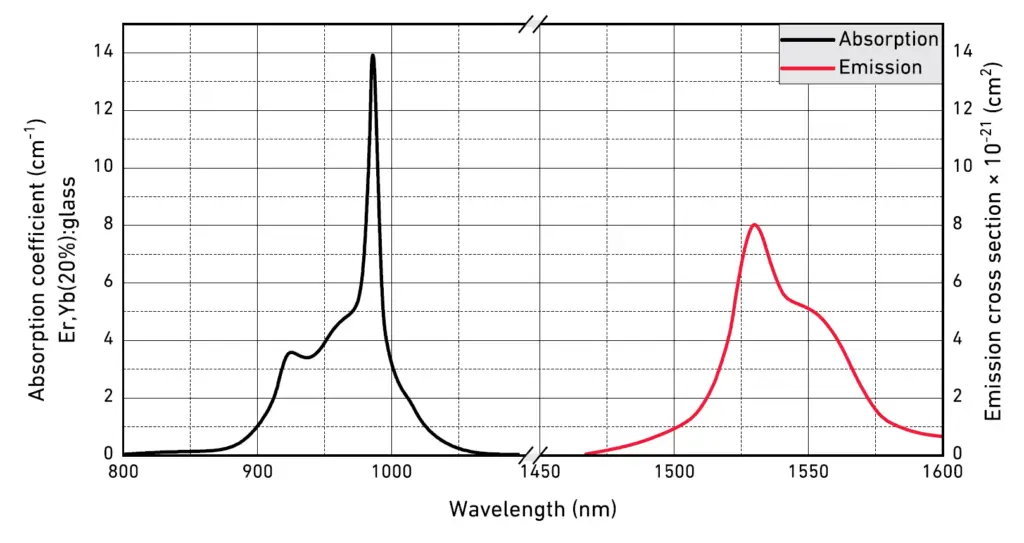
A comprehensive transmission spectrum (graph shown) reveals the high absorption at ~970 nm and a strong emission at ~1534 nm, with minimal losses and consistent transmission efficiency over a broad wavelength range.
Standard AR coatings available for dual wavelengths:
Customized coatings available upon request.
| Face Dimensions | Length | End Faces | Doping | Coatings | Price (USD) |
|---|---|---|---|---|---|
| 3 × 3 mm | 5 mm | Brewster-angle cut | Yb: 20%, Er: 1% | Uncoated | 370 |
| 3 × 3 mm | 10 mm | Right-angle cut | Yb: 20%, Er: 0.5% | AR@940 nm + 1535 nm | 435 |
| 3 × 3 mm | 10 mm | Right-angle cut | Yb: 20%, Er: 0.5% | AR@940 nm + 1535 nm | 435 |
| Customization | Any | Any | Any | Upon request | Upon Request |