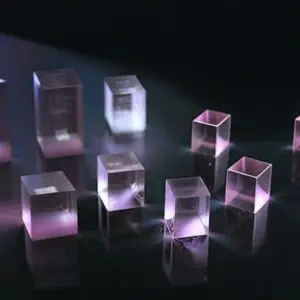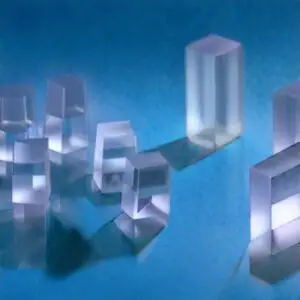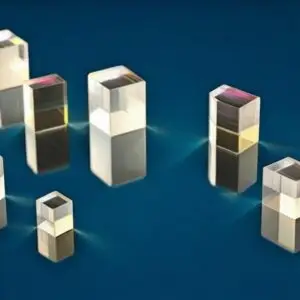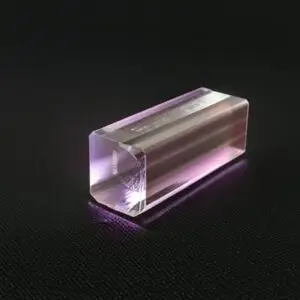
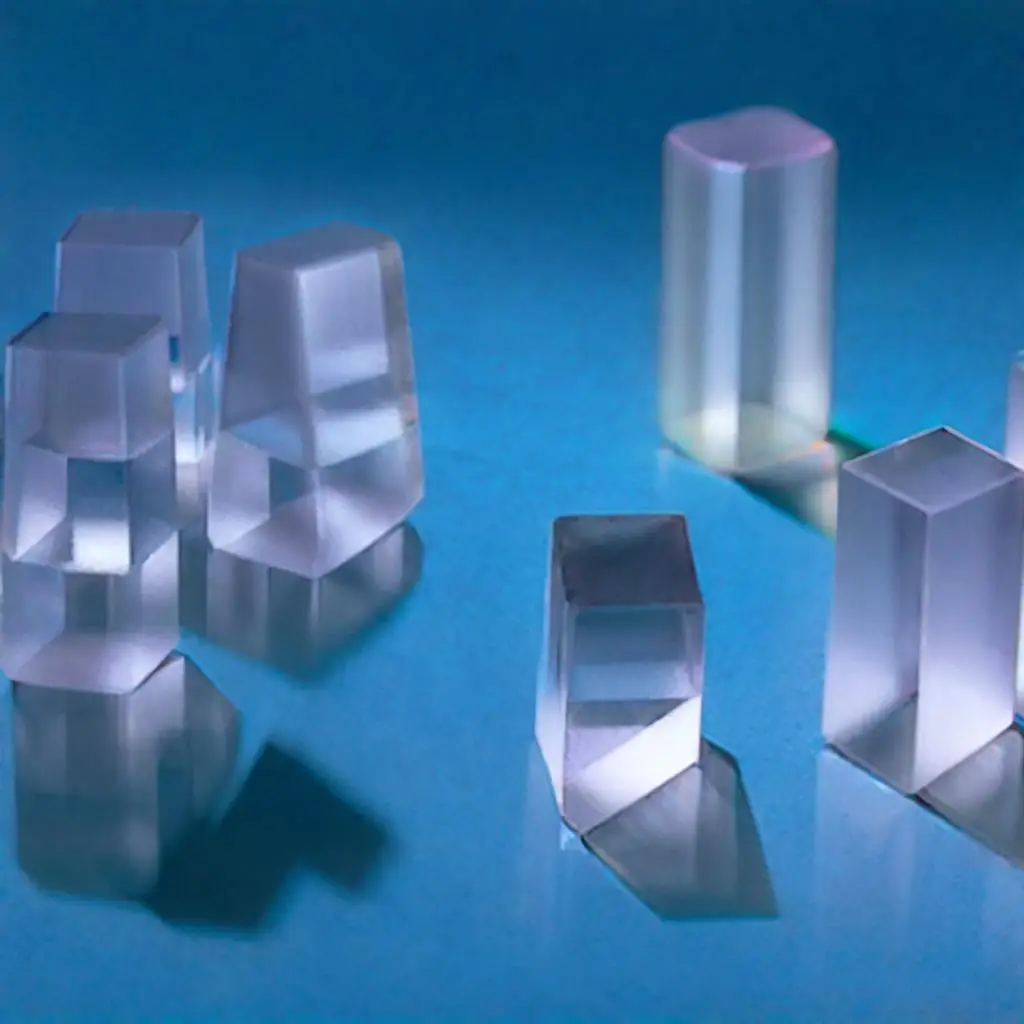
POC-OC-122485-Eye Safe Laser Crystal

  • Operates in a wavelength range (>1.4 µm) that is considered safe for the human eye.
  • High damage threshold and strong absorption in the vitreous body reduce risks to the retina.
  • Ideal for applications in laser ranging, target recognition, and optical communication.
  • Exhibits excellent thermal, mechanical, and optical properties for stable high-power laser systems.
  • Customizable crystal dimensions and coatings to meet application-specific requirements.

Customizable Components Available for This Material to Meet Your Specific Needs!

General Description

Eye Safe Laser Crystals are specialized materials designed to emit laser wavelengths greater than 1.4 µm, which is safe for the human eye as per US national safety standards. This wavelength range ensures that most of the light intensity is absorbed by the vitreous body rather than damaging the retina. An exemplary wavelength is 1.57 µm, which offers 400 times safer exposure compared to conventional 1.06 µm lasers. These crystals are widely utilized in applications that demand precise laser targeting while adhering to stringent safety protocols. Their efficiency in mid-infrared wavelengths and exceptional optical performance make them indispensable in fields such as laser radar, medical treatment, and optical fiber communication.

General Applications and Examples

  1. Laser Ranging:
    Eye safe laser crystals are used in advanced laser range finders for accurate distance measurements in various industries, including automotive and surveying.
  2. Laser Irradiation:
    Their high damage threshold makes them suitable for applications requiring focused and sustained irradiation for scientific or industrial use.
  3. Laser Radar (LIDAR):
    In LIDAR systems, these crystals enable precise and safe target detection and navigation, widely used in automotive safety systems, drones, and environmental mapping.
  4. Target Recognition:
    Their unique wavelength properties ensure contrast enhancement between the target and background, enabling efficient recognition in defense and aerospace applications, including identifying vehicles, ships, and other objects.
  5. Medical Laser Systems:
    Eye safe laser crystals are critical for medical treatments such as dermatological procedures and minimally invasive surgeries, providing safe and precise laser operation.
  6. Optical Fiber Communication:
    These Eye Safe Laser Crystal  are ideal for mid-infrared fiber communication systems, ensuring minimal transmission loss and reliable data transfer over long distances.

Chemical and Structural Properties

PropertyValue
Chemical CompositionCustomized for specific applications
Density~6.5 g/cm³
Thermal Conductivity~20 W·m⁻¹·K⁻¹
Melting Point~1500°C
Crystal Orientation<111>, <100>, or custom
DurabilityHigh damage threshold
Cleavage PlaneCustomizable

Optical Properties

PropertyValue
Emission Wavelength1.5–1.7 µm
Transparency Range1.4–3 µm
Refractive Index~1.8
Laser Damage Threshold>500 MW/cm²
Nonlinear CoefficientHigh
Absorption CoefficientLow

Standard Fabrication Specifications

SpecificationValue
Dimensional Tolerance±0.05 mm
Surface Flatnessλ/8 @ 632.8 nm
Surface Quality40-20 (scratch-dig)
Parallelism<30 arcsec
Bevel<0.25 × 45°
Diameter RangeUp to 100 mm
Thickness Range0.5–10 mm

Spectrum Transmission Curve

The spectrum transmission curves demonstrate the crystal’s strong transmission efficiency in the 1.5–1.7 µm range, ensuring optimal performance for eye-safe laser applications. Detailed spectral data can be provided upon request.

Coating Specification

  • Anti-Reflective Coatings: Optimized for the 1.5–2.0 µm range with reflectance <0.3%.
  • High-Damage Threshold Coatings: Suitable for high-power laser systems.
  • Custom Coatings: Available for specific operational environments, such as harsh conditions or extended wavelength ranges.
  • Adhesion Test: Compliant with MIL-C-675C military standards, an adhesion test involved applying a tape that meets LT-90 specifications onto the lens film layer. The tape was affixed fully and then removed vertically. This procedure was performed three times, resulting in no blistering or peeling.
  • Temperature Test: In line with MIL-C-675C specifications, test pieces were subjected to temperatures of -62±1℃ and 71±1℃. After maintaining them at room temperature (16℃~32℃) for two hours, the adhesion test was repeated, confirming no film detachment.
  • Abrasion Resistance Test: Conforming to MIL-C-675C and CCC-C-440 standards, the abrasion resistance test involved a gauze tester applying a minimum force of 1.0 lbs (0.45 kg) to the film. This was repeated 25 times with gauze widths of 1/4 inch (6.4mm) and 3/8 inch (9.5mm), ensuring no damage occurred to the film surface.
  • Humidity Test: Under MIL-C-675C criteria, the test piece was placed in a controlled temperature and humidity chamber set to 49 ±2℃ and 95%~100% humidity for 24 hours. The film remained intact, with no peeling, scratches, or other defects.
  • Solvent and Cleaning Testing: Following MIL-C-675C specifications, test pieces were exposed to room temperature conditions (16℃~32℃) and tested with acetone and alcohol for at least 10 minutes each. After air drying and subsequent cleaning with a cotton cloth soaked in alcohol, the film surface showed no signs of peeling or scratches.
  • Salt Spray Test: After 100 hours in a 35°C environment with a 5% saltwater concentration, the film showed no signs of damage.
ProductDimensionsPrice (USD)
Eye Safe Laser Rods5–50 mm length$2,000–$7,000
Eye Safe Optical Windows20–100 mm diameter$3,500–$12,000
Eye Safe Nonlinear MediaCustom dimensions$4,000–$15,000
Customization OptionsAvailable upon requestContact for quote
//body code