
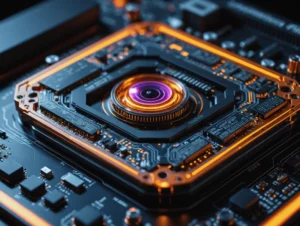
Description
Germanium is a common infrared optical material used in MWIR and LWIR systems.
It can be manufactured into infrared windows, lenses, blanks, domes, coated optics, and custom optical components. Germanium is commonly used in thermal imaging cameras, infrared sensors, night vision systems, surveillance systems, industrial inspection, aerospace, defense, and scientific instruments.
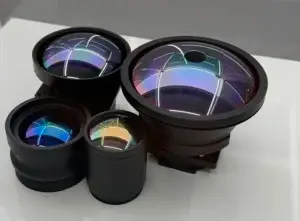
Germanium for MWIR and LWIR Applications: What Customers Should Know
Germanium is one of the most widely used infrared optical materials for thermal imaging and infrared sensing systems.
It is commonly selected for MWIR and LWIR optical systems because it can support infrared transmission in important thermal imaging wavelength ranges.
In addition, this material can be manufactured into different optical component forms, including windows, lenses, blanks, domes, and coated optical parts.
What Are MWIR and LWIR?
MWIR and LWIR are two common infrared wavelength ranges used in thermal imaging and infrared sensing systems.
| Infrared Range | Common Wavelength Range | Typical System |
|---|---|---|
| MWIR | 3–5 µm | Cooled infrared systems |
| LWIR | 8–12 µm or 8–14 µm | Uncooled thermal imaging systems |
MWIR systems are commonly used for higher sensitivity, longer-range observation, and more demanding infrared imaging applications.
LWIR systems are widely used in thermal cameras, surveillance systems, industrial inspection, fire detection, and general thermal imaging applications.
Why Is Germanium Used in MWIR and LWIR Systems?
Because of its excellent infrared transmission capability, Germanium is widely used in MWIR and LWIR systems.
It is also suitable for precision optical processing and coating.
Due to its infrared transmission capability, it is commonly selected for systems requiring MWIR or LWIR wavelength support:
- Infrared transmission
- Thermal imaging performance
- Detector or sensor protection
- MWIR or LWIR wavelength support
- Custom optical windows or lenses
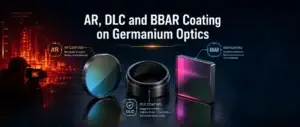
- AR, DLC, BBAR, or custom coating
- Stable optical quality for infrared systems
For many infrared systems, Germanium windows protect the detector or optical path, while Germanium lenses help focus infrared energy onto the detector.
Germanium in MWIR Applications
Typically, MWIR systems operate in the 3–5 µm wavelength range. Therefore, Germanium components used in these systems must provide suitable transmission and optical performance.
These systems are often used with cooled infrared detectors and may be selected for applications requiring higher sensitivity or longer observation distance.
Germanium components used in MWIR systems may include:
- Germanium windows
- Germanium lenses
- Germanium blanks
- AR-coated Germanium optics
- BBAR-coated Germanium optics
- Custom Germanium components
Common MWIR applications include:
- Cooled thermal imaging systems
- Long-range observation
- Scientific infrared instruments
- Aerospace systems
- Defense and surveillance systems
- Gas detection and measurement systems
- Custom IR optical assemblies
Germanium in LWIR Applications
Similarly, LWIR systems normally operate in the 8–12 µm or 8–14 µm wavelength range. As a result, Germanium remains a popular choice for uncooled thermal imaging applications.
LWIR is commonly used with uncooled thermal detectors, making it widely used in commercial, industrial, and security thermal imaging systems.
Germanium components used in LWIR systems may include:
- Germanium windows
- Germanium lenses
- Germanium domes
- DLC-coated Germanium windows
- AR-coated Germanium optics
- Custom LWIR optical components
Common LWIR applications include:
- Thermal imaging cameras
- Infrared sensors
- Security and surveillance systems
- Industrial inspection
- Fire detection systems
- Night vision systems
- Vehicle-mounted thermal cameras
- Outdoor monitoring systems
- Custom thermal camera modules
Germanium Windows for MWIR and LWIR
Germanium windows are flat optical components used to transmit infrared energy while protecting the internal optical system.
They are commonly used in front of:
- Infrared detectors
- Thermal camera systems
- IR sensors
- Lens assemblies
- Protective housings
- Optical instruments
A Germanium window may be supplied uncoated, AR-coated, DLC-coated, BBAR-coated, or custom-coated depending on the application.
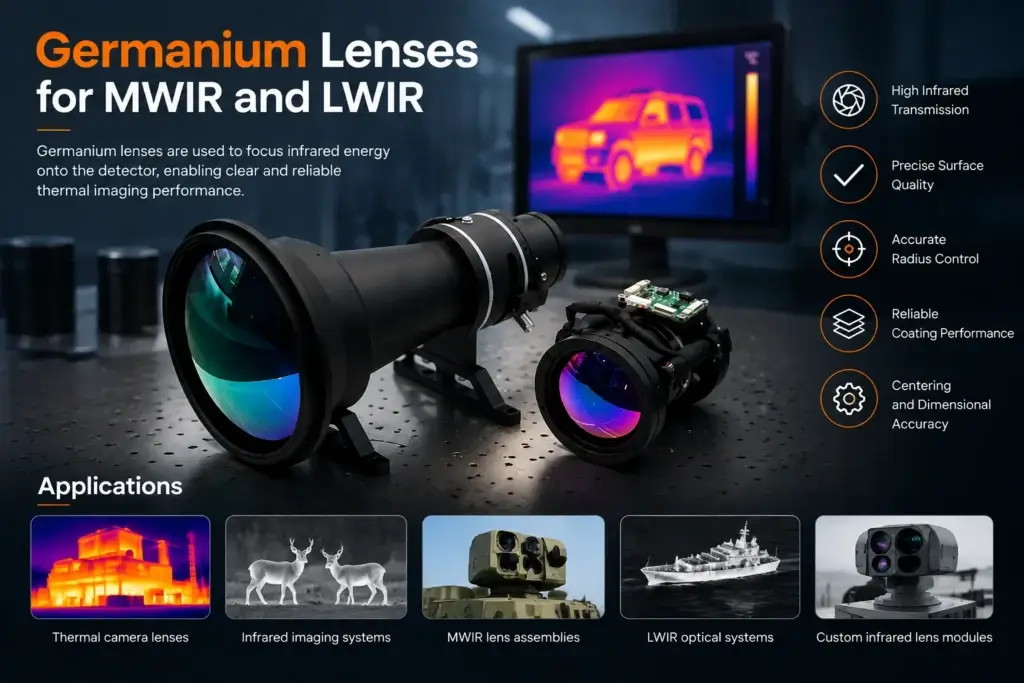
Germanium Lenses for MWIR and LWIR
Germanium lenses are used to focus infrared energy onto the detector.
They may be used in:
- Thermal camera lenses
- Infrared imaging systems
- MWIR lens assemblies
- LWIR optical systems
- Custom infrared lens modules
Germanium lenses may require precise surface quality, radius control, coating performance, centering, and dimensional accuracy.
Coating Options for MWIR and LWIR Germanium Optics
Coating is important because Germanium has high surface reflection when uncoated.
Common coating options include:
| Coating Type | Main Purpose | Common Use |
|---|---|---|
| AR Coating | Reduce reflection and improve IR transmission | MWIR and LWIR windows/lenses |
| DLC Coating | Improve surface protection | Outdoor or exposed Germanium windows |
| BBAR Coating | Support broader infrared transmission | Broadband IR systems |
| Custom IR Coating | Designed based on system wavelength | Special MWIR/LWIR requirements |
For outdoor or harsh environment applications, DLC coating may be used on the exposed side of the Germanium window.
Germanium Product Forms for MWIR and LWIR
| Product Form | Common Purpose | Example Application |
|---|---|---|
| Germanium Window | Protection and IR transmission | Thermal camera front window |
| Germanium Lens | Focus infrared energy | MWIR or LWIR lens assembly |
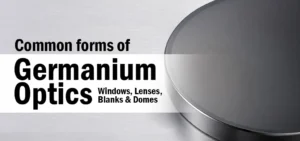
| Germanium Blank | Semi-finished part for further processing | Custom optical fabrication |
| Germanium Dome | Curved protective component | Surveillance, aerospace, defense systems |
| Coated Germanium Optic | Improve transmission or protection | AR, DLC, BBAR, or custom coating |
What Information Should You Provide Before Requesting a Quote?
To request Germanium components for MWIR or LWIR applications, it is helpful to provide:
- Application field
- Wavelength range: MWIR, LWIR, or broadband IR
- Product type: window, lens, blank, dome, or custom part
- Diameter, size, or drawing
- Thickness or center thickness
- Surface quality
- Surface flatness or surface figure
- Parallelism or wedge requirement
- Coating requirement
- Coating side requirement
- Clear aperture
- Operating environment
- Quantity
- Drawing or specification, if available
Example Germanium Specification for LWIR Application
| Item | Example Specification |
|---|---|
| Material | Germanium / Ge |
| Component Type | Infrared optical window |
| Wavelength Range | 8–12 µm LWIR |
| Shape | Round flat window |
| Diameter | 50.00 ± 0.01 mm |
| Thickness | 5.00 ± 0.01 mm |
| Surface Quality | 60/40 scratch-dig |
| Surface Flatness | λ/2, or based on drawing |
| Parallelism | ≤3 arc minutes, if required |
| Coating | AR coating / DLC coating / custom coating |
| Application | Thermal imaging / IR sensor protection |
| Quantity | 10 pcs / prototype / batch production |
Conclusion
Overall, Germanium remains one of the most important infrared optical materials for MWIR and LWIR applications. Because of its transmission capability, mechanical stability, and coating compatibility, it continues to be widely used for thermal imaging, infrared sensing, surveillance, and industrial applications.
It can be manufactured into windows, lenses, blanks, domes, coated optics, and custom optical components. The correct Germanium component depends on wavelength range, application, coating requirement, optical tolerance, size, and operating environment.
POC supplies Germanium windows, lenses, blanks, domes, AR-coated Germanium optics, DLC-coated Germanium windows, BBAR-coated Germanium components, and custom Germanium optical parts based on customer drawings and application requirements.
Contact us to discuss your MWIR or LWIR Germanium optical component requirements.